As Amazon Associates, we earn from qualifying purchases. This means we may receive a small commission at no extra cost to you if you click through and make a purchase.
Maximum Travel Speed
600 mm/s
Build Volume
220 x 220 x 220 mm
Dimensions and Weight
16"D x 14"W x 18"H; 22 pounds
Motion Architecture
CoreXY all-metal frame structure
Full spec sheet 7 more rows from the listing
| Manufacturer | Zhejiang Flashforge 3D Technology Co., Ltd. |
| Model Name | Adventurer 5M |
| Maximum Acceleration | 20000 mm/s² |
| Extruder Type | Direct drive reaching up to 280°C |
| Volumetric Flow Rate | 32 mm³/s maximum flow |
| Bed Leveling | Fully automatic one-click leveling |
| Platform Surface | Dual-sided flexible PEI sheet |
Shoppers considering the Flashforge Adventurer 5M typically want to know if an accessible CoreXY 3D printer can deliver legitimate high-speed output without constant mechanical troubleshooting. Traditional desktop printers with moving beds often struggle at higher velocities, introducing ringing and layer shifts due to the mass of the moving build plate. With an all-metal CoreXY framework, fully automated bed leveling, and a direct drive extruder capable of up to 600 mm/s travel speeds, this machine promises to eliminate the tedious calibration rituals that once plagued desktop fabrication. However, balancing rapid throughput with long-term reliability on an open-frame system requires a clear understanding of its real-world hardware capabilities, proprietary design choices, and maintenance demands.
This review cuts through promotional claims to give you an objective look at everyday ownership, mechanical durability, and potential operational bottlenecks. We evaluate the true stability of the CoreXY motion system, assess how well the fully automatic bed leveling functions over time, and inspect the maintenance realities of the proprietary quick-swap nozzle assembly. We also explore the Flash Studio software workflow and explain how this open-chassis model compares to enclosed alternatives like the flash forge adventurer 5m pro, giving you the facts needed to decide if it belongs on your workbench.
What You Get With the Flashforge Adventurer 5M

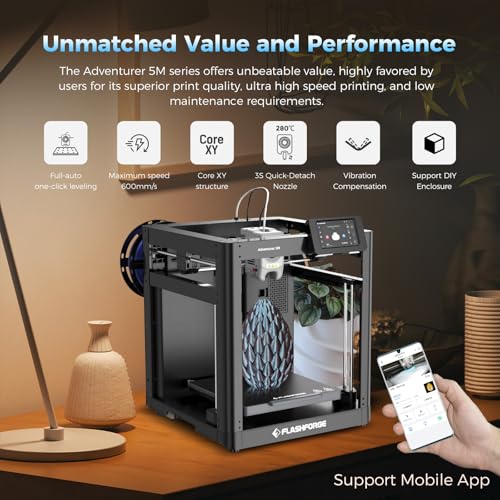


The Flashforge Adventurer 5M arrives as a semi-assembled desktop system engineered for fast deployment, bundling several core hardware modules directly into the package.
- All-metal CoreXY motion framework housed in a rigid metal and polycarbonate structure
- Direct drive extruder operating up to 280°C with dual-fan part cooling
- Three-second quick-detachable hotend assembly featuring a standard 0.4mm nozzle
- Dual-sided flexible textured PEI spring steel build plate
- Fully automatic one-click bed leveling and calibration system
- Integrated vibration compensation technology to reduce surface ghosting
- Maximum travel speed capability of 600 mm/s with 20000 mm/s² acceleration
- Real-time wireless remote monitoring and print control via the Flash Studio mobile application
CoreXY Architecture and High-Speed Motion Stability
The mechanical core of the Flashforge Adventurer 5M relies on a CoreXY kinematic layout, which anchors both drive motors to the stationary frame and uses continuous belts to guide the toolhead. Unlike Cartesian bed-slingers where the heavy build plate moves back and forth along the Y-axis, CoreXY kinematics isolate bed movement to the vertical Z-axis. This reduction in moving gantry mass allows the toolhead to achieve travel speeds up to 600 mm/s and accelerations up to 20000 mm/s² without dragging substantial inertia behind it. For those researching an adventurer 5m 3d printer, this kinematic structure represents a substantial improvement in print speed and mechanical stability over older motion styles.
Rapid acceleration inevitably introduces vibrational energy into the chassis, which can translate into ghosting or ringing artifacts on finished print perimeters. Flashforge addresses this issue by pairing an all-metal skeleton and polycarbonate outer panels—giving the machine a sturdy total weight of 22 pounds—with active vibration compensation firmware algorithms. By mathematically countering resonance frequencies during rapid direction changes, the printer maintains crisp surface details and sharp corners even when running at aggressive feed rates. The stationary platform further protects tall prints from the layer-shifting risks that frequently occur on moving beds.
However, the open-chassis construction of this CoreXY machine presents specific environmental considerations that buyers must keep in mind. Because the motion belts, linear guide rods, and bearings are completely exposed to the surrounding room, they are susceptible to workshop dust, debris, and stray filament fibers over time. Long-term reliability requires routine visual checks, wiping down guide rods, and applying fresh lubricant to prevent friction from degrading mechanical tolerances. Additionally, unshielded CoreXY designs are vulnerable to ambient room drafts, which can cause uneven cooling on larger parts if the machine is positioned near air conditioners, open windows, or ventilation ducts.
Automated Bed Leveling and First-Layer Consistency
First-layer adhesion is widely recognized as the foundation of successful 3D printing, and the automated bed leveling system on the Adventurer 5M eliminates the need for manual leveling thumbscrews. Operating on a one-click automated routine, the system checks multiple points across the 220 x 220 x 220 mm build platform to detect minor surface irregularities and tilt. The controller then generates a precise digital compensation mesh that adjusts the Z-axis height in real time during printing. This automated calibration saves valuable setup time and drastically flattens the learning curve for beginners who might otherwise struggle with manual paper tests or dial indicators.
The print surface itself is a dual-sided textured PEI spring steel sheet, providing reliable adhesion during extrusion and simple mechanical part removal after cooling. As the heated bed reaches target temperature, the PEI coating secures standard filaments firmly to prevent lifting edges or warped base layers. Once the print completes and the magnetic steel plate drops to room temperature, users simply lift and gently flex the plate to release finished models without needing scrapers or pry tools. This dual-sided design also doubles the working lifespan of the build surface, allowing you to flip the sheet if one side suffers wear or accidental damage.
While automated leveling provides outstanding day-to-day convenience, it shifts full reliance onto the electronic sensor array and mechanical cleanliness. If small filament droppings or stray debris lodge beneath the flexible PEI sheet, the automated sensor will register a false high spot, resulting in uneven extrusion across that area. Furthermore, because there are no manual bed adjustment wheels, users cannot physically tram the bed if structural misalignment occurs. Maintaining first-layer consistency requires keeping the magnetic base completely clear of foreign particles and ensuring the steel sheet sits squarely against the alignment stops before initiating a print routine.
Extruder Reliability and Hotend Upkeep
High-speed extrusion requires an efficient hotend capable of continuously melting filament at high throughput, and the Adventurer 5M features a direct drive extruder boasting a maximum volumetric flow rate of 32 mm³/s. Capable of reaching 280°C, the hotend melts thermoplastic rapidly to keep pace with high gantry velocities. The system also includes an efficient ceramic heater block that reaches 200°C in roughly 35 seconds, minimizing preheating delays before each job. Dual-fan part cooling ducts blow air directly beneath the nozzle tip, rapidly solidifying deposited plastic to preserve fine bridging details and steep overhangs.
Maintenance convenience is highlighted by the three-second quick-detachable nozzle design, which allows operators to swap out the entire hotend assembly without hand tools, loose wiring, or thermal paste. The machine includes a standard 0.4mm nozzle out of the box, but the ecosystem also supports optional hotend assemblies ranging from 0.25mm for fine aesthetic detail to 0.8mm for high-speed, structural functional prints. This modular setup simplifies clearing stubborn clogs or switching nozzle sizes, transforming what used to be a tedious, tool-heavy maintenance chore into a quick mechanical swap.
Nevertheless, this quick-detachable design introduces proprietary hardware trade-offs that prospective owners must evaluate. Unlike conventional printers that utilize standardized threaded brass nozzles, the Adventurer 5M relies entirely on Flashforge-specific modular assemblies. If a component fails or wears out, replacement hotends must be purchased specifically for this ecosystem. Makers who evaluate high-speed alternatives like the bambu labs a1 combo 3d printer often weigh whether they prefer proprietary modular toolheads built for rapid replacement or traditional hardware standards with broader third-party availability.
Software Workflow and Remote Monitoring Ecosystem
The digital workflow on the Adventurer 5M centers on the Flash Studio software suite and mobile companion application, providing wireless connectivity for file sending, slicing, and print job monitoring. The mobile app gives users real-time status alerts, allowing you to check print progress or modify print settings remotely without needing to stand over the machine. For busy makers running iterative design cycles, this connectivity streamlines operations and provides helpful visibility into production status from across a home or workshop environment.
While mobile monitoring adds genuine utility, buyers should prepare for occasional quirks common to cloud-connected 3D printers. Network latency or intermittent wireless signal drops can sometimes delay app telemetry updates, requiring users to rely on the physical touchscreen on the printer frame for immediate diagnostics. For users working in locations without reliable Wi-Fi or those with strict privacy requirements, the printer supports direct offline job loading via a standard USB flash drive, ensuring production can continue completely disconnected from external networks.
From a manufacturer support perspective, Zhejiang Flashforge 3D Technology Co., Ltd. has established a mature distribution and customer support framework, delivering regular firmware updates to refine acceleration parameters and stepper motor tuning. This active firmware development reflects noticeable progress compared to legacy systems such as the older creator 5 pro, which required far more manual intervention. To ensure stable long-term operation, users should routinely check for official firmware updates and seat the 22-pound machine on a rigid, unyielding table that effectively absorbs mechanical vibration.
Flashforge Adventurer 5M Pros and Cons
Pros
- Rapid 600mm/s travel speed and high acceleration
- One-click fully automatic bed leveling
- Quick 3-second detachable nozzle system
- Direct drive extruder reaching up to 280°C
- Dual-sided flexible textured PEI build plate
Cons
- Open-frame structure vulnerable to room drafts
- Proprietary quick-swap nozzle design limits generic replacements
- Build volume limited to 220x220x220mm
Is the Flashforge Adventurer 5M Worth It
The Flashforge Adventurer 5M delivers excellent value for hobbyists, makers, and educators seeking a fast, dependable CoreXY platform without entering a steep mechanical learning curve. Its combination of 600 mm/s travel speeds, fully automated bed leveling, and a simple three-second nozzle detachment system removes the most frustrating setup hurdles in desktop 3D printing. For printing standard materials like PLA and PETG with clean first layers and minimal calibration fuss, this machine represents a remarkably capable out-of-the-box solution.
However, this open-frame model is less suited for professionals who need to print advanced high-temperature engineering filaments such as ABS, ASA, or polycarbonate. Without an enclosed, thermally controlled chamber, these materials are highly prone to warping, splitting, and poor layer adhesion due to ambient air currents. Those focused specifically on technical industrial materials should budget for an enclosed alternative or plan to add an aftermarket enclosure around the machine to maintain consistent internal temperatures.
In summary, if you understand the boundaries of an open-frame design and accept the proprietary nature of its quick-swap hotends, the Adventurer 5M stands out as a solid, high-velocity workhorse. Its rigid all-metal frame, responsive direct drive extruder, and modern automated calibration provide a high-performing desktop fabrication experience that delivers consistent results across day-to-day hobbyist and prototyping projects.
FAQ
What build volume does the Flashforge Adventurer 5M offer?
The printer provides a build volume of 220 x 220 x 220 mm. This cubic capacity is well-suited for everyday hobby printing, prototyping functional parts, and small batch production runs on its dual-sided flexible PEI platform.
How long does the hotend take to reach printing temperature?
The direct drive hotend heats up to 200°C in roughly 35 seconds, minimizing preparation time before print jobs begin. It can reach maximum operating temperatures of up to 280°C for processing various standard filament types.
Can I use standard V6 or MK8 threaded nozzles with this printer?
No, the Adventurer 5M utilizes a proprietary three-second quick-detachable nozzle assembly. While it comes with a standard 0.4mm nozzle installed, Flashforge offers compatible replacement assemblies ranging from 0.25mm to 0.8mm designed specifically for this toolhead.
Does the Flashforge Adventurer 5M require manual bed leveling?
No manual leveling is necessary. The printer features a fully automated one-click leveling system that maps the build surface and generates a compensation mesh without the need for manual knobs or paper gauging.
What materials are used to construct the printer frame?
The machine is constructed using an all-metal CoreXY internal frame paired with polycarbonate exterior elements, resulting in a total machine weight of 22 pounds that helps absorb mechanical vibration during high-speed printing.
How does remote monitoring work on the Flashforge Adventurer 5M?
Remote monitoring functions through the Flash Studio mobile application over Wi-Fi. Users can observe real-time print progress, tweak operational parameters, and receive status notifications directly on their mobile device.