As Amazon Associates, we earn from qualifying purchases. This means we may receive a small commission at no extra cost to you if you click through and make a purchase.
Maximum Travel Speed
600 mm/s
Build Volume
220 x 220 x 220 mm
Dimensions and Weight
16"D x 14"W x 18"H; 22 pounds
Extruder Maximum Temperature
280°C Direct Drive
Full spec sheet 7 more rows from the listing
| Motion Architecture | CoreXY All Metal Structure |
| Maximum Acceleration | 20000 mm/s² |
| Max Volumetric Flow Rate | 32 mm³/s |
| Hotend Heat-Up Time | 35 seconds to 200°C |
| Nozzle Replacement System | 3-second detachable nozzle (0.4mm standard; 0.25mm–0.8mm optional) |
| Print Surface | Dual-sided PEI platform |
| Bed Leveling | One-click fully automatic bed leveling |
Selecting a high-speed desktop machine requires balancing rapid throughput against long-term mechanical endurance. The Flashforge Adventurer 5M is designed for makers and prototyping workshops seeking high-velocity output without the tedious calibration rituals of legacy printers. Built around a CoreXY all-metal architecture, it promises to cut production cycles drastically through rapid acceleration and high travel velocities. However, high-velocity mechanics introduce elevated physical stresses on belts, pulleys, and extruders, making it vital to inspect whether the structural hardware can sustain continuous workshop workloads.
This comprehensive flashforge adventurer 5m review examines how the machine performs under real fabrication demands. We break down the published adventurer 5m 3d printer specs, test the real-world convenience of its automated leveling system, evaluate the quick-swap nozzle assembly, and assess long-term operating vulnerabilities. Whether you are expanding a small print farm or seeking an approachable upgrade, this analysis covers what to expect regarding component durability, daily maintenance, and manufacturer support.
What You Get With the Flashforge Adventurer 5M

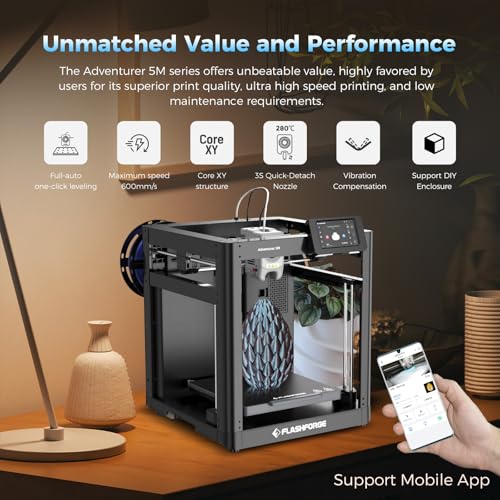


The Flashforge Adventurer 5M arrives as an open-chassis desktop fabrication tool engineered for straightforward assembly. The package provides the core mechanical hardware and baseline accessories needed to begin printing right out of the box:
- CoreXY all-metal structural frame featuring an open-air design composed of metal and polycarbonate materials.
- Direct drive extruder assembly capable of operating at temperatures reaching up to 280°C.
- Quick-detachable 0.4mm nozzle mechanism engineered for three-second tool-free changes, compatible with optional 0.25mm to 0.8mm sizes.
- Dual-sided textured PEI flexible steel build platform providing a 220 x 220 x 220 mm build envelope.
- High-flow hotend supporting volumetric flow rates up to 32mm³/s with rapid 35-second heating to 200°C.
- One-click fully automatic bed leveling system with digital surface mapping and no manual adjustment knobs.
- Dual-fan printhead cooling setup coupled with internal vibration compensation technology to mitigate high-speed ringing.
- Wireless network integration enabling remote monitoring and print control via the Flash Studio mobile application.
CoreXY Kinematics and Real-World Velocity
The defining mechanical feature of this printer is its CoreXY motion platform. Delivering an adventurer 5m corexy speed rating of up to 600mm/s alongside 20000mm/s² acceleration, it moves the printhead far faster than traditional Cartesian machines. In a CoreXY arrangement, two stationary stepper motors work cooperatively using crossed belt systems. Because both heavy motors remain bolted directly to the metal frame rather than riding along the axes, the moving gantry carries minimal mass. This drastic weight reduction permits aggressive direction changes without losing step synchronization, making the machine exceptionally agile during detailed prototyping runs.
Raw speed is useless if the toolhead cannot melt plastic fast enough, but Flashforge addresses this volumetric bottleneck directly. The hotend delivers up to 32mm³/s of volumetric flow, ensuring sufficient polymer melts even when the printhead travels at elevated velocities. The heater block reaches 200°C in roughly 35 seconds, minimizing pre-print dwell times. To counteract the severe inertial vibrations caused by 20000mm/s² acceleration, integrated vibration compensation calculates mechanical resonance frequencies and adjusts motor pulses dynamically, significantly reducing ghosting artifacts on external part perimeters.
Nevertheless, running high-velocity kinematics places substantial ongoing strain on mechanical wear items. Dual continuous drive belts require equal tensioning to keep the toolhead perpendicular, which can challenge users upgrading from entry-level bedslingers such as the creality ender 3 v3 ke. Over hundreds of operating hours, pulleys, belt teeth, and linear guide rods experience friction loads that necessitate regular cleaning and lubrication. Maintaining precise belt tension across both parallel loops is essential if you wish to prevent dimensional skewing across diagonal geometries.
Automated Bed Leveling and First Layer Consistency
Consistent first-layer adhesion determines whether a print completes successfully or ends in an expensive hotend jam. The flashforge ad5m auto leveling system eliminates manual bed tramming by deploying a fully automatic sensor routine. Before printing, the assembly probes the dual-sided PEI build platform across a dense grid, detecting microscopic surface deviations and compiling a detailed digital topography mesh. The firmware uses this mesh to adjust Z-axis heights dynamically during initial layers, ensuring uniform squish without requiring thumbwheel adjustments or manual dial indicators.
This automated calibration routine makes the adventurer 5m for beginners one of the most frictionless platforms in its class. Novice operators frequently battle manual paper feeler gauges and uneven bed corners, leading to poor bed adhesion or nozzles scraping directly into print surfaces. By automating the entire Z-offset sequence, Flashforge eliminates setup guesswork. New users can initiate fabrication jobs straight from the box with minimal risk of first-layer detachment, lowering the barrier to entry for educational environments and hobby workspaces.
The included build plate is a dual-sided textured PEI spring steel sheet measuring 220 x 220 x 220 mm. Textured PEI offers strong mechanical bonding for heated thermoplastics while allowing finished prints to release easily once the plate cools down and is gently flexed. However, high-speed directional changes exert localized lateral shear against the plate surface. Over extended shop usage, the textured PEI coating will gradually wear smooth in the central print zone, meaning replacement build plates represent a normal periodic maintenance item for high-volume users.
Hotend Architecture and Quick Nozzle Maintenance
The toolhead design focuses on user convenience through a proprietary adventurer 5m nozzle replacement assembly. Traditional nozzle changes demand heating the hotend past 200°C, securing the heater block with pliers, and carefully unthreading delicate components while avoiding delicate thermistor wires. Flashforge bypasses this hazard with a three-second detachable nozzle design that unlatches mechanically. This tool-free mechanism lets operators swap clogged hotends or change extrusion profiles without handling scorching brass threads or risking stripped heat breaks.
The machine ships with a standard 0.4mm nozzle module, but the platform accommodates optional factory sizes ranging from 0.25mm for fine miniatures up to 0.8mm for high-strength functional brackets. A direct drive extruder feeds filament straight into the thermal break, providing the precise retraction control necessary to prevent stringing during 600mm/s travel moves. With an upper operating temperature limit of 280°C, the hotend easily processes everyday filaments like PLA and PETG while maintaining sufficient thermal headroom for technical filaments that require elevated melting temperatures.
While the quick-detachable system is remarkably efficient for fast workshop turnarounds, it introduces a proprietary supply chain limitation. Standard aftermarket V6, MK8, or Volcano nozzles cannot be threaded into the Adventurer 5M toolhead. Operators must purchase integrated Flashforge nozzle modules whenever a replacement is needed. For workshops that prioritize cheap, ubiquitous replacement components, relying exclusively on proprietary hotend cartridges represents an ongoing operational trade-off that must be weighed against the convenience of tool-free swaps.
Hardware Longevity and Operating Vulnerabilities
When assessing long-term adventurer 5m reliability, buyers must evaluate how the open-frame chassis withstands sustained high-speed printing. Several common flashforge adventurer 5m problems emerge directly from intense mechanical vibrations. At travel speeds up to 600mm/s, the metal and polycarbonate frame absorbs constant kinetic shock. Over time, frame fasteners can slowly loosen, drive belts can lose tension, and linear guide rods can gather airborne debris. Because the chassis is fully open, ambient dust settles directly onto moving assemblies, making regular cleaning and rod lubrication mandatory to avoid premature bearing wear.
Software and network management center around the Flash Studio mobile application, which provides remote monitoring and status notifications. While wireless monitoring adds genuine day-to-day convenience, users remain dependent on network stability and the manufacturer’s mobile software ecosystem. Furthermore, the open-frame design creates thermal challenges when attempting to print temperature-sensitive technical materials like ABS or ASA. Users seeking high-temperature enclosure consistency without drafting issues often evaluate enclosed models like the flash forge adventurer 5m pro to maintain ambient heat.
Post-purchase customer support is an equally critical consideration. Regarding the flashforge adventurer 5m warranty, the listing from Zhejiang Flashforge 3D Technology Co., Ltd. does not specify exact warranty periods, coverage limitations, or return terms. For commercial operations that demand guaranteed uptime and rapid parts dispatch, this lack of explicit documentation means warranty claims and component replacements may require navigating international support channels. Those managing heavy production schedules or requiring multi-spool automated switching may alternatively look toward larger commercial platforms like the creality k2 combo 3d printer to satisfy complex fabrication requirements.
Flashforge Adventurer 5M Pros and Cons
Pros
- High travel speed reaching 600mm/s
- Fully automatic one-click bed leveling system
- Tool-free 3-second quick-detachable nozzle mechanism
- High-flow direct drive extruder heating to 280°C
- Rapid 35-second hotend warm-up to 200°C
Cons
- Open-air frame lacks thermal draft protection
- Proprietary nozzle cartridges prevent using standard nozzles
- Listing does not specify warranty terms
Is the Flashforge Adventurer 5M Worth It
Deciding whether the Flashforge Adventurer 5M is the right tool depends entirely on your production goals and workspace conditions. If your primary objective is churning out standard PLA and PETG parts rapidly without spending hours tramming the bed or unjamming threaded hotends, this machine provides tremendous capability. The blend of 600mm/s travel speed, responsive vibration compensation, and a three-second quick-detachable nozzle system removes the primary friction points of hobbyist 3D printing, making it highly productive for prototyping and rapid iteration.
However, the machine does not suit every manufacturing scenario. The open-air frame leaves parts susceptible to thermal drafts, making large ABS or polycarbonate prints prone to cracking and bed warping. Additionally, the proprietary nozzle architecture prevents you from buying standard third-party replacement nozzles, tying your operational costs directly to official Flashforge supply stock. Buyers should also prepare for regular preventative maintenance, as running a CoreXY system at 20000mm/s² acceleration demands periodic belt tuning and guide rod upkeep.
For makers, educators, and hobbyists who prioritize raw speed, automated convenience, and low initial setup friction, the Adventurer 5M represents a compelling CoreXY platform. As long as you understand the limitations of its open chassis and proprietary hotend assembly, it delivers modern high-velocity performance that dramatically accelerates desktop fabrication.
FAQ
Does the Flashforge Adventurer 5M feature an enclosed print chamber?
No, the listing confirms an open CoreXY chassis built from metal and polycarbonate components. It does not include side enclosure panels or a top lid. While this open architecture allows easy access to the build area and toolhead, it exposes prints to ambient drafts, making temperature-sensitive filaments harder to manage.
How does the three-second quick nozzle replacement work?
The machine uses a modular, tool-free cartridge mechanism instead of standard threaded nozzles. Rather than using wrenches on a heated hotend, operators simply release the retention latch and pull the nozzle module free in about three seconds. This simplifies clearing severe filament jams and enables swift transitions between standard 0.4mm and optional 0.25mm to 0.8mm nozzle sizes.
Can the Flashforge Adventurer 5M print engineering filaments like ABS or nylon?
The direct drive extruder reaches 280°C, providing the thermal capability needed to melt engineering-grade polymers. However, because the printer has an open frame without an enclosed or heated chamber, materials like ABS, ASA, and nylon are prone to warping, corner lifting, and layer separation caused by ambient room drafts.
What application is used to monitor the Flashforge Adventurer 5M remotely?
The printer connects to Flash Studio, a dedicated mobile application designed for real-time progress monitoring, parameter adjustments, and status alerts. This network integration lets users observe ongoing jobs and modify operational settings from a mobile device across local networks.
What is the warranty coverage on the Flashforge Adventurer 5M?
The manufacturer listing does not specify explicit warranty terms, duration, or replacement coverage details. Zhejiang Flashforge 3D Technology Co., Ltd. handles customer service, but buyers should consult their specific seller or reach out to the manufacturer directly prior to purchase to clarify warranty duration and replacement part policies.