As Amazon Associates, we earn from qualifying purchases. This means we may receive a small commission at no extra cost to you if you click through and make a purchase.
Continuous AC Output
2400W
Battery Capacity
3014.4Wh (3014Wh)
Battery Chemistry
LiFePO4 (Lithium Iron Phosphate)
Enclosure Material
Plastic Housing in Grey Finish
Full spec sheet 7 more rows from the listing
| Cycle Life Rating | 6000+ Cycles |
| Surge Power Capacity | 4800W |
| Maximum Engine Power | 3000W Inverter Architecture |
| Output Voltage | 120V |
| AC Outlets | 2 Total Outlets |
| RV and DC Specific Ports | Dedicated TT-30 RV Outlet, 12V/30A DC Port |
| AC Fast Recharge Speed | 78 minutes to 80% maximum |
Choosing a dependable high-capacity energy system requires balancing physical footprints against thermal stability and long-term electrical throughput. The BLUETTI Elite 300 enters the market targeting homeowners preparing for emergency blackouts and RV travelers demanding plug-and-play capability without cumbersome external converters. Often sought out as the bluetti elite 300 v2 update in the high-density portable generator segment, this unit pairs a substantial 3014.4Wh storage capacity with an integrated 2400W pure sine wave inverter. For prospective buyers assessing whether this hardware justifies an investment, the primary consideration centers on whether its condensed enclosure can withstand the continuous thermal stress of running household essentials and recreational vehicle systems over many years.
This comprehensive analysis examines the real-world operational strengths and structural trade-offs of the power station. Rather than focusing merely on promotional benchmarks, we investigate the engineering compromises inherent in shrinking a 3kWh LiFePO4 battery pack by nearly 59% compared to traditional large power stations. Throughout this guide, we evaluate the unit across multiple rigorous categories: continuous inverter surge handling, RV integration via native TT-30 and high-output DC ports, solar replenishment rates with the supplied dual 200W panels, long-term battery cell degradation over 6000 cycles, and critical gaps in manufacturer documentation. By examining these structural facets, you can determine if this setup delivers dependable power for your specific emergency backup or travel configuration.
What You Get With the BLUETTI Elite 300
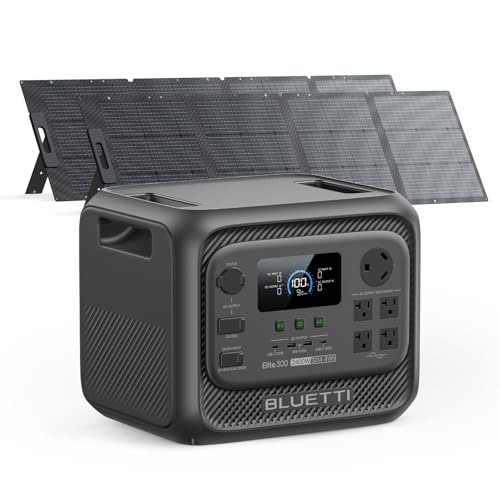


The package combines the primary energy storage console with an off-grid solar capture kit, although prospective owners should note that the solar panels ship separately from the central battery unit. Inside the shipping packages, you will find:
- BLUETTI Elite 300 portable power station with 3014.4Wh LiFePO4 battery
- Two 200W portable solar panels
- Dedicated solar charging cable
- Standard AC wall charging cable
- Chassis grounding screw for electrical grounding requirements
- Comprehensive user manual covering operational protocols
Long-Term Durability and LiFePO4 Cell Longevity
The foundational selling point of this unit is its internal cell chemistry, specifically engineered around lithium iron phosphate cells rated for 6000+ life cycles. For off-grid residents and emergency planners, bluetti elite 300 lifepo4 cycle life represents a distinct departure from standard lithium nickel manganese cobalt configurations that routinely degrade after 500 to 1000 full discharge iterations. Operating across 6000 cycles theoretically equates to well over a decade of daily deep cycling before the internal pack experiences significant capacity loss. Lithium iron phosphate also offers superior chemical and thermal stability, inherently mitigating thermal runaway risks when operated under substantial electrical loads.
However, long-term dependability depends on more than cell chemistry alone; the physical packaging and thermal management system dictate whether those cells ever reach their rated cycle count. The unit features an ultra-compact chassis design recognized by Frost & Sullivan as the world’s smallest 3kWh portable power station, measuring nearly 59% smaller than conventional large-scale units. Packing 3014.4Wh of chemical energy and a 2400W continuous inverter into such a condensed plastic housing creates intense internal heat density. While compact portability eases transport, heat remains the primary enemy of lithium cells and internal microelectronics. Users planning frequent high-draw cycles must maintain clear airflow around all intake vents to prevent thermal throttling over continuous multi-year deployments.
Buyers should also weigh long-term customer protection against hardware failures. When evaluating the bluetti elite 300 warranty, the listing does not specify the exact warranty duration, fine print exclusions, or regional service handling protocols. In practical terms, an enclosure made of plastic operating high-amperage components requires enforceable manufacturer support if an integrated charge controller or inverter board malfunctions after a few years. Before committing, purchasers should clarify warranty registration requirements directly with the vendor to ensure their investment remains protected throughout its operational lifespan.
Home Backup Performance and Real-World Appliance Runtime
During unexpected grid failures, deploying the system for bluetti elite 300 home backup delivers significant energy security if appliance draws are mapped accurately. With an internal capacity of 3014.4Wh and a 2400W continuous pure sine wave output, the console sustains critical household gear simultaneously. A modern residential refrigerator cycling between 120W and 200W, emergency communications routers drawing 15W, LED illumination circuits, and medical devices such as CPAP machines operate seamlessly within this output threshold. For households evaluating different footprint sizes, comparing this unit against smaller devices like the bluetti elite 100 v2 portable power station illustrates how much extra buffer a true 3kWh reservoir supplies during extended winter storms.
When calculating expected bluetti elite 300 runtime, prospective buyers must account for inevitable inverter efficiency losses. While the spec sheet lists a baseline runtime of 7 hours, real-world discharge times vary dramatically based on connected wattage and ambient temperatures. AC inverters consume an operational baseline known as parasitic or idle draw simply keeping internal transformers and display systems active. Typically, power conversion incurs roughly 10% to 15% system overhead, leaving approximately 2550Wh to 2700Wh of usable power from the 3014.4Wh total pool. A steady 300W combined household load will yield approximately 8.5 to 9 hours of continuous power, whereas running a continuous 1500W space heater will exhaust the reserves in under two hours.
Surge handling represents another vital checkpoint for household resilience. The Elite 300 features a 4800W surge threshold and a 3000W maximum engine power rating, which is engineered to absorb the momentary inrush currents created by inductive motor starts. Compressors inside older chest freezers, shallow-well water pumps, and sump pumps demand momentary power spikes that can double or triple their rated running wattage. The 4800W buffer ensures that when high-torque electric motors initiate their cycle, the inverter does not immediately trip into overload protection, preserving continuous refrigeration and basement dewatering during severe localized storms.
RV Integration and Connection Port Selection
Travelers configuring the bluetti elite 300 for rv living benefit from integrated hardware options specifically designed to streamline recreational vehicle setup. Instead of requiring external 15A-to-30A dogbone adapters that introduce heat buildup and mechanical resistance, the console features a dedicated TT-30 receptacle alongside a high-amperage 12V/30A DC port. This direct interface enables RV owners to connect their rig’s primary shore power cord directly into the station, delivering immediate power to internal 120V breaker panels, distribution centers, internal lighting systems, and residential-style appliances without modifying existing electrical hookups.
However, electrical realities require careful load management when plugging a 30-amp camper into this station. Although the TT-30 outlet matches the mechanical footprint of standard 30-amp RV shore pedestals, the internal continuous inverter is rated at 2400W. At standard 120V delivery, 2400W equates to 20 continuous amps, not 30 amps. While the 4800W surge overhead easily accommodates the starting surge of a high-efficiency RV rooftop air conditioner or microwave, campers cannot run the air conditioning, electric water heater, and microwave simultaneously. Users must treat the power budget as a 20-amp service, shedding non-essential high-draw appliances to avoid tripping the station’s internal circuit breaker.
Physical outlet quantity presents another operational limitation documented in the bluetti elite 300 specs. The listing notes a total of 2 power outlets on the device. For a station boasting over 3kWh of capacity, possessing only two native AC receptacles limits direct multi-device home plug-ins without utilizing an external, grounded power strip. BLUETTI does supply a grounding screw in the packaging, which is an essential inclusion for RV and mobile environments where floating neutrals can trigger fault errors in modern RV surge protectors or sensitive electronic controllers.
Solar Recharging Speeds and Input Replenishment Realities
Field replenishment defines the true viability of any off-grid setup, and evaluating this package in a bluetti elite 300 solar generator review reveals distinct operational trade-offs. The bundled package includes two 200W solar panels, providing 400W of total theoretical photovoltaic harvesting capacity. According to product specifications, recharging this 3014.4Wh battery from 0% to 100% using these supplied panels requires approximately 7 to 15 hours. For comprehensive testing data on solar collection under varied weather conditions, our deep dive into the bluetti elite 300 with solar panels breaks down angle positioning and real-world efficiency figures.
In realistic off-grid conditions, solar capture rarely matches lab-rated maximums due to atmospheric haze, suboptimal sun angles, and solar panel surface heat. Achieving the optimal 7-hour recharge window requires flawless, unobstructed peak solar radiance that yields near 100% panel efficiency across the entire midday cycle—a rarity in real-world camping or overcast emergency settings. In typical daylight conditions yielding 75% efficiency, a 400W solar array delivers roughly 300W per hour to the battery. At that replenishment rate, fully recovering a drained 3014.4Wh reservoir requires between 10 and 12 hours of active sunlight, meaning solar replenishment will comfortably span across two full solar days rather than completing within a single afternoon.
These replenishment metrics reveal specific bluetti elite 300 problems for users facing prolonged power blackouts. If your emergency plan involves continuously discharging 1500Wh per day to run home refrigeration and medical machinery, the included 400W array barely recoups the expended energy, leaving no margin for cloudy days. For rapid replenishment when wall power or a standby generator is accessible, the unit provides high-speed AC grid charging capable of reaching 80% capacity in a maximum of 78 minutes. Furthermore, the unit accommodates car, lead-acid, and generator inputs, giving users diverse charging options when natural sunlight proves insufficient.
BLUETTI Elite 300 Pros and Cons
Pros
- Massive 3014.4Wh LiFePO4 battery capacity
- Exceptional 6000+ cycle life rating
- Compact design 59% smaller than competitors
- Native TT-30 RV and 12V/30A DC ports
- Substantial 4800W surge output capacity
- Fast AC charging to 80% in 78 minutes
Cons
- Only two AC power outlets provided
- Solar panels ship separately from main unit
- Solar charging requires up to 15 hours
- Listing does not specify manufacturer warranty length
Is the BLUETTI Elite 300 Worth It
Deciding if the BLUETTI Elite 300 represents a sound equipment investment depends strictly on how your power needs align with its physical footprint and electrical layout. If you are an RV traveler or boondocker searching for a clean, gas-free power source that slides into compact storage compartments while offering native TT-30 connectivity, this machine excels. The Frost & Sullivan verified compact design delivers 3014.4Wh of energy in an enclosure nearly 59% smaller than standard units, solving the persistent dilemma of storage space constraints in smaller motorhomes, travel trailers, and tight utility closets.
For home emergency readiness, the system provides a dependable safeguard against severe grid instability. Homeowners who prioritize long-term chemical durability will appreciate the 6000+ LiFePO4 cycle life, which outlasts competing power stations by thousands of duty cycles. However, buyers requiring widespread multi-device connectivity should recognize that the listing specifies just two total power outlets, necessitating power strips for complex room setups. If your energy demands exceed what a 2400W inverter can provide or require expansive split-phase circuits, examining higher-tier alternatives such as the bluetti elite 400 might better fulfill heavy whole-house transfer switch applications.
Ultimately, the question of whether is bluetti elite 300 worth it comes down to balancing dense portability against specific port and solar limitations. For shoppers who demand an ultra-compact 3kWh capacity, substantial 4800W motor-starting surge capability, and modern lithium iron phosphate cell longevity, this power station serves as a highly robust backbone for portable and standby energy needs.
FAQ
How long does it take to recharge the battery using the included solar panels?
The included package comes with two 200W solar panels totaling 400W of rated photovoltaic capacity. According to manufacturer specifications, recharging the 3014.4Wh battery from empty to full with this array takes between 7 and 15 hours. Real-world recharge duration depends heavily on daylight intensity, geographic location, cloud cover, and seasonal sun angles, often requiring two full days of outdoor exposure to achieve a 100% charge.
Can the unit power an RV air conditioner through the TT-30 outlet?
Yes, the integrated TT-30 port allows direct connection to standard RV shore power cables without external adapters. With a 2400W continuous output and a 4800W surge capacity, the station can easily start and operate most modern, high-efficiency RV rooftop air conditioners. However, because 2400W delivers 20 continuous amps at 120V rather than the full 30 amps a standard campground pedestal supplies, users must refrain from running other high-wattage appliances simultaneously.
What makes LiFePO4 battery chemistry preferable for long-term ownership?
Lithium iron phosphate (LiFePO4) chemistry offers significant longevity and safety advantages over conventional lithium-ion cells. The Elite 300 is rated for 6000+ operational cycles, allowing daily charge and discharge cycles for over a decade before experiencing notable capacity reduction. In addition, LiFePO4 cells provide superior thermal and structural stability, reducing overheating hazards under continuous heavy inverter workloads.
What warranty coverage is provided with the power station?
The listing does not specify the exact warranty length, coverage terms, or replacement conditions for the Elite 300. Prospective purchasers should review official manufacturer registration documentation or contact the seller directly before purchasing to confirm what warranty period applies to the battery pack, internal inverter, and solar accessories.
Does the system include a grounding connection for safe operation?
Yes, the manufacturer includes a dedicated grounding screw in the packaging. Using this grounding screw to establish a proper electrical ground is highly recommended when connecting the station to RV electrical systems, transfer panels, or sensitive electronics to avoid floating neutral fault codes and enhance operating safety.