As Amazon Associates, we earn from qualifying purchases. This means we may receive a small commission at no extra cost to you if you click through and make a purchase.
Continuous Output Rating
2400 Watts Continuous Inverter Output
Battery Capacity
3014.4Wh (3014Wh)
External Chassis Construction
Molded Plastic Enclosure in Grey Finish
Battery Chemistry
Lithium Iron Phosphate (LiFePO4) with 6000+ Cycles to 80% Capacity
Full spec sheet 8 more rows from the listing
| Maximum Surge Power | 4800 Watts Surge Handling |
| Operating Voltage | 120 Volts AC |
| Engine and Inverter Type | Pure Sine Wave Inverter Architecture (3000W Maximum Engine Power) |
| Solar Recharging Timeframe | Approximately 7 to 15 Hours (via included 2x200W solar panels) |
| Rapid AC Replenishment Speed | Up to 80% Charge in 78 Minutes Maximum |
| Specialized Outlets | Integrated TT-30 RV Receptacle and 12V/30A High-Current DC Port |
| Total Power Outlets | 2 Outlets Noted in Primary Specifications |
| Compatible Power Sources | Solar, AC Grid, Car 12V/24V, Lead-Acid Battery, Fuel Generator |
If you are planning an extended off-grid excursion or preparing for sudden electrical utility interruptions, investing in the BLUETTI Elite 300 paired with two 200W solar panels represents a major commitment to personal energy independence. The fundamental question for prospective owners is whether this specific 400W solar bundle can realistically sustain a massive 3014.4Wh battery capacity during daily off-grid operation. While packaging a high-capacity lithium iron phosphate core with solar collectors provides theoretical self-sufficiency, real-world solar charging time depends heavily on seasonal conditions, solar panel angle, and system conversion efficiency. Understanding these physical limits is vital before relying on this equipment for remote expeditions or critical medical and residential devices.
This technical breakdown investigates the practical capabilities, continuous load endurance, and mechanical engineering choices of the power station. We examine the mathematical realities behind the advertised 7 to 15-hour solar recharging window, assess how the 2400W inverter handles sustained appliance loads, inspect the native recreational vehicle connections, and review the long-term reliability of its 6000-cycle cell architecture. By analyzing the verified specifications and component integration, this guide will clarify whether this configuration matches your operational needs or if your power consumption will outpace what this dual-panel kit can harvest.
What You Get With the BLUETTI Elite 300
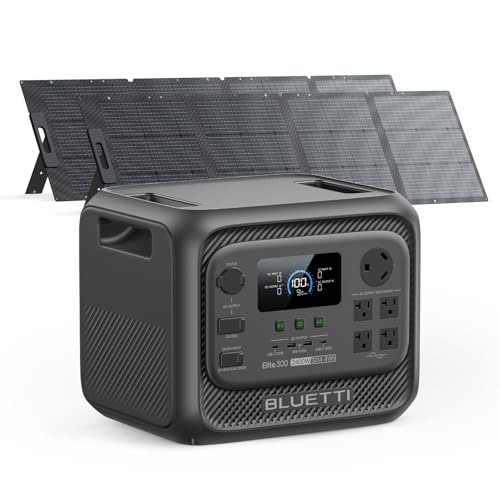


The solar generator package supplies the fundamental hardware required to begin generating and storing electricity away from the traditional grid. Buyers should anticipate multiple deliveries, as the solar panels ship separately from the central battery and inverter assembly.
- BLUETTI Elite 300 portable power station with an integrated 3014.4Wh LiFePO4 battery pack
- Two 200W solar panels for a combined 400W nominal input rating (shipped in separate packaging)
- Heavy-duty AC charging cable for conventional wall-outlet recharging
- Dedicated solar charging cable for connecting the external photovoltaic collectors
- Specialized grounding screw for electrical bonding and outdoor safety
- Comprehensive user manual covering operational protocols and connection parameters
Solar Charging Realities with the 400W Panel Configuration
Evaluating the practical utility of the bluetti 400w solar bundle requires aligning mathematical expectations with environmental variables. The system pairs two 200W solar collectors with a substantial 3014.4Wh battery bank. Under pristine laboratory testing conditions, a 400W array produces roughly 320 to 350 watts of net input after accounting for standard photovoltaic thermal losses, cable resistance, and the internal charge controller conversion step. If you drain the 3kWh capacity entirely, replenishing that volume requires sustained solar exposure that rarely occurs in a single afternoon. When analyzing the practical bluetti elite 300 solar charging time, the official estimate of 7 to 15 hours accurately reflects the divide between perfect summer tracking and imperfect seasonal daylight.
In real off-grid field environments, peak sunlight typically yields between four and five peak solar hours per day. Consequently, a 400W array delivering an average of 330 watts generates approximately 1300 to 1650 watt-hours of energy daily under clear conditions. This calculation illustrates an essential operational limitation: the bundled solar collectors cannot fully recharge an empty battery pack in a single day of typical sun exposure. Users moving from compact systems like the bluetti elite 100 mini 700w must recognize that while a 3kWh capacity offers exceptional running time, replenishing it from depleted status with only 400W of solar collection demands two consecutive days of favorable weather.
For users who expect continuous off-grid cycling, managing your daily energy budget is mandatory. If your connected devices draw 150 watts continuously, your daily power consumption reaches 3600 watt-hours, easily outstripping the replacement capacity of two 200W panels. The solar setup functions best as a collection system that extends your operating endurance or maintains battery equilibrium under conservative consumption patterns. Off-grid operators requiring daily turnaround of the entire 3014.4Wh reserve must consider supplemental charging sources such as an alternator connection or a portable dual-fuel generator.
RV Power Capabilities and Mobile Off-Grid Suitability
Recreational vehicle owners often face challenges adapting residential portable stations to travel trailers and campervans. Deploying the bluetti elite 300 for rv use bypasses these hurdles because the unit integrates dedicated mobile living ports directly into its control face. The chassis houses a native TT-30 120V outlet alongside a heavy-duty 12V/30A DC connection. This arrangement allows campers to plug their standard RV 30-amp shore power cord straight into the unit without relying on loose, high-resistance mechanical adapters that can overheat under sustained electrical draw.
With an inverter delivering 2400 continuous watts and an initial surge threshold of 4800 watts, the power station comfortably powers high-demand mobile appliances. It provides sufficient inductive surge headroom to start rooftop air conditioners, run high-draw convection microwaves, or cycle water pumps without tripping inverter overload safeguards. Furthermore, the 12V/30A DC port supplies clean, uninterrupted direct-current power to onboard 12-volt fuse blocks, keeping interior LED lighting, ventilation fans, and 12-volt compressor refrigerators operating smoothly without wasting power on continuous DC-to-AC inverter idling.
Form factor represents another significant logistical consideration for camper vans and travel trailers where floor area and cargo weight limits are constrained. The unit utilizes an ultra-compact engineering architecture that has been recognized by Frost & Sullivan as the world smallest 3kWh portable power station, measuring nearly 59% smaller than conventional 3kWh power banks. This compact footprint allows it to slide cleanly into exterior storage compartments or sit inside an RV dinette bench, making it a viable alternative for users comparing mobile power footprints to equipment like the bluetti elite 100 v2 portable power station.
Home Emergency Backup and Appliance Endurance
When unexpected severe weather downs regional utility infrastructure, deploying the bluetti elite 300 home backup system provides direct relief for domestic essentials. Its 3014.4Wh storage reservoir and 2400W continuous inverter profile are engineered to handle high-wattage residential appliances simultaneously. The unit easily handles the high starting amperage demanded by full-sized modern residential refrigerators, deep freezers, sump pumps, and medical equipment such as CPAP machines, while still having ample overhead to run internet routers, LED room lamps, and personal communication hardware.
Runtime management during a blackout depends directly on the connected electrical load. The manufacturer notes a general runtime profile of 7 hours, which typically corresponds to supporting a steady mixed load of around 350 to 400 watts. Under lighter emergency utilization—such as cycling a standard 150-watt compressor refrigerator alongside a 15-watt network router and minimal lighting—the system can reliably stretch its emergency reserves past 24 hours. Because it features a rapid AC recharging capability that hits 80% capacity in 78 minutes, users fortunate enough to experience intermittent grid restoration or who own a backup gas generator can top off the system during short utility windows.
Prospective buyers must also monitor mechanical and electrical limitations to prevent common bluetti elite 300 problems during extended grid failures. The system listing designates two primary power outlets, which means powering multiple household circuits requires thoughtful deployment of grounded multi-outlet splitters rather than plugging numerous independent lines directly into the chassis face. Additionally, the unit relies on high-velocity cooling fans to dissipate heat when maintaining continuous output near its 2400W inverter ceiling. In enclosed domestic living spaces, fan noise during prolonged heavy loads is an expected operational trait that users should account for during indoor placement.
Battery Longevity and Hardware Durability
Long-term cost efficiency for any high-capacity solar generator depends fundamentally on the durability of its internal chemical storage. The bluetti elite 300 lifepo4 battery life is a notable engineering strength, built on Lithium Iron Phosphate cells rated to deliver more than 6000 complete charge cycles before declining to 80% of original capacity. In practical terms, even if an owner subjects the unit to a complete discharge and recharge cycle every single day, the internal cells are engineered to maintain dependable capacity for more than sixteen years of continuous service.
This cell chemistry provides superior thermal and structural stability compared to conventional nickel-manganese-cobalt chemistries. LiFePO4 cells resist thermal runaway under sustained load, operate safely across wider environmental temperature thresholds, and exhibit minimal degradation when kept in high states of charge for emergency readiness. The internal Battery Management System continuously monitors cell balancing, individual voltage metrics, operating temperatures, and draw limits to protect the internal components from accidental short-circuits or excessive discharge rates.
The exterior construction balances weight reduction against field resilience. The housing is molded from high-impact rigid grey plastic to preserve portability for an energy reservoir exceeding 3000 watt-hours. While this exterior shell sheds unnecessary mass, plastic enclosures require careful handling during rugged overland expeditions compared to stamped aluminum chassis. Regarding post-purchase assurance, prospective buyers inquiring about bluetti elite 300 warranty and support should recognize that the listing does not specify the exact warranty length or customer service response turnaround times. Users must inspect the included printed manual or contact customer support directly to verify current regional warranty provisions and return policies.
BLUETTI Elite 300 Pros and Cons
Pros
- Substantial 3014.4Wh LiFePO4 battery capacity
- Long-lasting 6000+ cycle lifespan to 80%
- Native RV-ready TT-30 and 12V/30A ports
- Compact chassis 59% smaller than standard 3kWh units
- Potent 2400W output with 4800W surge overhead
- Rapid AC recharging reaching 80% in 78 minutes
Cons
- Slow 7 to 15-hour solar recharging window
- Solar panels and power station ship separately
- Molded plastic exterior requires careful handling
Is the BLUETTI Elite 300 Worth It
Determining whether this complete solar generator kit fits your requirements depends on your realistic energy usage patterns and charging expectations. When assessing if the bluetti elite 300 is worth it, buyers focused on recreational vehicle integration and home emergency preparedness will find exceptional value in its compact density. The engineering achievement of placing 3014.4Wh of LiFePO4 capacity into a chassis 59% smaller than older designs—combined with built-in TT-30 and high-output 12V DC ports—eliminates the clutter of external converters and large battery banks for mobile travelers.
Conversely, if your primary goal is complete, rapid-cycling off-grid autonomy in stationary settings, the included 400W solar panel configuration may present a bottleneck. Recharging 3014.4Wh with two 200W solar collectors takes between 7 and 15 hours of bright sunlight, meaning full battery recovery often spans across multiple days. If you operate heavy power tools or run high-draw devices daily in off-grid cabins, exploring higher-capacity options such as the bluetti elite 300 v2 or securing additional solar arrays will be necessary to balance high daily electrical consumption.
Ultimately, this bundled kit represents a dependable, well-proportioned energy reserve for users who want substantial storage capacity without unmanageable bulk. If you understand the realistic solar harvesting rates of a 400W array and plan to utilize utility grid power, generators, or multi-day solar collection to keep the 3kWh reservoir charged, the Elite 300 stands as an exceptionally capable mobile power center for emergencies and outdoor recreation.
FAQ
How long does the BLUETTI Elite 300 take to charge from solar panels?
Using the two 200W solar panels provided in this kit, the official bluetti elite 300 specs indicate a 0 to 100% recharging timeframe of roughly 7 to 15 hours. In typical outdoor environments with standard seasonal sun angles, achieving a full replenish from empty will generally require two consecutive days of favorable weather.
Can the BLUETTI Elite 300 run an RV air conditioner?
Yes, the unit provides 2400 watts of continuous pure sine wave power and up to 4800 watts of surge output, accompanied by a dedicated TT-30 RV receptacle. This output capability is sufficient to handle the starting compressor surge and running current of standard recreational vehicle air conditioning units.
Do the solar panels arrive in the same shipping box as the power station?
No, the product listing clearly specifies that the two 200W solar panels ship separately from the main Elite 300 power station. They may arrive on different days depending on carrier distribution logistics.
What happens when the battery reaches its 6000-cycle lifespan?
Reaching the 6000-cycle threshold does not mean the battery stops functioning. It indicates that after 6000 complete discharge and recharge cycles, the LiFePO4 cells are expected to retain approximately 80% of their original 3014.4Wh capacity, allowing the unit to continue operating with slightly reduced runtime.
What are the limitations of the chassis construction?
The unit features a rigid molded plastic outer casing designed to keep the overall weight manageable given the large 3kWh internal battery. While durable enough for standard camping and domestic storage, plastic does not provide the same impact resistance as metal housings against severe field abrasions or direct drops.