As Amazon Associates, we earn from qualifying purchases. This means we may receive a small commission at no extra cost to you if you click through and make a purchase.
Device Capacity
Up to 100 connected devices
Total Wireless Bandwidth
Up to 11 Gbps
Wi-Fi Generation
Wi-Fi 7 (802.11be)
Frequency Band Class
Tri-Band
Full spec sheet 7 more rows from the listing
| Maximum Upstream Transfer Rate | 11,000 megabits per second |
| Coverage Range | Up to 8,000 sq. ft. (expandable by 2,750 sq. ft. per satellite) |
| Total Port Count | 7 physical ports across the three units |
| LAN Port Bandwidth | 2500 Mbps (2.5 Gbps) |
| Operating System | NETGEAR proprietary firmware (Linux-based) |
| Network Security Protocols | WPA3, Advanced Firewall Security, IoT Network, Parental Control, VPN |
| Regional Restriction | Made for use in the US only |
Evaluating a whole-home network overhaul requires looking past peak theoretical ratings to inspect sustained signal integrity, operating stability, and long-term hardware support. The NETGEAR Orbi 770 Series enters the market as a tri-band Wi-Fi 7 mesh system designed for sprawling residences that struggle with persistent dead zones or severe throughput drops when dozens of active clients connect simultaneously. For households managing multiple high-bandwidth streams, smart home appliances, and concurrent work-from-home demands, this three-pack hardware configuration aims to deliver a unified wireless footprint without requiring complex network administration.
However, investing in a high-end mesh platform requires a balanced assessment of real-world functionality, ongoing software costs, and day-to-day usability. This analysis explores the core architecture of the system, including its multi-gigabit wired backhaul capabilities, backward compatibility with older Wi-Fi standards, the proprietary Linux-based firmware environment, and the value proposition of the included security software. Whether you are upgrading an older setup or configuring a modern smart home from scratch, the following sections detail what to expect from the hardware over extended ownership.
What You Get With the NETGEAR Orbi 770 Series



The retail package provides the essential hardware and software components necessary to replace an existing standalone router or gateway with a coordinated three-node mesh system.
- One primary NETGEAR Orbi 770 Series router engineered with tri-band Wi-Fi 7 capability and multi-gigabit interface support.
- Two matching Orbi 770 Series satellite units designed to extend network range and supply wired Ethernet connectivity across distant rooms.
- Combined wireless footprint rated to cover properties up to 8,000 square feet from basement to rooftop.
- Capacity to manage up to 100 simultaneous client devices across standard, guest, and IoT network segments.
- Integrated 2500 Mbps (2.5 Gbps) LAN bandwidth ports for high-throughput wired connections.
- Out-of-the-box security suite featuring Advanced Router Protection and WPA3 encryption.
- A 30-day trial for the NETGEAR Armor security platform covering connected devices against online threats.
- Access to the Orbi mobile application for guided configuration and remote management.
Tri-Band Architecture and Backhaul Stability
The foundation of the system rests on its tri-band configuration, which operates using modern Wi-Fi 7 wireless standards. In traditional dual-band mesh systems, wireless client devices must share the same frequency bands that the nodes use to communicate with each other, cutting usable bandwidth significantly as data travels across multiple hops. With the tp link axe5300 and similar high-performance systems demonstrating the value of multi-band traffic distribution, the Orbi 770 dedicates wireless spectrum to an enhanced backhaul channel, ensuring that data moving between the router and satellites does not crowd the frequencies used by everyday devices.
This dedicated channel helps maintain stable connections even during sustained data transfer events. In household environments where someone is streaming 8K media in a living room while another user participates in high-definition video conferencing in an upstairs office, the tri-band arrangement prevents local traffic bottlenecks. The netgear orbi 770 series wifi 7 implementation supports maximum theoretical transfer rates of up to 11 Gbps, allowing the hardware to handle dense concurrent traffic without the latency spikes commonly seen on older network generations.
Equally critical is backward compatibility. Although taking full advantage of the highest data transfer rates requires client hardware equipped with 802.11be radios, legacy devices operating on Wi-Fi 6, Wi-Fi 5, and older standards connect smoothly to the network. The hardware automatically negotiates the appropriate protocol for each client, preserving connection stability for older smart appliances and smart televisions while freeing up upper frequency headroom for newer laptops and smartphones.
Coverage Performance Across Sprawling Layouts
Covering larger living spaces often introduces signal attenuation challenges caused by interior walls, structural subfloors, and competing electromagnetic interference. The orbi 770 series for large homes is engineered specifically to eliminate dead zones across footprints up to 8,000 square feet using the included three-pack hardware array. By distributing the primary router alongside two satellite units, homeowners can create an overlapping blanket of coverage that reaches peripheral areas such as garages, basements, and exterior patios.
Node placement remains a vital consideration when optimizing signal distribution across multi-storey construction. Satellites must be positioned within solid wireless reach of the primary router to maintain a strong orbi 770 dedicated backhaul link. While enterprise-grade access point configurations like the ubiquiti u7 mesh require dedicated Ethernet drops throughout the home, the Orbi platform allows flexible wireless placement, provided the nodes remain within range of each other. If structural density degrades the wireless interconnect, users can leverage the integrated 2.5 Gbps Ethernet interfaces to establish a wired backhaul for flawless signal continuity.
For homes exceeding the base 8,000-square-foot rating, or properties with challenging floor plans, the system supports expansion through additional add-on units. Each individual add-on node expands the coverage zone by up to 2,750 square feet. However, buyers should note specific orbi 770 satellite compatibility limitations: mesh satellites from differing series or older hardware generations cannot be paired into this specific network topology, requiring users to acquire dedicated 770 Series hardware when expanding their existing installation.
Multi-Gigabit Ethernet and Setup Considerations
High-speed internet tiers are increasingly surpassing standard gigabit limits, making physical port capacity an important consideration for long-term network planning. The orbi 770 series multi-gig ethernet configuration features a total of 7 physical ports across the router and satellites, with local area network interfaces capable of handling up to 2500 Mbps. This ensures that households paying for multi-gigabit fiber or cable connections up to 2.5 Gbps can pipe that bandwidth directly into the network without encountering an immediate hardware throttle at the router’s input terminal.
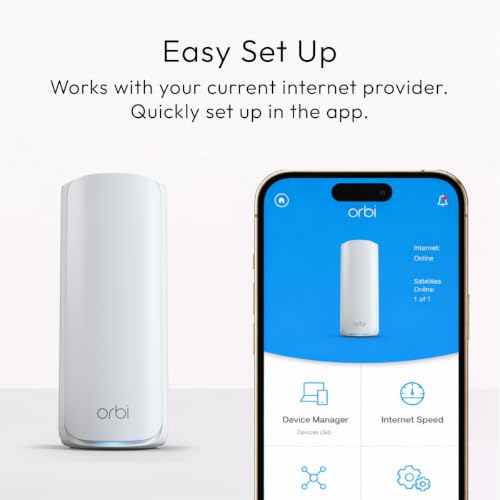
Integrating the system into an existing home network is managed through the Orbi mobile application. The software guides users through connecting the router to an existing cable or fiber modem, placing satellite units, and establishing unified network credentials. While the guided procedure simplifies deployment, buyers navigating netgear orbi 770 setup issues occasionally encounter initial detection delays when bridging certain ISP-supplied modem-router combo gateways. Putting the provider gateway into bridge or IP passthrough mode resolves IP conflicts and ensures the Orbi handles primary routing responsibilities correctly.
Compared to entry-level mesh alternatives like the netgear orbi 370, the 770 platform delivers significantly expanded port capacity and higher baseline throughput. The presence of 2.5 Gbps ports across both the router and the satellites allows gaming consoles, personal computers, and network storage devices to tap into rapid wired connections anywhere a satellite is placed, eliminating the latency and variability inherent in pure wireless links.
Firmware Maintenance and Subscription Costs
Network reliability depends heavily on sustained software maintenance. The system runs on NETGEAR proprietary Linux-based firmware that includes automated firmware updates enabled straight out of the box. Reliable netgear orbi 770 firmware reliability is vital for patching security vulnerabilities and maintaining device interoperability over years of continuous operation. Automatic background updates ensure that critical security definitions and protocol enhancements are applied without demanding constant oversight from the homeowner.
Out of the box, the hardware includes essential defensive measures such as WPA3 security protocols, an advanced firewall, parental control mechanisms, VPN support, and a dedicated IoT network. The dedicated IoT network allows smart home appliances, smart plugs, and security cameras to sit on an isolated wireless segment, preventing an insecure smart peripheral from exposing personal computing devices to potential network vulnerabilities.
Advanced real-time protection, however, relies on an external software service. The system includes a 30-day trial of NETGEAR Armor, which supplies active malware blocking, hacker protection, and identity theft defense for connected devices. Once the trial concludes, maintaining that comprehensive security layer requires an ongoing netgear armor subscription orbi 770 plan. Homeowners should consider this recurring operational cost when budgeting their network upgrade, although core routing functions, local firewall rules, and basic network management remain fully active even without a paid subscription.
NETGEAR Orbi 770 Series Pros and Cons
Pros
- Covers up to 8,000 square feet across three units
- Tri-band Wi-Fi 7 speeds reaching up to 11 Gbps
- Dedicated enhanced backhaul maintains stable node links
- Multi-gigabit 2.5 Gbps Ethernet ports on all units
- Manages up to 100 simultaneous connected devices
Cons
- Full security suite requires ongoing paid subscription
- Expansion limited strictly to Orbi 770 series satellites
- Engineered for use in the United States only
Is the NETGEAR Orbi 770 Series Worth It
Determining whether the system is the right choice depends on your property size, the speed of your internet service tier, and your tolerance for ongoing software subscriptions. As detailed in the orbi 770 series mesh wifi system specs, the platform is built for heavy data environments. Households with multi-gigabit internet plans up to 2.5 Gbps, high client counts reaching toward 100 devices, and spacious layouts up to 8,000 square feet will find the tri-band Wi-Fi 7 throughput and dedicated backhaul exceptionally capable of eliminating dead spots and congestion.
Conversely, the investment makes less sense for smaller apartments, single-story homes under 3,000 square feet, or households with modest internet service plans under 500 Mbps. In those scenarios, the high-throughput 11 Gbps wireless overhead and multi-gigabit Ethernet interfaces remain largely underutilized. Furthermore, users who prefer fully open-source firmware or who dislike hardware tied to optional subscription suites like NETGEAR Armor may find the software ecosystem less appealing.
Ultimately, is orbi 770 series worth it for homeowners seeking set-and-forget mesh stability? If you require wide-area coverage across multi-level construction, need wired multi-gigabit ports distributed across several rooms, and want future-ready Wi-Fi 7 wireless capabilities that accommodate both current and upcoming devices, the Orbi 770 provides a powerful, highly capable networking foundation.
FAQ
Does the NETGEAR Orbi 770 Series require a monthly subscription to work?
No, the system does not require a paid monthly subscription for standard operation. Core routing, Wi-Fi 7 broadcasting, guest network access, IoT segmentation, and basic firewall protections function out of the box. However, the comprehensive NETGEAR Armor security suite requires a separate paid subscription after the initial 30-day trial expires.
Can older Wi-Fi 5 and Wi-Fi 6 devices connect to this system?
Yes, the hardware maintains backward compatibility with legacy wireless protocols. Devices utilizing Wi-Fi 5 (802.11ac) or Wi-Fi 6 (802.11ax) will connect normally to the mesh network, allowing you to use existing smart televisions, gaming consoles, and mobile phones without issue.
Can I use older Orbi satellites with the Orbi 770 Series router?
No, the listing specifies that expansion requires an Orbi 770 Series satellite. Satellites from previous generations or different model lines cannot be integrated into this Wi-Fi 7 mesh system.
What internet speed tier works best with the Orbi 770?
The system is compatible with any standard cable or fiber internet service provider, but its 2500 Mbps (2.5 Gbps) LAN and WAN bandwidth capabilities make it particularly well-suited for high-speed fiber plans ranging between 1 Gbps and 2.5 Gbps.
Can the Orbi 770 units be connected using Ethernet cables?
Yes, the system features a hybrid network design with 7 physical ports across the three units. You can utilize the 2.5 Gbps Ethernet ports to establish a wired backhaul connection between the router and satellites for maximum throughput and stability.


