As Amazon Associates, we earn from qualifying purchases. This means we may receive a small commission at no extra cost to you if you click through and make a purchase.
Motor Power
500 Watts
Bowl Capacity
5.5 Quarts
Warranty Coverage
1-Year Replacement Plan
Operating Voltage
120 Volts AC
Full spec sheet 6 more rows from the listing
| Brand and Manufacturer | KitchenAid / Whirlpool Corp |
| Model Number | KSM55SXXX / KSM55SXXXPL |
| Speed Settings | 11 Distinct Speeds (Includes 1/2 Speed) |
| Kneading Capacity | Over 7 Pounds of Bread Dough |
| Batch Cookie Capacity | Up to 11 Dozen Standard Cookies |
| Included Accessories | Flat Beater, Dough Hook, Wire Whip, Bowl |
Home bakers researching the KitchenAid 5.5-Qt Stand Mixer generally want to know whether this machine provides enough muscle for heavy baking without succumbing to mechanical strain. Designed to bridge the gap between entry-level mixers and commercial-tier appliances, this 5.5-quart bowl-lift model targets cooks who find traditional hinge-style machines underpowered or unstable for dense recipes. Powered by a 500-watt motor and stabilized by a rigid pedestal, the unit delivers twice the usable bowl power above speed two compared to standard tilt-head models.
Selecting the right kitchen workhorse requires evaluating how its mechanical assemblies tolerate heavy loads over years of regular use. While marketing figures showcase impressive batch capabilities, true kitchen durability depends on gear resilience, attachment tolerances, and thermal limits during prolonged mixing cycles. In this comprehensive review, we examine the technical specifications, assess the structural trade-offs of the bowl-lift format, analyze stress limits when kneading dense dough, review attachment versatility, and inspect warranty coverage to determine whether this appliance justifies a permanent spot in your kitchen.
What You Get With the KitchenAid 5.5-Qt Stand Mixer
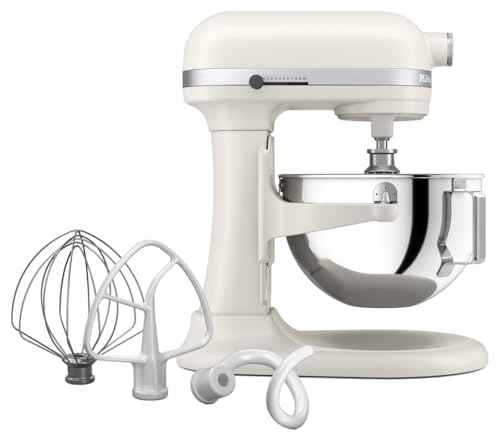


The KitchenAid 5.5-Qt Stand Mixer arrives with the necessary core components to begin baking immediately, featuring sturdy metal components and standard mixing accessories.
- KitchenAid 5.5-quart polished stainless steel mixing bowl with ergonomic handle
- Coated flat beater designed for creaming butter, blending batters, and shredding meats
- Coated spiral dough hook configured for kneading dense yeast mixtures
- Standard 6-wire whip for incorporating volume into egg whites and heavy creams
- Heavy-duty die-cast metal pedestal base with integrated dual-arm bowl-lift mechanism
- Variable 11-speed control assembly featuring an ultra-low half-speed fold function
- Multipurpose front attachment hub compatible with over ten optional culinary tools
Motor Power and Kneading Heavy Bread Dough
The core appeal of this machine centers on the KitchenAid 5.5 stand mixer motor power. Packing a 500-watt motor, it is calibrated to generate high torque at lower mixing speeds where heavy resistance occurs. According to manufacturer benchmarks, this system delivers twice the peak power in the bowl compared to the baseline KSM150 tilt-head platform when operating above speed two. This extra power translates into consistent paddle and hook velocity when plowing through cold butter, dense cookie batters, or large batches of mashed potatoes without experiencing immediate motor bogging.
When utilizing the KitchenAid mixer 5.5 for bread dough, the machine is rated to knead over seven pounds of dense yeast mixture. Bread making places extreme strain on planetary gear assemblies because heavy dough continually fights against the rotation of the hook. To protect the motor from burning out, dense doughs must always be kneaded on speed two rather than higher settings. Running low-hydration doughs such as sourdough or bagel mixtures at excessive velocities generates internal friction that can trip thermal overload switches or degrade internal lubricants prematurely.
For bakers who prepare multi-loaf batches weekly, the sustained torque output of the 500-watt motor provides noticeable stability compared to smaller consumer mixers. It maintains its rhythmic kneading stroke through extended mixing cycles without displaying erratic speed fluctuations. However, users must respect the practical batch boundaries; attempting to knead past rated capacities can generate excessive head heat, making it important to allow cooling intervals between consecutive heavy batches.
Bowl-Lift Architecture Versus Tilt-Head Designs
Understanding the differences in a KitchenAid 5.5 bowl lift vs tilt head matchup comes down to structural rigidity and counter ergonomics. Tilt-head units feature a mechanical hinge pin that allows the motor housing to pivot upward for easy bowl removal. Under heavy loads, however, that hinge point can flex, producing head bounce and uneven beater clearance. In contrast, the 5.5-quart model utilizes a fixed solid-column body where the motor head remains permanently stationary, locking all kinetic energy directly into the bowl rather than dissipating it through a moving joint.
The bowl-lift design secures the bowl using a three-point locking mechanism consisting of two lateral positioning pins and a sturdy rear retaining spring. A side-mounted lever physically elevates the bowl into the mixing zone. While this architecture eliminates frame flex, it changes how you interact with ingredients compared to a kitchen aide artisian mixer. With a fixed upper housing, adding ingredients requires either utilizing the bowl gap carefully or lowering the lift arms between additions.
Countertop clearance represents another vital consideration for this bowl-lift format. Because the motor housing does not tilt upward, the mixer requires zero vertical clearance expansion during operation, making it suitable for spaces beneath standard overhead cabinets. However, the fixed height means that installing or removing the wire whip and dough hook requires lowering the bowl completely, demanding slightly more front-to-back workspace on your kitchen counter to slide bowls out comfortably.
Mechanical Wear and Potential Failure Points
Evaluating KitchenAid KSM55 reliability requires inspecting the mechanical stress points that experience continuous friction over years of ownership. A primary concern among long-term owners involves KitchenAid 5.5 mixer failure points such as internal gear wear and beater clearance drift. Modern KitchenAid drivetrains incorporate precision gears inside a sealed transmission case. When subjected to extreme overload, such as an immovable dough obstruction, these gears are designed to absorb stress to protect the motor, but sustained strain can lead to tooth chipping or grease migration away from key contact surfaces.
Beater-to-bowl clearance represents another critical maintenance factor that influences component longevity. If the mixer calibration drifts, the coated flat beater or spiral dough hook can make physical contact with the stainless steel bowl floor. This contact not only scratches the metal basin but also causes the white polyester coating on the beaters to chip over time. Conducting a periodic dime test using the central adjustment screw ensures that tools clear the bowl surface by roughly one millimeter, mirroring the maintenance routine of older heavy-duty machines like the kitchenaid mixer 5 qt professional.
The manual lift mechanism also introduces wear interfaces that benefit from careful handling. The dual lift arms rely on precision alignment pins to hold the bowl level beneath the planetary spindle. Forcing the bowl down without disengaging the rear spring clip can strain the lever linkage over time. Keeping the lift rails clean of flour buildup and ensuring the bowl snaps firmly into all three locking points preserves proper tool alignment and minimizes unnecessary side-load strain on the drive shaft.
Attachment Hub Versatility and Speed Regulation
A major evolution found in the KitchenAid mixer 5.5 specs is the introduction of an 11-speed control system operated by a mechanical knob. Unlike older ten-speed platforms, this configuration adds a dedicated half-speed setting positioned below speed one. This half-speed mode runs at an ultra-low rotational velocity specifically engineered for gentle folding. It allows bakers to incorporate delicate additions such as fresh berries, egg whites, or chocolate chips without crushing them or overworking gluten structures in tender cake batters.
The half-speed setting also addresses the common issue of dry ingredient dispersion. Starting heavy mixtures or adding loose flour at higher velocities often produces powder clouds that coat surrounding countertops. By beginning every mixing cycle at half speed, ingredients wet down smoothly before you ramp up to higher velocity settings. This refined speed curve gives the operator exceptional control from delicate aerating tasks to aggressive beating.
Front attachment versatility expands the mixer beyond simple baking tasks. The standard front hub accommodates KitchenAid 5.5 mixer attachments compatibility across more than ten optional accessories, ranging from pasta rollers to meat grinders. Drawing upon the continuous 500-watt drivetrain, this hub handles heavy resistance tasks that would quickly overwhelm a compact hand tool like the kitchenaid ultra power 5-speed hand mixer. As with all hub accessories, operating at the specific speed recommended in the accessory manual preserves gear integrity and prevents transmission strain.
KitchenAid 5.5-Qt Stand Mixer Pros and Cons
Pros
- High-torque 500-watt motor handles dense dough
- Rigid 3-point locking bowl-lift design
- Dedicated 1/2 speed setting for gentle folding
- Large 5.5-quart capacity fits 11 dozen cookies
- Universal hub compatible with over 10 attachments
Cons
- Requires vertical clearance to remove tools
- Tighter bowl access compared to tilt-head designs
- Coated beaters require careful clearance calibration
Is the KitchenAid 5.5-Qt Stand Mixer Worth It
Determining whether the KitchenAid mixer 5.5 is worth it depends on your baking volume and culinary routines. For serious bread makers, avid holiday bakers, and home cooks who routinely prepare double batches of cookies or shred large quantities of meat, the solid bowl-lift platform provides tangible value. The rigid three-point locking foundation, 500-watt power output, and dedicated half-speed fold control combine to deliver stable performance that eliminates the annoying head bounce common in smaller machines.
Conversely, occasional bakers who primarily whip single meringues, blend light boxed cake mixes, or have limited counter space may find this 5.5-quart machine excessive. The bowl-lift mechanism demands a more deliberate workflow when adding ingredients or scraping down bowl walls compared to a tilt-head mixer. If your kitchen routine does not involve stiff doughs or high-volume batches, the extra weight and fixed-column height might feel more cumbersome than helpful in daily cooking.
Prospective buyers must also consider the KitchenAid 5.5 quart mixer warranty. Backed by Whirlpool’s 1-year replacement plan, the appliance is protected against initial factory defects and component failures. To maximize your investment, operating the machine within its designated speed limits—especially when kneading heavy bread doughs—and routinely checking tool clearances will ensure this durable kitchen workhorse operates reliably for countless baking projects.
FAQ
Can the KitchenAid 5.5-Qt Stand Mixer handle dense bread dough without stalling?
Yes, the 500-watt motor provides sufficient torque to knead dense bread doughs, supporting batches up to seven pounds. To prevent excessive gear stress and motor overheating, always perform yeast dough kneading exclusively on speed two.
What is the purpose of the 1/2 speed setting on this mixer?
The 1/2 speed setting operates at an ultra-low rotational speed designed specifically for gentle folding. It allows you to incorporate delicate ingredients like berries and egg whites without crushing them, while preventing flour clouds during initial mixing.
Are standard KitchenAid hub accessories compatible with this model?
Yes, the mixer features the universal front attachment hub, making it compatible with over ten optional KitchenAid attachments including pasta rollers, food grinders, and vegetable spiralizers.
How does the bowl-lift design differ from a tilt-head mixer during operation?
A bowl-lift mixer features a stationary motor head and uses a manual lever to raise and lower the bowl, eliminating frame flex during heavy mixing. A tilt-head mixer hinges at the base, allowing the head to pivot back for easier bowl access but introducing potential head bounce under heavy loads.
What does the manufacturer warranty cover on this 5.5-quart stand mixer?
The mixer includes a 1-year replacement plan managed by Whirlpool Corporation, which covers functional defects and mechanical breakdowns under normal residential use during the first year of ownership.


