As Amazon Associates, we earn from qualifying purchases. This means we may receive a small commission at no extra cost to you if you click through and make a purchase.
Motor Power Rating
325 Watts
Total Liquid Capacity
5 Quarts
Warranty Protection
1-Year Manufacturer Warranty
Physical Dimensions
13.9 Inches Deep by 14.1 Inches High by 8.7 Inches Wide
Full spec sheet 6 more rows from the listing
| Brand | KitchenAid |
| Model Series | Artisan KSM150PS (Featured in Black Matte KSM150PSBM) |
| Electrical Rating | 120 Volts AC |
| Speed Control | 10 Speeds via Mechanical Slide Knob |
| Planetary Touchpoints | 59 Action Points Around the Bowl |
| Design Architecture | Tilt-Head with Mechanical Locking Lever |
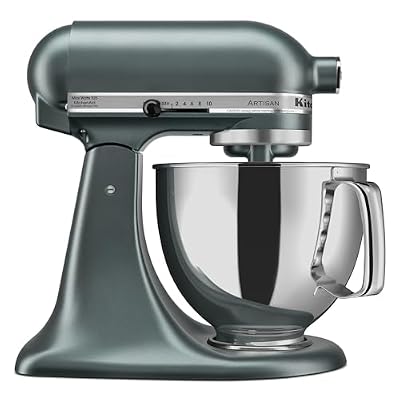
Shoppers searching for a kitchenaid mixer 5 qt professional are often guided directly toward the KitchenAid Artisan 5-Qt tilt-head stand mixer. This model crossover causes considerable confusion in the marketplace because KitchenAid manufactures both consumer tilt-head machines and commercial-style bowl-lift appliances. The Artisan KSM150PS series represents the benchmark countertop mixer for home kitchens, combining a 325-watt motor, planetary mixing motion, and an extensive palette of exterior finishes. However, assuming that this popular five-quart machine delivers the unrelenting torque of a commercial bakery workstation is a common mistake that can lead to motor strain, gear wear, and premature mechanical failure.
In this technical evaluation, we examine the construction quality, operational boundaries, and maintenance requirements of the Artisan platform. We assess how the 325-watt power plant copes with dense doughs, inspect the stability of the tilt-head hinge assembly under continuous load, and dissect the one-year warranty coverage. By exploring the mechanical realities behind the marketing claims, this guide helps prospective owners determine whether this tilt-head model matches their routine culinary workload or if their baking demands require stepping up to a dedicated heavy-duty machine.
What You Get With the KitchenAid Artisan 5-Qt


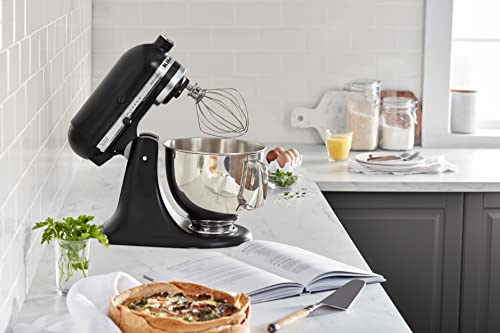
The KitchenAid Artisan 5-Qt ships with the foundational equipment needed to handle standard mixing, beating, and kneading tasks straight out of the box:
- KitchenAid 5-quart tilt-head stand mixer base with 325-watt motor and multi-purpose attachment hub
- 5-quart polished stainless steel mixing bowl equipped with an ergonomic handle
- Coated flat beater designed for standard cake batters, frostings, and cookie doughs
- Coated C-dough hook engineered to knead yeast-leavened bread and pizza doughs
- 6-wire whip configured for aerating egg whites, heavy cream, and delicate sponge mixtures
- One-piece pouring shield designed to channel dry ingredients into the bowl while containing splatters
Motor Power and Heavy Dough Performance
Evaluating kitchenaid mixer 5 qt professional specs requires a clear look at the internal drive assembly. The Artisan model operates on a 325-watt motor connected to an alternating current power supply. In everyday kitchen tasks such as blending cake batters, whipping meringues, or emulsifying frostings, this powertrain delivers smooth and consistent torque. The 59 planetary touchpoints ensure that the agitator rotates on its own axis while orbiting the perimeter of the bowl, systematically gathering ingredients from the sidewalls and bottom without requiring frequent manual spatula scraping.
Operational challenges arise when home bakers subject this consumer-grade motor to dense culinary mixtures. KitchenAid rates the five-quart bowl to mix batches of up to nine dozen cookies based on small 28-gram dough portions. While standard chocolate chip cookie dough mixes without hesitation, encountering kitchenaid artisan 5 quart motor problems becomes common when users attempt heavy whole-grain loaves, stiff bagel doughs, or double batches of pizza crust. The 325-watt motor relies on internal gearing that absorbs substantial thermal and mechanical stress when kneading low-hydration flours. When overloaded, the motor housing can become noticeably warm to the touch, and the motor pitch shifts downward as rotational resistance spikes.
Managing the kitchenaid 5 quart mixer dough capacity requires strict adherence to manufacturer speed thresholds. KitchenAid explicitly instructs users to knead yeast doughs exclusively on speed 2. Running the mixer at higher speeds during the kneading cycle forces the motor to draw excessive current, accelerating internal wear and risking thermal cutoff. Home bakers who routinely knead multiple loaves of dense sourdough each week will quickly realize that the Artisan is engineered primarily for general-purpose baking rather than heavy bread production. For serious bread makers, evaluating a heavier platform like the kitchenaid 5.5 quart bowl-lift stand mixer provides the structural rigidity and elevated motor reserves needed for challenging dough formulations.
Tilt-Head Mechanism Stability and Wear
The defining design attribute of the Artisan series is its hinged upper motor housing. The tilt-head architecture provides unobstructed access to the mixing bowl, allowing users to scrape down ingredients, swap beaters, or add dry dry goods without unlatching the bowl itself. A side-mounted mechanical lever locks the head into the lowered operating position. For cooks with limited upper cabinet clearance or those who prioritize streamlined ingredient additions, this configuration offers practical convenience during routine meal preparation.
However, the convenience of a hinged frame introduces a structural vulnerability not found in solid, commercial-style mixers. During dense mixing cycles, the mechanical resistance created by the dough hook exerts upward rotational force against the motor head. This constant vertical thrust causes the head to flex and bounce against the locking pin. Over extended periods of repetitive kneading, owners frequently report head play and search for a reliable kitchenaid tilt head wobble fix. This movement is not necessarily an immediate defect, but rather an inherent consequence of relying on a single horizontal steel pivot pin to join two heavy cast-metal castings.
To preserve long-term kitchenaid 5 qt mixer reliability, owners must periodically perform basic mechanical adjustments. Located in the throat of the mixer base is a slotted neck adjustment screw that calibrates the beater clearance against the bottom of the stainless bowl. Turning this screw clockwise raises the beater, while turning it counterclockwise lowers it. When excessive bounce occurs, tightening the hinge pin set screw underneath the base and fine-tuning the neck screw eliminates excess clearance. Ignoring this mechanical drift allows the beater to strike the stainless steel bowl floor, causing cosmetic damage and chipping the protective enamel coating on the included beaters.
Artisan Tilt-Head Versus Professional Bowl-Lift Builds
Understanding the differences between the kitchenaid artisan vs professional 5 qt platforms is vital for making an informed investment. While marketing naming conventions sometimes blur the lines, the Artisan is fundamentally an intermediate home appliance, whereas KitchenAid Professional series mixers utilize a static, rigid column with a crank-operated bowl-lift carriage. The bowl-lift architecture eliminates the upper hinge entirely, anchoring the bowl to dual supporting arms and a rear retention clip. This rigid frame absorbs mechanical vibration efficiently, preventing the upward deflection common to tilt-head designs.
Beyond frame rigidity, true professional-oriented models feature differing internal transmission components, heavier motor windings, and wider operational footprints. The Artisan measures 14.1 inches in height, fitting neatly beneath standard 18-inch upper kitchen cabinets even during storage. However, when the head is tilted fully back to remove the bowl, the total vertical height expands beyond 17.5 inches, requiring users to slide the mixer forward to the edge of the counter. Bowl-lift machines remain at a fixed operational height, requiring only vertical clearance to insert ingredients from the top.
For cooks who primarily prepare delicate pastries, batters, and occasional light breads, the Artisan remains an accessible choice that outpaces entry-level units like the kitchen aid classic mixer. The Artisan provides a larger five-quart capacity, a contoured bowl handle, and twenty additional watts of motor output over classic introductory models. Yet, buyers should not confuse these convenience enhancements with industrial durability. If daily culinary tasks center on high-torque kneading or grinding dense meats using auxiliary attachments, commercial-style bowl-lift machines offer superior structural integrity.
Warranty Coverage and Consumer Protection Realities
Long-term appliance satisfaction hinges directly on manufacturer warranty commitments and post-warranty serviceability. The kitchenaid ksm150ps warranty coverage spans exactly one year from the verified date of purchase. This limited warranty covers functional defects in materials and factory workmanship, offering hassle-free replacement during the initial 12-month window if the machine experiences catastrophic mechanical failure under normal household conditions.
From an advocacy standpoint, a single-year warranty on an iconic countertop appliance that commands a significant investment is relatively conservative. Many prospective buyers purchase KitchenAid mixers assuming they carry generational, multi-decade factory protection based on the historic reputation of vintage machines. Modern Artisan mixers incorporate a deliberate failure point: an internal sacrificial nylon or composite worm gear. This gear is engineered to strip intentionally if the beater jams, protecting the 325-watt motor from burning out entirely. While this mechanical safeguard prevents electrical fires and motor destruction, repairing a stripped gear outside the 12-month warranty window requires either third-party mechanical repair or hands-on consumer disassembly.
Consumer advocacy analysis reveals that while replacement parts for the KSM150PS are widely available through independent appliance repair networks, factory customer service after the one-year mark generally directs owners toward paid service centers. Buyers planning to use their mixer extensively should maintain proof of purchase, inspect the packaging upon arrival, and rigorously test all speeds and attachments during the initial year of ownership to identify factory assembly defects before the manufacturer protection expires.
KitchenAid Artisan 5-Qt Pros and Cons
Pros
- Versatile 10-speed motor with planetary action
- Convenient tilt-head design for bowl access
- Includes five essential bowl and mixing accessories
- Universal hub supports over 10 attachments
- Available in more than 20 color finishes
Cons
- Limited 1-year manufacturer warranty coverage
- 325-watt motor struggles under heavy doughs
- Tilt-head hinge develops play under high torque
Is the KitchenAid Artisan 5-Qt Worth It
Determining whether the KitchenAid Artisan 5-Qt represents good value depends entirely on matching your culinary habits to its specific engineering strengths. For the majority of home bakers who prepare birthday cakes, seasonal cookie batches, quick breads, frostings, and whipped cream, the Artisan is an exceptional performer. Its 10-speed knob control provides granular speed management, moving seamlessly from a gentle stir speed that folds dry flour without powder clouds up to a rapid speed 8 or 10 for stiff meringues. The wide availability of over 20 exterior finishes also makes it a striking visual centerpiece for home countertops.
Conversely, for culinary enthusiasts focused on artisanal bread making, high-yield pizza baking, or heavy batch cooking, the Artisan reveals its mechanical ceilings. The 325-watt motor and tilt-head locking hinge are not built to endure the continuous punishment of low-hydration bread doughs without experiencing thermal strain and head bouncing. If you bake multiple loaves of dense sourdough every week, the investment is better directed toward a heavy-duty bowl-lift mixer or a specialized spiral kneader designed specifically to handle heavy dough loads.
Ultimately, the Artisan KSM150PS strikes a dependable compromise between everyday user friendliness and multi-functional kitchen versatility. When operated within its recommended capacities—using speed 2 for kneading and respecting volume limitations—it delivers dependable domestic utility. Buyers who understand its operational boundaries will enjoy a versatile countertop appliance, but those expecting industrial bread-kneading performance will find the consumer tilt-head architecture pushed beyond its structural limits.
Frequently Asked Questions
Does the KitchenAid Artisan 5-Qt feature professional all-metal gears?
The KitchenAid Artisan utilizes a heavy-duty metal transmission casing, but it incorporates an engineered sacrificial nylon worm gear inside the drive train. This gear is intentionally designed to strip if the mixing tool encounters an immovable obstacle or an extreme overload. Sacrificing the gear prevents the 325-watt electric motor from overheating or suffering terminal electrical failure. Replacement gears are readily available, but rebuilding the drive assembly requires opening the mechanical housing and repacking the gearbox with food-grade grease.
What is the maximum bread dough capacity for this 5-quart mixer?
KitchenAid rates the 5-quart bowl to process enough dough for standard home bread recipes, but real-world performance depends heavily on dough hydration. For standard yeast doughs, the mixer handles formulations yielding approximately two standard 1-pound loaves of white bread. When preparing dense whole-wheat, rye, or stiff bagel doughs, the dough weight should be kept lower to prevent the 325-watt motor from bogging down. Furthermore, all yeast dough kneading must be conducted strictly on speed 2 to avoid overtaxing the motor windings.
How do you fix a loose or wobbling tilt-head?
A wobbling tilt-head is generally resolved by adjusting the mechanical hinge and neck clearance screws. To calibrate the mechanism, tip the motor head back into the raised position to locate the slotted set screw in the base throat. Turning this screw slightly counterclockwise lowers the beater, while turning it clockwise raises it, establishing the optimal clearance where the beater does not touch the bowl bottom. If the head shifts horizontally, inspect the heavy steel pivot pin under the neck and tighten the internal hex set screw that locks the pin into the casting.
What is covered under the KitchenAid KSM150PS warranty?
The KitchenAid KSM150PS carries a 1-year limited warranty from the original date of purchase. This manufacturer warranty covers failures resulting from defects in materials or factory workmanship under normal domestic household use. It does not cover damages resulting from commercial operation, accidents, unauthorized alterations, misuse, or operating the mixer on incorrect electrical voltages. If a defect emerges within the first year, KitchenAid will arrange to deliver an identical or comparable replacement unit free of charge.
Can the Artisan handle attachments like meat grinders and pasta rollers?
Yes, the front attachment hub on the KitchenAid Artisan is universally compatible with over 10 optional hub-powered accessories sold separately by KitchenAid and third-party manufacturers. Because the hub is driven directly by the internal transmission, it powers pasta rollers, vegetable spiralizers, grain mills, and food grinders. However, when operating high-torque accessories like meat grinders, users should cut chilled meats into small strips and run the mixer at the recommended speeds to prevent overloading the 325-watt motor.