As Amazon Associates, we earn from qualifying purchases. This means we may receive a small commission at no extra cost to you if you click through and make a purchase.
Rated Print Speed Range
30 mm/s to 600 mm/s
Total Pack Weight
8.8 pounds (4 kg total across 4 spools)
Material Type
Polylactic Acid (PLA)
Filament Diameter
1.75 mm
Full spec sheet 6 more rows from the listing
| Brand | Creality |
| Color | Black |
| Dimensional Accuracy | ±0.03 mm (item highlight notes ±0.02 mm) |
| Ecosystem Integration | CFS RFID smart recognition for K2 series and Hi series |
| Part Number | Hyper-RFID_BBBB-4kg_3301010591_US1 |
| Global Trade Identification Number | 00198549053417 |
Evaluating whether Creality Hyper PLA Black delivers on its advertised 600 mm/s flow capability requires a close look at thermal stability, extruder feed consistency, and manufacturing tolerances. Packaged as a four-kilogram multi-pack containing four individual spools, this formulation addresses the demanding volumetric output needed by modern rapid-motion platforms. Buyers adopting high-speed hardware often struggle with under-extrusion, inconsistent layer bonding, and sudden heat creep when pushing ordinary filament past conventional velocity boundaries. If you operate high-output machines and demand clean black cosmetic finishes, understanding how this specific filament performs under high mechanical stress is vital before stocking multiple kilograms.
This reliability assessment examines the physical and structural attributes of Creality Hyper PLA Black across long-duration print cycles. We analyze its integrated radio-frequency identification tag integration for automated management systems, inspect the spool winding consistency to gauge snag vulnerability, and review its dimensional variance against precision manufacturing claims. Furthermore, we clarify how flow dynamics influence hotend reliability, helping you determine whether this bulk multi-pack solves high-velocity production challenges or introduces unneeded maintenance hurdles to your workshop.
What You Get With the Creality Hyper PLA Black


The product package delivers four individually packaged spools designed specifically to supply high-output production setups and automated multi-material loading systems without requiring immediate resupply.
- Four separate 1-kilogram spools of 1.75 mm black polylactic acid filament, providing 4 kilograms (8.8 pounds) of total printing material.
- Integrated CFS RFID identification chips embedded in each spool hub to automate material detection, slicer profile selection, and waste monitoring on compatible Creality hardware.
- Neatly wound plastic spools engineered to reduce mechanical snagging, binding, and uneven layer cross-overs during rapid unwinding.
- High-fluidity resin formulation rated to maintain extrusion consistency across an operational speed bracket spanning 30 mm/s up to 600 mm/s.
- Factory packaging designed to shield filament from contamination, though the listing does not specify the inclusion of specific humidity indicator cards or vacuum valve mechanisms.
High-Speed Extrusion Dynamics and Flow Consistency
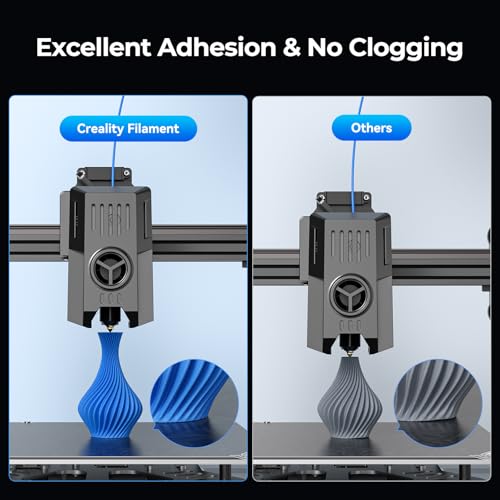
Achieving stable high-velocity deposition requires a filament formula that melts quickly in the heater block and solidifies immediately upon exiting the nozzle orifice. Creality Hyper PLA for high speed printing is engineered specifically to maintain a fluid melt pool without developing excessive backpressure inside the thermal barrier. When running machines capable of 600 mm/s linear acceleration, standard PLA often suffers from localized melt starvation, leading to chalky finishes, missing perimeters, and internal wall delamination. This formulation maintains fluidity under rapid volumetric feeding, ensuring that continuous extrusion keeps pace with modern CoreXY motion systems like the creality k2 combo 3d printer.
The transition from a solid state to a low-viscosity liquid must be balanced by effective part-cooling fans at the toolhead. Because the material is formulated to exit the nozzle rapidly, insufficient auxiliary cooling can result in corner curling, drooping overhangs, and melted bridging geometry. Operators pushing print rates toward the upper 600 mm/s boundary must verify that their hotend maintains stable heater cartridge power while side-cooling blowers prevent heat accumulation on short layer times. Running Creality Hyper PLA black at standard rates between 50 mm/s and 100 mm/s remains fully functional, but the optimized melt flow truly proves its utility when volumetric displacement exceeds 20 cubic millimeters per second.
Thermal stability inside the melt zone also influences the final surface sheen and color saturation. Printing at standard velocities produces a satin black exterior, whereas running at extreme velocities can create minor sheen variations due to differing crystallization cooling curves. Maintaining a uniform speed profile across outer perimeters ensures that the cosmetic appearance of technical enclosures and consumer prototypes remains smooth, uniform, and free of the speed banding artifacts commonly seen with non-optimized resins.
Extruder Grip and Clogging Prevention Under Heavy Retraction
Preventing mechanical feeder failures during protracted multi-hour prints requires consistent physical hardness along the filament strand. A major concern when processing high-flow plastics is heat creep, where thermal energy travels upward past the heat break into the cold zone, softening the incoming polymer prematurely. Creality Hyper PLA clogging issues are significantly mitigated by the resin’s quick transition behavior, yet users operating fully enclosed build chambers must remain vigilant. When interior enclosure temperatures rise above the glass transition threshold of PLA, the filament can soften before entering the melt chamber, leading to flattened drive notches and total feed stoppage.
The mechanical interaction between drive gears and the 1.75 mm strand requires calibrated grip tension. If dual-drive gears exert excessive bite pressure on softened filament, the material can strip, depositing plastic dust across the drive teeth and causing intermittent under-extrusion. Upgrading or inspecting hardware such as the creality k2 extruder kit ensures that drive gears maintain precise tension without deforming the filament path during heavy retraction sequences.
Retraction distance and frequency also govern clogging vulnerability during complex multi-part jobs. High-speed profiles execute rapid retract and unretract motions within milliseconds, creating micro-vacuums inside the nozzle that can introduce air bubbles or pull hot plastic into the cold zone. Maintaining a short direct-drive retraction distance keeps the melt transition zone stable, preventing solidified plugs from jamming the throat tube during intricate lattice prints or multi-object build plates.
Spool Winding Precision and Mechanical Snag Risks
Continuous unattended manufacturing demands precise spool winding to prevent tension spikes that can stall stepper motors or snap filament mid-print. Creality Hyper PLA spool tangle risk is minimized through machine-guided parallel winding, which lays consecutive loops cleanly side by side across the spool hub. In high-speed printing environments, an unexpected filament overlap is disastrous because rapid toolhead acceleration tightens minor loops instantly, leaving no slack for the feeder mechanism to recover before a layer failure occurs.
Unlike conventional printing where spools rotate sluggishly, high-velocity extrusion demands rapid, intermittent bursts of spool rotation followed by abrupt stops. When the toolhead decelerates after a high-speed travel move, spool inertia can cause the plastic reel to over-rotate, casting loose loops over the spool flange. When comparing spool mechanics to proven everyday materials like overture pla plus, users operating free-spinning top-mounted spool holders should ensure moderate hub friction or use enclosed feeder rollers to suppress slack overruns.
Proper end-of-spool handling is equally critical to avoiding mid-print disasters. The listing specifies neatly wound spools designed for clog-free feeding, but operator discipline remains paramount when changing reels. Allowing the free filament tail to snap back onto the spool without securing it through the perimeter retention holes will induce an overlapping loop that inevitably binds several layers deep. Inspecting each new spool upon unboxing ensures that no transport jostling has dislodged outer wraps before loading.
Dimensional Tolerance, Structural Strength, and RFID Compatibility
Extrusion precision hinges directly upon diameter consistency along the entire 1-kilogram length of each spool. Reviewing the Creality Hyper PLA specs reveals a dimensional tolerance specified at ±0.03 mm, with listing highlights also claiming precision reaching ±0.02 mm. This tight cross-sectional control ensures that the volumetric calculation made by your slicer corresponds directly to the physical volume deposited on the build plate. Variations wider than ±0.05 mm often cause noticeable layer line banding, intermittent over-extrusion scars, or micro-voids that compromise part hermeticity.
Beyond aesthetic precision, structural integrity represents a major advantage for functional prototyping. According to the manufacturer data, Creality Hyper PLA tensile strength exceeds standard PLA and is formulated to be tougher than ABS in tensile resistance. Standard polylactic acid is notoriously brittle under shock loads, frequently snapping cleanly along layer lines when subjected to dynamic impacts. The modified polymer matrix in this formulation enhances impact toughness, permitting functional brackets, drone frames, and shop jigs to absorb stress without catastrophic brittle failure.
Smart material management further distinguishes the spool design. Creality Hyper PLA RFID compatibility enables automated handshakes when spools are inserted into the Creality Filament System (CFS), instantly syncing profiles with K2 Plus, K2 Pro, and Hi series units. However, third-party machines cannot read these tags, operating instead as standard manual spools. Makers considering alternative high-flow materials like elegoo rapid pla plus should note that while open-market spools lack Creality RFID tags, Hyper PLA remains fully printable on any standard 1.75 mm platform once sliced with appropriate volumetric boundaries.
Creality Hyper PLA Black Pros and Cons
Pros
- High-speed flow rating up to 600 mm/s
- Integrated CFS RFID automatic material recognition
- Tight dimensional tolerance of ±0.03 mm
- Superior tensile strength exceeding standard ABS
- Neatly wound spools reduce feeding snags
Cons
- RFID features limited to compatible Creality hardware
- Enclosed chamber heat creep risks during slow prints
- Maximum speed benefits require high-flow hotends
Is the Creality Hyper PLA Black Worth It
Determining whether is Creality Hyper PLA worth it depends largely on your machine capabilities and project requirements. If you operate high-speed 3D printers operating beyond 250 mm/s—particularly Creality CFS-equipped systems—this 4-pack bundle delivers outstanding value in workflow automation, flow consistency, and print speed. The mechanical strength improvements over standard PLA give functional components real structural durability, while the automated RFID pairing removes friction from multi-spool setups.
Conversely, for users operating standard legacy printers capped at 50 mm/s to 60 mm/s, the rapid-melt formulation provides negligible performance benefits over conventional PLA. While it functions without issue at modest speeds, paying for high-velocity additives and proprietary RFID chips that your hardware cannot utilize is inefficient. Similarly, those who prioritize UV stability or high heat deflection over impact strength should consider technical engineering filaments rather than high-flow PLA.
For commercial makers, rapid prototypers, and multi-color production shops, the Creality Hyper PLA Black 4-pack stands out as a dependable workhorse. Its balanced combination of tight dimensional tolerance, dependable spool winding, and enhanced tensile toughness makes it a premier choice for turning high-speed machine investments into reliable, high-volume production output.
FAQ
Can Creality Hyper PLA Black be used on 3D printers from other brands?
Yes, Creality Hyper PLA Black features a universal 1.75 mm diameter and operates reliably on any FDM 3D printer capable of processing standard PLA. However, the embedded RFID features function exclusively with compatible Creality CFS hardware, meaning users on non-Creality machines must select or tune their slicer profiles manually.
What specific printers support the automatic RFID recognition feature?
According to the product specifications, the RFID-enabled spool is automatically recognized by the Creality Filament System (CFS) when paired with the K2 Plus, K2 Pro, and Hi series 3D printers, enabling automated parameter synchronization and material management.
Does printing at 600 mm/s require special hardware modifications?
Printing at 600 mm/s requires a machine specifically engineered for extreme acceleration, high volumetric flow hotends, and powerful part-cooling systems. While the filament formulation supports 600 mm/s flow rates, running it on an entry-level or legacy printer will not magically increase machine travel speed beyond the printer’s mechanical limits.
What causes nozzle clogging when printing with Hyper PLA?
Nozzle clogging is typically caused by heat creep in enclosed printer chambers, excessive retraction distances pulling molten filament into the cold break, or running extrusion temperatures too low for the commanded volumetric speed. Maintaining proper chamber ventilation and matching hotend temperatures to feed velocity prevents these jams.
How does the tensile strength of Hyper PLA compare to standard materials?
The manufacturer listing states that Hyper PLA is tougher than standard PLA and provides greater tensile strength than ABS. This formulation enhances impact resistance and structural integrity, reducing the brittleness commonly associated with conventional polylactic acid.