As Amazon Associates, we earn from qualifying purchases. This means we may receive a small commission at no extra cost to you if you click through and make a purchase.
Liquid Volume
4 fluid ounces
Part Number
Fusilade-4oz
Active Ingredient
Fluazifop-P-butyl (24.5%)
Other Ingredients
75.5%
A closer look at the official fusilade ii specs highlights a potent, highly concentrated formulation that requires careful calibration before application.
Full spec sheet 6 more rows from the listing
| Brand Name | Syngenta |
| Model Number | Fusilade-4oz |
| UPC | 702941012035 |
| Item Form | Liquid concentrate |
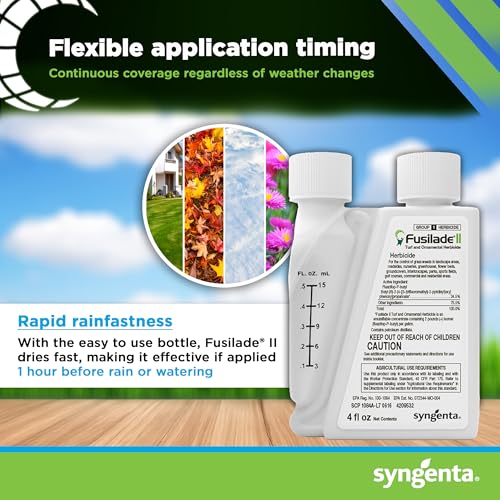
| Rainfast Interval | 1 hour |
| Target Coverage | Annual and perennial grass weeds |
If invasive grassy weeds are encroaching on flower beds or choking out desirable plantings, locating a selective chemical that eradicates grass without destroying nearby broadleaf landscape foliage is notoriously difficult. The Syngenta Fusilade II liquid concentrate is engineered specifically to address this dilemma, functioning as an aggressive graminicide that leaves established non-target plants unharmed. Packaged in a compact 4-ounce bottle under model Fusilade-4oz, this selective post-emergent formulation is tailored for grounds managers, nursery caretakers, and property owners seeking surgical grass removal across landscape beds, sports fields, and select turfgrass varieties. However, because its chemistry is tuned strictly against true grasses, deploying it requires strict discipline; a single drift event or rate miscalculation can severely damage desired lawn grasses.
Determining whether this concentrated herbicide warrants a place in your maintenance shed depends on your target weed species and your willingness to measure chemical inputs with laboratory precision. In this critical analysis, we examine the practical realities of using this fluazifop p butyl weed killer, including exact mixing ratios, tank-mixing requirements, rainfast durability, and selective turf application rules. We also evaluate the operational differences between directed spraying and over-the-top landscape treatments to ensure you achieve reliable weed eradication without triggering unintentional defoliation across your valuable ornamental shrubbery.
What You Get With the Syngenta Fusilade II



The Syngenta Fusilade II package delivers a specialized chemical concentrate engineered specifically for post-emergent selective grass management across turfgrass, nursery beds, and landscape installations. Inside the retail packaging, the manufacturer provides the liquid chemical unit designed for targeted spot treatments and small-to-medium broadcast programs:
- One 4-fluid-ounce bottle of Syngenta Fusilade II liquid herbicide concentrate (Model: Fusilade-4oz, UPC: 702941012035).
- Active ingredient formulation comprising 24.5 percent Fluazifop-P-butyl for targeted systemic grass control.
- 75.5 percent inert and supporting ingredients designed to facilitate liquid dispersion and spray tank stability.
- Systemic chemical action formulated to absorb and translocate throughout target weed shoots and roots.
- Rapid rainfast chemical capability that seals and resists precipitation within one hour of application.
- Application flexibility allowing both directed spot treatment and over-the-top foliar broadcast in approved ornamentals.
- Label allowances for reduced-rate selective suppression of bermudagrass in established tall fescue and zoysia turf.
Mixing Precision and Surfactant Requirements
Achieving dependable results with Syngenta Fusilade II demands strict adherence to the manufacturer’s specified concentration rates, as casual estimates will lead to either failed weed control or severe non-target injury. The listing specifies a standard spot treatment fusilade 2 herbicide mixing ratio of 0.75 fluid ounces of concentrate per gallon of clean water, combined with 0.5 fluid ounces of a non-ionic surfactant. Unlike ready-to-use consumer sprays that tolerate uneven coverage, this 24.5 percent fluazifop-P-butyl chemistry functions via precise biochemical pathways that require exact fluid measurements. Because this bottle contains a total of 4 fluid ounces, a single container yields roughly five individual one-gallon batches, meaning even a minor measuring error of a quarter-ounce represents a massive percentage variation in the final spray solution.
The inclusion of a high-quality fusilade 2 non ionic surfactant is not an optional enhancement; it is a foundational component of the delivery mechanism. Grassy weeds frequently possess waxy cuticles and vertical, narrow leaf blades that naturally cause aqueous spray droplets to bead up and roll harmlessly off the plant onto the soil. Adding the recommended 0.5 ounces of non-ionic surfactant breaks the surface tension of the water carrier, flattening the droplets and allowing the active fluazifop-P-butyl chemistry to adhere firmly across the foliage long enough to penetrate the vascular tissue. Omitting the surfactant from your tank batch will almost inevitably result in poor absorption, wasting chemical volume and requiring costly reapplication passes.
Applicators must also account for tank cleanliness and equipment calibration prior to blending. When dealing with broadleaf weed pressures in general turf, property managers often turn to multi-ingredient products such as tzone se herbicide to clear pastures and lawn areas. However, because Fusilade II is a specialized grass herbicide, any residual broadleaf chemicals or unwashed tank residues can cross-contaminate your mix, causing leaf burn or mortality on prized landscape specimens. Dedicating a clean, calibrated hand-pump or backpack sprayer exclusively to ornamental grass control eliminates the risk of cross-contamination and ensures the 0.75-ounce-per-gallon mixture delivers uniform foliar coverage.
Selectivity and Safety Across Landscape Ornamentals
The standout advantage of fusilade ii turf and ornamental herbicide is its ability to eliminate intrusive grass species directly within landscape plantings without harming broadleaf ornamentals and established shrubs. In traditional hand-weeding scenarios, invasive grasses weave their root systems through the root balls of perennial flowers and decorative groundcovers, making physical extraction virtually impossible without uprooting the ornamental itself. The 24.5 percent active ingredient works by inhibiting acetyl-CoA carboxylase within susceptible monocotyledonous grasses, a biological pathway fundamentally distinct from that of broadleaf plants, enabling safe over-the-top spraying in designated nursery and landscape settings.
While the product is recognized as a fusilade 2 herbicide safe ornamentals solution, applicators must exercise caution when selecting their spray method. The listing highlights both over-the-top spraying and directed spot treatments, but your technique should correspond to the maturity and species of the surrounding plants. Directed spraying—aiming the nozzle exclusively at the base and foliage of the invasive grass while shielding ornamental foliage—remains the safest operational standard. While many established nursery shrubs and woody ornamentals can tolerate broadcast contact without adverse effects, tender annual blooms, delicate foliage, or stressed plants can experience transient leaf spotting or slight cosmetic stunting if drenched with surfactant-laden herbicide solution.
Understanding the internal movement of the herbicide explains why complete foliar drenching is unnecessary. As a systemic graminicide, the active ingredient translocates throughout the plant, migrating from the leaf surface into active growing points, shoots, and underground rhizomes or stolons. Rather than burning the foliage on contact, the chemistry slowly disrupts internal cellular division. Property owners who panic at the lack of immediate desiccation and re-spray the area risk saturating the surrounding mulch and soil with surplus chemical, which can stress vulnerable ornamental root zones. Patience and precision deliver the targeted results the listing promises without exposing landscape beds to chemical overload.
Bermudagrass Suppression in Fine Turf
One of the most technically demanding applications outlined in the product documentation is fusilade ii bermudagrass control within established cool-season and select warm-season lawns. Bermudagrass is an exceptionally aggressive perennial grass characterized by persistent stolons and deep rhizomes that readily invades home lawns and athletic fields. According to the manufacturer description, Fusilade II can be deployed at reduced rates to selectively suppress and remove bermudagrass out of tall fescue and zoysia grass stands. This unique selective capability provides turf managers with a vital tool for reclaiming manicured lawns without resorting to complete chemical renovation via non-selective vegetation killers.
However, selective suppression in fine turf leaves virtually zero margin for applicator error. Both tall fescue and zoysia grass are true grasses, meaning they possess a finite metabolic threshold for fluazifop-P-butyl before they, too, succumb to phytotoxic injury. Applying the chemical at standard spot-treatment rates rather than the precise reduced rates designated for turf will cause severe yellowing, canopy thinning, or permanent turf loss in desired fescue stands. For complex lawn maintenance where broadleaf weeds are simultaneously present, turf managers often integrate broadleaf-specific controls like t zone se herbicide in separate seasonal passes, but combining distinct chemistries or exceeding recommended turf dosages will inevitably push fine turf beyond its stress limits.
Furthermore, achieving complete eradication of bermudagrass requires a deliberate, multi-application suppression strategy rather than an instantaneous single-spray fix. The product description emphasizes that perennial grass weeds require thorough root and shoot translocation. Because mature bermudagrass stores massive carbohydrate reserves in subterranean rhizomes, a single reduced-rate application may yellow the top growth while leaving underground nodes capable of regeneration. Property owners must commit to carefully timed, sequential applications during active growth periods, allowing the fescue or zoysia canopy to gradually outcompete the weakened weed grass without suffering lasting chemical damage.
Application Timing, Rainfast Durability, and Knockdown Speed
Proper timing relative to weather and plant physiology is essential when implementing fusilade ii application instructions. The manufacturer emphasizes rapid rainfast coverage, noting that the post-emergent spray solution dries and becomes fully rainfast within just one hour of application. This rapid one-hour window provides outstanding operational flexibility, particularly in regions subject to unpredictable afternoon thunderstorms or for commercial crews operating on strict daily service schedules. Once that sixty-minute drying threshold has passed, precipitation or routine landscape irrigation will not wash the active ingredient from the leaf surface, ensuring continuous weed absorption.
Despite the listing describing the product as delivering rapid weed knockdown, buyers must understand the physiological timeline of systemic graminicides compared to fast-acting contact desiccant sprays. The manufacturer states that the chemistry translocates into shoots and roots with visible effects, such as characteristic yellowing, appearing within one week of treatment. The initial symptom is typically a cessation of growth within forty-eight hours, followed by a gradual chlorotic yellowing of the youngest central leaves. Complete necrosis, collapse of the vascular crowns, and root death typically develop over a span of two to three weeks, depending on ambient temperatures and the metabolic vigor of the weed.
Environmental conditions at the exact moment of application play an enormous role in systemic uptake. Fluazifop-P-butyl requires actively growing weed tissue to translocate effectively throughout the plant’s vascular framework. Spraying perennial or annual grasses during severe drought stress, extreme cold, or scorching summer heat above ninety degrees Fahrenheit can trigger plant dormancy, closing leaf stomata and halting internal nutrient transport. For optimal results, apply the herbicide when target grasses are actively pushing new green shoots and soil moisture is adequate, maximizing chemical movement directly into the basal meristems for lasting control.
Syngenta Fusilade II Pros and Cons
Pros
- Rainfast within one hour of application
- Selective control over annual and perennial grass weeds
- Safe for over-the-top spraying on approved ornamentals
- Potent 24.5 percent Fluazifop-P-butyl active formula
- Suppresses bermudagrass in tall fescue and zoysia
Cons
- Requires separate purchase of non-ionic surfactant
- Demands precise measurement to prevent turf damage
- Does not control broadleaf weed species
- Small 4-ounce bottle yields limited mixed volume
Is the Syngenta Fusilade II Worth It
When evaluating whether is fusilade 2 worth it, the answer depends almost entirely on the specific weed problem you face and your technical willingness to handle concentrated chemical solutions. For property owners and commercial landscapers managing intricate ornamental flower beds, shrub borders, or nursery containers that are being overrun by persistent annual grasses or invasive bermudagrass, this herbicide is practically indispensable. Its proven ability to be applied over-the-top of tolerant ornamentals or as a surgical spot spray saves dozens of hours of painstaking manual labor, extracting invasive roots without disturbing delicate decorative plantings.
Conversely, this product represents the wrong investment for buyers seeking an all-in-one lawn weed killer or those who prefer pre-mixed, plug-and-play garden products. Because Fusilade II is strictly a grass-selective post-emergent concentrate, it will not control dandelions, clover, spurge, or any other broadleaf weed species. Furthermore, attempting to use this chemical across common lawn grasses like Kentucky bluegrass, perennial ryegrass, or non-tolerant warm-season turf will result in severe lawn destruction. If your property needs broadleaf weed removal or simple broadcast lawn treatments, consumer-grade multi-spectrum products remain far safer and less technically demanding.
Ultimately, Syngenta Fusilade II delivers exceptional value for careful applicators who possess a dedicated tank sprayer, a reliable non-ionic surfactant, and the discipline to measure 0.75-ounce dosages accurately. The 4-ounce liquid bottle provides concentrated firepower capable of generating multiple gallons of finished spray, making it a highly economical and dependable grass-control tool when deployed with surgical precision.
FAQ
What is the standard Fusilade 2 herbicide mixing ratio for spot treatments?
According to the product specifications, the standard spot treatment ratio is 0.75 fluid ounces of Fusilade II concentrate combined with 0.5 fluid ounces of a non-ionic surfactant per one gallon of clean water. Accurate measurement is critical to avoid under-dosing target weeds or applying excessive chemical to nearby landscape beds.
Does Fusilade II require a non-ionic surfactant for every application?
Yes, the manufacturer explicitly directs mixing 0.5 fluid ounces of non-ionic surfactant with every gallon of spray solution. The surfactant lowers the surface tension of water droplets, preventing the herbicide from beading up and rolling off waxy, upright grass foliage, thereby ensuring maximum chemical penetration and absorption.
How quickly does Fusilade II take effect on target grasses?
The manufacturer listing states that the herbicide moves into the shoots and roots to produce visible symptoms, such as leaf yellowing, within one week of application. While target grass growth stops shortly after treatment, complete browning, crown collapse, and systemic root death generally require two to three weeks of active plant metabolism.
Can Syngenta Fusilade II be used for selective bermudagrass control in lawns?
Fusilade II is labeled for reduced-rate applications to selectively suppress and remove invasive bermudagrass from established tall fescue and zoysia grass lawns. However, applicators must follow reduced-rate guidelines strictly, as applying full ornamental rates to turfgrass will cause severe discoloration and potential turf loss.
Is Fusilade II safe to spray over the top of landscape ornamentals?
The product description notes that Fusilade II can be applied over-the-top or as a directed spray around valuable ornamental plants and shrubs without causing harm. However, directing the spray precisely at the target weed foliage remains the safest practice to prevent cosmetic marking or transient stress on sensitive or newly planted landscape specimens.
How does weather or precipitation affect Fusilade II after application?
Fusilade II features rapid rainfast coverage that dries and becomes weather-resistant within one hour of application. Rainfall or sprinkler irrigation occurring after this sixty-minute period will not diminish the herbicide’s effectiveness or wash the systemic active ingredient off treated foliage.