As Amazon Associates, we earn from qualifying purchases. This means we may receive a small commission at no extra cost to you if you click through and make a purchase.
Item Weight
1 kg (35.3 Ounce / 2.2 LBS)
Material Type
Polylactic Acid
Filament Diameter
1.75 millimeters
Additional Features
High Speed Printing, Easy To Print
Full spec sheet 6 more rows from the listing
| Brand | eSUN |
| Color | Fire Engine Red |
| Manufacturer Part Number | PLA-Basic175O-FR1P1-AE |
| UPC | 840249105698 |
| Packaging | Vacuumed sealed bag with desiccant |
| Feed Characteristics | Low odor, low shrinkage, anti-warping formula |
If you are evaluating whether to buy eSUN Fire Engine Red PLA for your workshop, the short answer is that this modified formulation is engineered specifically for fast extrusion rates without sacrificing basic layer cohesion. Designed as an upgrade over standard polylactic acid, this material incorporates specialized additives to increase melt flow and reduce viscosity inside modern high-flow hotends. Buyers seeking a dependable everyday filament will find that it matches the demands of modern motion systems, though users running enclosed chambers or ultra-abrasive setups need to be aware of its structural limitations. If your goal is producing clean visual models, prototypes, and decorative items at elevated travel speeds, this red spool provides predictable volumetric behavior right out of the vacuum seal.
In this comprehensive eSUN Fire Engine Red PLA review, we examine the mechanical integrity, winding quality, and thermal behavior that define everyday performance. We explore real-world printing concerns including spool winding consistency, hotend jam risks during extended runs, and how the filament responds to aggressive acceleration. Whether you are outfitting a fast CoreXY machine or a tuned bed-slinger, this review breaks down the exact specifications, verified hardware compatibility, and critical handling practices required to prevent failed prints and nozzle clogs.
What You Get With the eSUN Fire Engine Red PLA
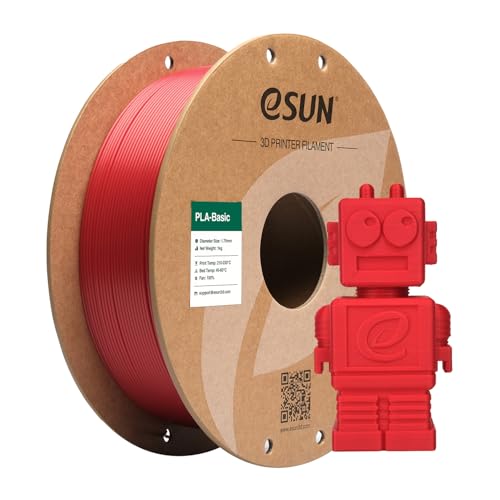

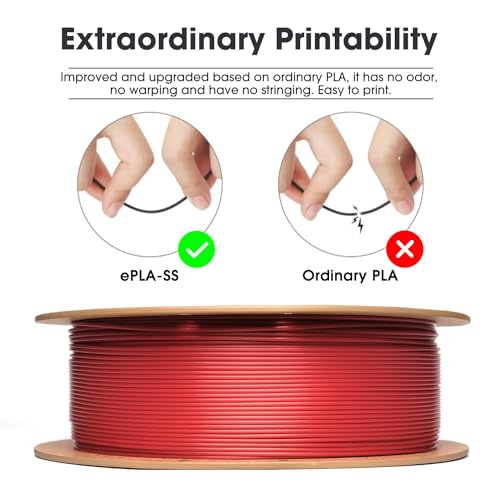

The eSUN Fire Engine Red PLA package is delivered with standard protective essentials aimed at maintaining filament dryness and mechanical readiness before deployment on your machine spool holder.
- 1 kilogram net weight spool of 1.75mm Fire Engine Red PLA Basic filament
- Vacuum-sealed heavy-duty plastic storage bag designed to block ambient humidity
- Internal desiccant packet to absorb residual moisture during storage and transit
- Full 1KG spool reel engineered for uniform diameter tolerance and tangle-free unwinding
- Renewable plant-derived starch raw material composition
High-Speed Extrusion and Flow Dynamics
Operating modern 3D printers at speeds exceeding several hundred millimeters per second requires a material that transitions rapidly from solid to liquid without creating excessive backpressure in the melt zone. The eSUN PLA Basic for high speed printing addresses this dynamic by integrating flow-enhancing modifiers into the polylactic acid matrix. During rapid extrusion cycles, the polymer melts smoothly, allowing the extruder gears to push material consistently without grinding into the filament strand. This heightened fluidity ensures that layer deposition remains unbroken even when accelerations fluctuate dramatically on intricate perimeter paths.
When assessing overall eSUN high speed pla reliability, the primary technical consideration is how the filament maintains wall uniformity under high volumetric flow demands. Standard PLA formulations often exhibit severe under-extrusion when pushed beyond twelve cubic millimeters per second because their melt index cannot keep pace with high feed rates. This Fire Engine Red variant demonstrates noticeably better fluidity, filling infill patterns and outer perimeters evenly. The reduced internal friction during extrusion also lessens the torque load placed on stepper motors, which directly minimizes motor heat buildup during marathon print jobs.
Makers who produce utility prints or custom fixtures, such as mounting brackets intended for consumer gear like a solo stove mesa, must understand that flow speed does not eliminate the physical thermal ceiling of polylactic acid. While this filament flows exceptionally well at elevated speeds, its glass transition range remains unchanged. High-speed printing must still be balanced with adequate part cooling to preserve structural geometry, especially on short layer times where radiant nozzle heat can soften fine details before subsequent layers are deposited.
Spool Winding Consistency and Feed Reliability
Spool integrity is a vital factor in uninterrupted production, as even a minor overlap on the reel can stall a direct drive extruder or trigger an optical runout sensor. The eSUN 1.75mm PLA Basic spool winding is engineered with automated tension control to prevent crossing strands and snarls. The filament sits neatly layer by layer across the 1KG spool reel, allowing the spool to rotate freely on standard roller bearings and internal spindle holders. Consistent diameter tolerance throughout the entire spool ensures that the drive gears experience constant grip without sudden slips or diameter-induced surges.
Mechanical feed reliability also depends heavily on how the filament behaves when uncoiling through reverse-Bowden tubes or multi-material routing paths. Poorly wound spools tend to bite into adjacent loops when pulled with high force, causing the toolhead to starve for plastic mid-print. With eSUN Fire Engine Red PLA, the winding remains stable from the outer perimeter down to the inner core. Users running automated filament management units will appreciate that the spool geometry rotates without excessive friction, preventing the motor stalls that often plague irregularly coiled reels.
Just as stable material tolerances are essential when assembling precision recreational equipment such as a breeo x series fire pit, dimensional consistency across a filament strand is critical for predictable layer adhesion. A diameter deviation exceeding standard bounds can create uneven flow, manifesting as surface banding or under-extrusion. The roundness and tight manufacturing tolerances of this spool ensure that the extruder maintains uniform pressure, leading to clean exterior perimeters free of unsightly flow artifacts.
Thermal Stability and Nozzle Clogging Risks
Minimizing eSUN Fire Engine Red PLA nozzle clogging requires a clear understanding of heat distribution within the extruder assembly. Because this filament melts readily to facilitate fast extrusion, it can be susceptible to heat creep if cooling fans fail to maintain a sharp thermal break. In all-metal hotends operated inside fully enclosed printer chambers, heat traveling upward from the heater block can soften the filament prematurely above the heat break throat. When this happens, the expanded plastic forms a plug that halts extrusion entirely.
To preserve operational reliability, proper eSUN Fire Engine Red PLA print settings must balance melt temperatures with ambient enclosure ventilation. When printing on enclosed CoreXY systems, cracking the chamber door or removing the top panel prevents the internal chamber temperature from approaching the softening point of the raw material. Furthermore, setting retraction distances correctly prevents molten material from being pulled into the cooler zones of the throat where it can solidify and cause catastrophic jams.
When manufacturing functional parts, prototypes, or decorative enclosures near high-heat leisure equipment such as a ninja fireside 360, users must remember that standard polylactic acid formulations will distort under sustained radiant heat. Keeping your printing hotend clean, running regular cold pulls between filament swaps, and verifying that the heat sink cooling fan is functioning at maximum efficiency are the most effective strategies for preventing downtime and avoiding nozzle clogs with this filament.
Packaging Integrity and Moisture Sensitivity
Even the highest quality polylactic acid degrades rapidly when exposed to airborne water vapor, making factory packaging a primary reliability concern. The eSUN Fire Engine Red PLA arrives in a heavy-duty vacuum-sealed pouch containing an active desiccant packet to ensure optimal dryness upon delivery. Unbroken vacuum sealing guarantees that the polymer has not absorbed moisture during warehouse transit, eliminating the risk of steam bubbles, crackling at the nozzle, and excessive stringing on your initial prints.
Once the packaging is unsealed, however, the material immediately begins absorbing moisture from ambient air. Hydrated PLA develops microscopic voids during extrusion, which severely compromises tensile strength along the Z-axis and creates unwanted cosmetic flaws on the print exterior. To maintain the smooth extrusion characteristics advertised in the eSUN PLA Basic specs, users should store the spool inside a dedicated sealed drybox with fresh desiccant whenever it is not mounted on an active printer.
For operations located in regions with high relative humidity, feeding directly from an active heated drybox is recommended for extended multi-day print runs. Maintaining moisture-free filament prevents chemical hydrolysis during melting, which is known to cause brittle extrusion and weak interlayer bonding. The clean factory packaging provides an ideal baseline, but long-term success relies entirely on diligent dry storage practices once the vacuum barrier is breached.
eSUN Fire Engine Red PLA Pros and Cons
Pros
- High melt flow tailored for fast printing
- Automated tangle-free spool winding
- Vacuum sealed with desiccant included
- Broad compatibility across modern FDM machines
- Renewable plant-derived starch composition
Cons
- Low thermal threshold softens in hot environments
- Requires drybox storage after opening
- Unsuitable for high-stress mechanical components
Is the eSUN Fire Engine Red PLA Worth It
Deciding whether this spool represents a sensible investment comes down to your production priorities, hardware setup, and aesthetic requirements. For hobbyists, makers, and print farms running modern fast-feed machines like Bambu Lab, Creality K1, or Voron series printers, this material delivers the rapid flow and consistent diameter needed to maximize machine throughput. The rich, vibrant fire engine red coloration provides excellent visual contrast, making it an outstanding choice for rapid prototyping, cosplay props, display figures, and general educational projects.
Conversely, users who require high-impact mechanical strength, functional components destined for automotive engine bays, or parts exposed to prolonged direct sunlight should look toward engineering-grade filaments like PETG, ABS, or polycarbonate. As a modified polylactic acid, this filament retains the inherent environmental vulnerabilities of plant-based materials, including a low thermal deflection point. If your projects demand heat resistance or UV durability, standard PLA formulations are not the appropriate medium regardless of how fast they print.
Ultimately, if your primary objective is dependable, high-speed everyday printing with minimal stringing and smooth surface finishes, the eSUN Fire Engine Red PLA stands out as a reliable workhorse. When paired with proper retraction calibration, adequate cold-end ventilation, and dry storage, it provides exceptional visual fidelity and mechanical predictability across a broad spectrum of desktop 3D printers.
FAQ
What are the recommended print settings for eSUN Fire Engine Red PLA?
While exact values depend on your specific hotend and motion system, this high-speed material performs best at extrusion temperatures between 200°C and 230°C. Heated print beds should be set between 50°C and 60°C for optimal initial layer adhesion. High-speed setups running at significant volumetric flow rates should target the higher end of the temperature spectrum to ensure complete melting in the hotend.
Does eSUN Fire Engine Red PLA suffer from nozzle clogging during fast extrusion?
Under normal conditions with proper cooling, the filament feeds smoothly without clogging the nozzle or extruder. Clogs typically occur only when excessive heat creep develops in poorly ventilated all-metal hotends or when retracting molten filament too far up into the cold zone. Maintaining adequate heatsink fan airflow prevents these feed complications.
How does eSUN 1.75mm PLA Basic spool winding prevent tangles?
The spool is wound using automated precision machinery that layers the strand evenly across the full width of the reel. Because filament loops cannot naturally cross under tension during manufacturing, tangles only occur if the loose end is released and allowed to slip underneath adjacent coils during handling. Always secure the strand end in the designated spool rim holes when not in use.
Is eSUN Fire Engine Red PLA suitable for outdoor functional prints?
No, standard PLA formulations are not recommended for sustained outdoor use. Extended exposure to direct sunlight and outdoor temperatures above 50°C can cause the material to soften, warp, and degrade. For outdoor functional items, UV-resistant materials such as ASA or PETG are far better suited.
Which 3D printers are compatible with eSUN Fire Engine Red PLA?
This filament is broadly compatible with most 1.75mm FDM 3D printers and high-speed motion platforms. Verified systems include the Bambu Lab P1P, P1S, X1, X1C, A1, and A1 mini; Creality K1, K1 Max, Ender 3, and Ender 7; AnkerMake M5; Voron 2.4; FLSUN V400; Prusa MK3 and subsequent revisions; as well as UltiMaker, MakerBot, Flashforge, and Raise3D machines.


