As Amazon Associates, we earn from qualifying purchases. This means we may receive a small commission at no extra cost to you if you click through and make a purchase.
Heating System
ThermoJet Instant Heating Technology
Water Reservoir Capacity
47 Fluid Ounces
Portafilter Size
54mm (19 Gram Capacity)
Product Weight
10.9 Pounds
The operational limits, dimensions, and electrical demands of the Breville Bambino BES450BSS are outlined in the specification table below:
Full spec sheet 8 more rows from the listing
| Model Number | BES450BSS |
| Warm-Up Time | 3 Seconds |
| Temperature Control | Digital PID Temperature Regulation |
| Power Consumption | 1560 Watts |
| Voltage Requirement | 110 to 120 Volts |
| Control Interface | Push Buttons (1-Cup, 2-Cup, Hot Water, Steam) |
| Dimensions (D x W x H) | 13.7 x 6.3 x 12.0 Inches |
| Manufacturer Warranty | 1-Year Limited Product Warranty |
Selecting an entry-level espresso machine often forces buyers to balance modern convenience against long-term mechanical dependability. The Breville Bambino, designated under model number BES450BSS, is engineered specifically for home baristas who want cafe-style extraction without the prolonged warm-up times and sprawling footprints typical of traditional commercial setups. Utilizing an instantaneous heating element, digital PID temperature management, and a standard 54mm portafilter, the brushed stainless steel unit is designed to pull balanced shots using 19 grams of ground coffee while fitting into tight spaces. However, prospective buyers must recognize that compact engineering introduces distinct trade-offs in thermal mass, component longevity, and daily maintenance routines that differ significantly from heavier, boiler-based espresso appliances.
This critical evaluation examines what owners can realistically expect from the machine over months and years of continuous operation. Drawing directly from published technical specifications and mechanical requirements, we evaluate the durability of the internal heating pathways, analyze common maintenance friction points, and review how the manufacturer handles component failures under its limited warranty coverage. Whether you are investigating the unit as your first step into specialty espresso or comparing it to benchmarks discussed across our wider Breville Bambino espresso machine coverage, this analysis provides the practical data required to decide if the BES450BSS can meet your daily brewing expectations.
What You Get With the Breville Bambino


Unboxing the Breville Bambino reveals a focused hardware package designed to accommodate both beginner pre-ground coffee users and home baristas who grind fresh whole beans. The equipment supplied directly in the retail box includes:
- Breville Bambino BES450BSS espresso machine in brushed stainless steel finish
- 54mm stainless steel portafilter designed for 19-gram doses
- 1-cup single wall filter basket for freshly ground specialty beans
- 2-cup single wall filter basket for double extractions
- 1-cup dual wall filter basket for pre-ground coffee extraction
- 2-cup dual wall filter basket for pressurized brewing
- Manual coffee tamper sized for the 54mm basket diameter
- Stainless steel milk frothing jug
- Steam wand tip cleaning tool for clearing milk deposits
- Starter packet of descaling powder
- Removable 47 fluid ounce rear water reservoir
- Voucher program providing two complimentary bags of specialty coffee upon official machine registration
ThermoJet Heating Longevity and Component Wear
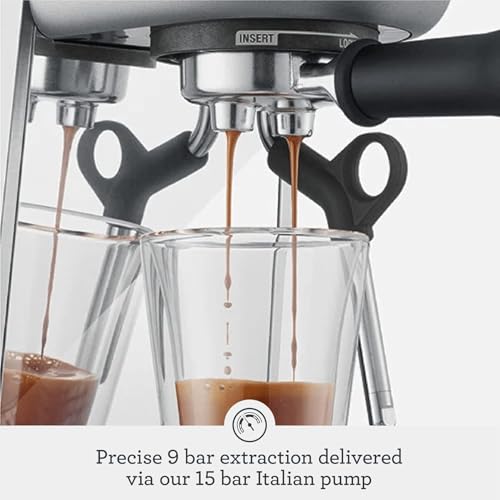
The foundational selling point of the Breville Bambino specs is the proprietary ThermoJet heating architecture. Traditional home espresso makers rely on brass or stainless steel boilers that heat a reservoir of water over ten to twenty minutes. In contrast, Breville Bambino thermojet heating uses an ultra-low-mass internal coil powered by 1560 watts that brings flowing water to optimal extraction temperature in just three seconds. This instantaneous transition eliminates waiting times for your morning routine, and the integrated PID digital controller actively monitors water temperature to prevent excessive thermal swings. Additionally, the system incorporates low-pressure pre-infusion, gradually raising water pressure at the start of brewing to expand the coffee puck evenly before reaching full extraction pressure.
While the thermal efficiency of the ThermoJet is undeniable, the physical reality of rapid thermal cycling presents specific engineering concerns for long-term Breville Bambino reliability. Because the heating path heats and cools rapidly dozens of times per week, the miniature fluid lines and internal silicone connectors experience continuous mechanical expansion and contraction. Over extended periods, rapid thermal expansion can stress internal seals faster than the passive heat cycles seen in conventional single-boiler machines. Furthermore, the absence of a large thermal mass means the group head does not retain ambient heat; the physical metal of the group and portafilter must be warmed by running a manual blank water shot prior to brewing your first espresso.
When evaluated against larger sister appliances like the Breville Bambino Plus espresso machine, which shares a similar ThermoJet core, buyers must understand that the BES450BSS lacks an automated purging cycle for its steam circuit. Temperature stability depends entirely on the digital PID adjusting water pulses on the fly. For households pulling one or two drinks daily, this design provides years of responsive heating, but high-volume environments demanding back-to-back shots will push this lightweight thermal block to its operating limits, occasionally requiring short rests between intense steaming and extraction cycles.
Routine Maintenance Cycles and Descaling Demands
Water chemistry and preventative upkeep govern the functional lifespan of any home espresso maker, but Breville Bambino maintenance is especially critical due to the microscopic passages inside the ThermoJet block. Because the water paths inside the instantaneous coil are exceptionally narrow, mineral accumulation can restrict flow far more rapidly than in wide boiler tanks. Even modest calcium deposits cause noticeable drop-offs in water flow, incomplete shot volumes, or lukewarm extractions. If scale hardens inside the heating element, water cannot pass through, rendering the appliance completely inoperable.
Consequently, managing Breville Bambino descaling problems requires strict adherence to maintenance alerts. The machine features automated button alerts that signal when a descaling cycle is mandatory. Users must dissolve the included descaling powder into the 47-fluid-ounce water reservoir and initiate the automated flush sequence. A critical operational failure occurs when users delay this cycle: modern Breville logic boards can lock the machine out of standard brewing functions until the full descaling cycle is run to completion. Using pre-filtered water with low mineral content minimizes scale accumulation, yet periodic chemical flushing remains non-negotiable for long-term operation.
Milk system upkeep requires equal discipline. Unlike automated milk appliances, the BES450BSS utilizes a manual steam wand that allows operators to texture microfoam for latte art using the included stainless steel jug. However, residual milk fats quickly bake onto the wand’s interior and tip orifice if not cleared immediately. The user must manually activate the steam valve for several seconds after every use to blow out milk droplets and wipe down the exterior casing. If the wand loses pressure or stops dispensing steam entirely, operators must use the included steam wand tip cleaning tool to unblock the tiny outlet apertures.
Warranty Realities and Long-Term Support Limits
Consumer protections for the BES450BSS are governed by the manufacturer’s 1-Year Limited Product Warranty. This coverage protects the original purchaser against verified defects in materials and factory workmanship under ordinary domestic operating conditions. If an internal pump fails, a logic board stops responding, or the heating block experiences an electrical open circuit within the first 365 days, the manufacturer will repair or replace the hardware at its discretion. The company also offers an incentive program providing two free bags of specialty coffee upon registration, encouraging owners to log their serial numbers promptly after purchase.
However, navigating Breville Bambino warranty support requires an understanding of what the limited policy excludes. Warranty claims routinely reject damage caused by mineral scale buildup, user neglect, using incorrect voltages, or operating the machine commercially in an office setting. If internal lines calcify because regular descaling schedules were ignored, repairs are classified as preventable customer neglect, leaving the owner responsible for service costs or product replacement. Furthermore, warranty fulfillment typically requires shipping the entire 10.9-pound unit to an authorized service facility, which can leave coffee drinkers without an espresso machine for multiple weeks during testing and repair.
After the one-year warranty period expires, long-term support presents unique challenges typical of compact appliances. Traditional, heavier espresso machines built with commercial-off-the-shelf valves, such as those found on simpler mechanical appliances like the De’Longhi Stilosa manual espresso machine, can often be repaired using universal brass fittings and generic pumps. The Breville Bambino, by contrast, relies heavily on proprietary molded sub-assemblies, custom solenoid configurations, and integrated electronic logic boards. While exterior accessories like the 54mm portafilter, single wall baskets, and dual wall baskets are easily replaced, repairing internal electronic faults out of warranty frequently proves cost-prohibitive compared to full replacement.
Countertop Stability and Workflow in Small Kitchens
Countertop real estate is a primary constraint for urban apartments, shared galley kitchens, and compact coffee bars. Measuring 6.3 inches wide, 13.7 inches deep, and 12 inches high, the Breville Bambino for small kitchens is one of the narrowest semi-automatic espresso machines available. It slides comfortably beneath standard upper cabinetry and claims less space than a standard four-slice toaster. Its 47-fluid-ounce reservoir is positioned vertically at the rear, keeping overall width minimal while providing enough water volume for multiple consecutive days of single-cup brewing.
Nevertheless, the machine’s compact physical footprint introduces practical workflow compromises directly tied to its 10.9-pound weight. Because the chassis is constructed from lightweight materials wrapped in a brushed stainless steel outer skin, the unit lacks the physical ballast of heavier commercial machines. Locking the 54mm portafilter into the group head creates substantial rotational torque. When users attempt to lock the handle with one hand, the entire machine tends to slide or twist across the countertop. Operating the Bambino cleanly requires placing your free hand firmly on top of the machine casing to stabilize the frame while locking the portafilter into the brewing gasket.
Workflow navigation also involves learning the simplified button interface. The front control panel features dedicated push buttons for single-cup extraction, double-cup extraction, hot water dispensing, and steam activation. While the interface is clean and uncluttered, the compact drip tray fills rapidly. The machine discharges internal pressure relief and flush water directly into the lower basin, meaning the shallow tray must be emptied and rinsed every few shot cycles to prevent countertop spills. For users with limited workspace, keeping a waste cloth nearby is an essential operational habit.
Breville Bambino Pros and Cons
Pros
- Instant three-second ThermoJet heat-up time
- Digital PID temperature control for consistent extraction
- Pre-infusion gradually increases pressure for balanced flavor
- Includes both single wall and dual wall baskets
- Ultra-compact 6.3-inch width fits small kitchens
- Complete accessory kit includes tamper and milk jug
Cons
- Lightweight chassis shifts when locking the portafilter
- Narrow internal heating lines require frequent descaling
- Shallow drip tray fills quickly and requires frequent emptying
Is the Breville Bambino Worth It
Determining whether the Breville Bambino is worth it comes down to matching your expectations against its specific design strengths and operational limits. For espresso novices, busy professionals, and households with limited counter space, the machine delivers exceptional value. The three-second warm-up time from the ThermoJet system eliminates the friction of waiting for a machine to heat up before work, while the inclusion of both single wall baskets for fresh coffee grinding and dual wall baskets for pre-ground grocery coffee allows users to develop their barista skills at their own pace.
Conversely, the machine is not well-suited for high-volume environments or hobbyists seeking a permanent, decades-long mechanical appliance. The reliance on lightweight components, combined with the susceptibility of the narrow ThermoJet lines to scale clogs, means this appliance demands meticulous cleaning and water filtration to achieve a long working lifespan. Those who prioritize heavy, all-metal industrial construction that can be disassembled with standard hand tools will find the compact, electronic-heavy layout restrictive.
Ultimately, the Breville Bambino BES450BSS excels at its intended mission: delivering genuine espresso extractions, precise digital PID temperature control, and manual microfoam texturing inside an impossibly slim format. If you are willing to use scale-free water, perform the necessary descaling cycles, and hold the top of the chassis when mounting the portafilter, this machine provides an authentic espresso workflow without demanding extensive kitchen real estate.
FAQ
How does the ThermoJet heating system work on the Breville Bambino?
The ThermoJet heating system uses an instantaneous internal coil powered by 1560 watts to heat flowing water directly on demand rather than storing water in a traditional boiler. This technology allows the machine to reach optimal espresso extraction temperature in three seconds, significantly reducing standby power consumption and warm-up waiting time.
What should you do if the Breville Bambino steam wand stops flowing?
If the steam wand loses pressure or stops emitting steam, dried milk solids have likely clogged the small opening at the tip. Use the steam wand tip cleaning tool included in the machine packaging to push through the nozzle hole and clear the blockage. After clearing the opening, run the manual steam function into an empty vessel to purge any remaining debris.
How often does the Breville Bambino require descaling?
The frequency of descaling depends on your household water hardness and daily shot volume, but the machine is programmed with an internal alert system that flashes button indicators when a cleaning cycle is due. In typical home environments, owners should expect to run a descaling cycle using the manufacturer-approved descaling powder every two to three months to prevent internal blockage of the ThermoJet pathways.
Can the Breville Bambino pull back-to-back espresso shots reliably?
Yes, the 1560-watt heating system recovers temperature almost instantly, allowing you to pull consecutive shots without long thermal recovery periods. However, because the machine lacks a massive commercial group head, you should run a brief blank water shot through the portafilter before the first extraction to ensure the metal basket and group gasket are thoroughly preheated.
What is covered under the Breville Bambino one-year warranty?
The 1-Year Limited Product Warranty covers repair or hardware replacement for defects arising from faulty materials or factory assembly during standard personal household use. It explicitly does not cover physical damage from accidents, commercial usage, or internal component failures caused by mineral scale buildup resulting from failure to descale the unit.