As Amazon Associates, we earn from qualifying purchases. This means we may receive a small commission at no extra cost to you if you click through and make a purchase.
Product Dimensions
16.61 x 7.36 x 6.42 inches
Supported Platforms
xTool P Series (P2 & P2S)
Attachment Modules
Chuck, Roller, Sphere, Ring
Chuck Diameter
130mm
Full spec sheet 7 more rows from the listing
| Brand | xTool |
| Manufacturer | Makeblock Co., Ltd. |
| Model Number | MXA-P004-001 |
| Alignment System | 360° LiDAR Mapping Alignment |
| Special Features | MagSwap Quick-Swap, Auto Mode Recognition, 3D Preview |
| Recommended Uses | Engraving, Drilling, Sanding |
| Manufacturer Warranty | 12 Months |
Laser operators researching the xtool m2 rotary attachment are frequently searching for an upgrade path or cross-compatibility across desktop machines, but hardware clarity is essential before making an investment. The xTool RA3 is designed specifically for the xTool P Series ecosystem, built natively for the P2 and P2S CO2 laser cutters rather than diode-based desktop units. Misunderstandings around rotary sizing and machine generations often lead buyers to purchase accessories their chassis cannot physically or electronically support. This evaluation breaks down the engineering behind the unit, examining its mechanical structure, magnetic modularity, and real-world operational constraints.
Throughout this breakdown, we examine whether the switch to a tool-free magnetic design compromises mechanical rigidity during long production runs. We also evaluate how the integrated 360-degree LiDAR mapping system interacts with cylindrical substrates, what the manufacturer warranty actually protects, and how its batch capabilities perform under continuous shop use. By looking closely at the hardware limitations and setup requirements, you can decide whether this specialized rotary system matches your studio workflow.
What You Get With the xTool RA3
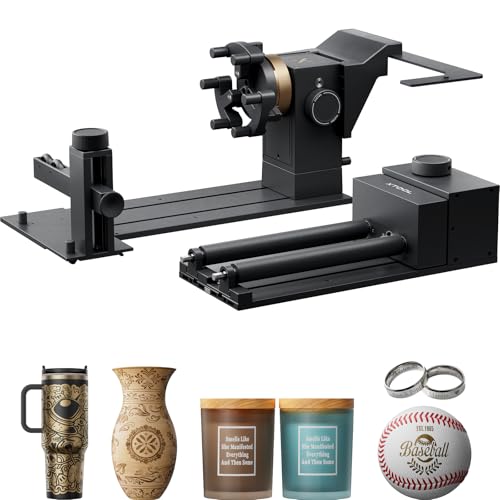


The xTool RA3 package is centered around modularity, packaging four dedicated operational modes into a single reconfigurable chassis driven by magnetic alignment rather than manual hardware fastening.
- MagSwap tool-free quick-swap base mechanism designed for rapid component transitions.
- Four interchangeable engraving configurations including chuck, roller, sphere, and ring fixtures.
- Enlarged 130mm chuck attachment engineered to secure wider cylindrical vessels and tapered items.
- One-step inner ring angle adjustment bracket dedicated to inside-diameter jewelry engraving.
- LiDAR-assisted automatic mode recognition, 360-degree surface mapping, auto-focus, and software 3D preview.
- Integrated batch processing support across both roller and jaw configurations.
- Single-unit packaging listed under model number MXA-P004-001 with P2 and P2S system compatibility.
Platform Compatibility and Series Exclusivity
The most critical factor prospective buyers must address is the strict hardware boundary defining this accessory. While hobbyists frequently inquire about an xtool m2 rotary attachment or search for ways to adapt newer components to open-frame diode engravers like the xtool d1 pro, the listing explicitly notes that the RA3 is currently exclusive to the P Series. The unit requires direct mechanical and electronic synchronization with the enclosed gantry, motorized z-axis, and sensor suite found exclusively on the P2 and P2S CO2 machines.
This exclusivity stems from the automated communication loop between the rotary and the laser enclosure. The xtool ra3 rotary compatibility relies on automatic mode recognition and sensor data exchange that legacy diode platforms simply do not possess. If you operate an M-series hybrid, an open-frame frame machine, or a third-party laser, the RA3 cannot function as a plug-and-play accessory. Attempting to force physical compatibility into non-supported enclosures bypasses the safety interlocks and electronic signaling required for operation.
For current owners of P Series hardware, this tight integration eliminates the guesswork of auxiliary wiring and custom height risers. The rotary dimensions of 16.61 by 7.36 by 6.42 inches are tailored to sit within the lower cavity of the P2 chassis. However, treating this attachment as a universal shop tool is a mistake. Buyers must confirm their base machine model before purchasing, as the manufacturer provides no mounting adapters or firmware profiles for external or older hardware lines.
MagSwap Mechanism and Long-Term Mechanical Reliability
The defining mechanical innovation highlighted in the xtool ra3 rotary attachment specs is the MagSwap tool-free quick-swap interface. Traditional laser rotaries depend on hex bolts, thumb screws, and manual jaw adjustments that require external hand tools whenever transitioning between a wine glass and a tumbler. The RA3 replaces mechanical fasteners with magnetic docking points for the chuck, rollers, sphere bracket, and ring assembly. In theory, this cuts downtime between varied engraving jobs down to mere seconds.
From a reliability perspective, evaluating xtool magswap reliability requires a realistic view of workshop physics. Magnetic coupling delivers speed, but rotary engraving introduces continuous rotational inertia, particularly when accelerating and decelerating heavy drinkware. While the magnets are engineered to hold components firmly during standard rotational indexing, operators must remain vigilant about fine debris. Laser processing inevitably generates airborne particulate, carbon dust, and vaporized coatings. Over time, microscopic metallic or abrasive particles can collect around magnetic seatings, introducing minute leveling errors if mating surfaces are not routinely wiped down.
Another practical consideration is structural wear on the interchangeable jaws. The listing emphasizes that assembly, jaw adjustment, and fixture swaps occur without screws. For high-volume production studios running continuous shifts, magnetic latches eliminate stripped screw threads, which is a common failure point on older aluminum fixtures. However, users must avoid dropping or forcefully jarring the magnetic modules, as chipped magnetic casings or misaligned contact faces will directly compromise the concentric rotation required for fine-pitch vector passes.
LiDAR Mapping Integration and Alignment Performance
Alignment errors remain the primary cause of ruined inventory when engraving cylindrical substrates, which makes the inclusion of 360-degree LiDAR mapping alignment central to the RA3 value proposition. Traditional rotary work requires manual focus sticks, visual crosshair positioning, and mathematical circumference calculations in software. On the RA3, the system utilizes the machine’s onboard LiDAR sensor to execute automatic mode recognition, 3D surface previewing, and automated height focusing before the beam fires.
This automated loop directly tackles common xtool rotary laser alignment issues such as rotational slip and optical distortion. By scanning the outer profile of an irregular object, the software generates a true 3D preview, allowing operators to position text and vector graphics across tapered walls without manual wrap calculations. This capability is especially beneficial for complete 360-degree wrap designs on wide vases or bottles where a fraction of a millimeter of drift would create a visible seam.
Despite these smart safeguards, optical sensors are not entirely immune to environmental challenges. Highly reflective metals, clear glass without marking spray, or high-gloss tumbler coatings can occasionally scatter LiDAR beams if surface conditions alter optical refraction. Operators working in busy production environments must ensure the laser carriage optics and rotary sensors remain free from smoke film. Automated alignment dramatically reduces initial setup friction, but regular lens inspection remains mandatory to keep the 3D surface mapping reliable across diverse materials.
Workflow Performance for Tumblers, Rings, and Bulk Runs
Commercial viability hinges on how smoothly an attachment processes everyday orders, and using the xtool ra3 for tumbler engraving reveals clear workflow gains over earlier mechanical revisions. The enlarged 130mm chuck provides substantial gripping surface, accommodating wide-mouth insulated mugs and larger glassware without requiring secondary riser blocks. Paired with batch processing options across both roller and jaw configurations, the RA3 allows operators to process repetitive cylindrical jobs with minimal manual realignment between cycles.
Jewelry personalization presents unique spatial challenges, which the hardware addresses through a dedicated xtool ra3 ring attachment setup. Small items like wedding bands require precise holding force to prevent surface scratching while ensuring the laser maintains accurate focal distance on curved internal diameters. The RA3 incorporates a one-step inner ring angle adjustment mechanism, enabling users to tilt and secure rings without disassembling the primary chuck spindle. This eliminates the tedious shimming often required on generic three-jaw lathe fixtures.
When weighing the xtool ra3 vs ra2 pro, the operational distinction centers primarily on speed of conversion and workflow automation. Where the older ra2 pro rotary relies on manual fastener adjustments and standard measurement inputs, the RA3 integrates intelligent recognition directly into the software interface. For shops transitioning from sporadic rotary jobs to high-quantity drinkware runs, the combination of the 130mm chuck, magnetic jaw swapping, and batch modes significantly cuts physical handling time per finished piece.
xTool RA3 Pros and Cons
Pros
- Tool-free MagSwap quick-change attachment system
- Four operational modes for chuck roller sphere ring
- 360-degree LiDAR mapping with automatic mode recognition
- Enlarged 130mm chuck for large-diameter workpieces
- Integrated batch processing for roller and jaw modes
Cons
- Strictly exclusive to xTool P Series machines
- Magnets susceptible to debris accumulation over time
- Standard 12-month manufacturer warranty duration
Is the xTool RA3 Worth It
Deciding whether to buy the RA3 depends entirely on your current laser chassis and order volume. If you are asking is xtool ra3 worth it while operating a desktop diode system or seeking an entry-level universal tool, the answer is straightforward: no. The strict restriction to P Series machines makes the RA3 an unusable accessory for unsupported hardware. Investing in this rotary without owning a P2 or P2S laser will leave you with an incompatible mechanical module that cannot interface with your machine software.
For dedicated P2 and P2S production shops, the assessment changes considerably. The integration of the MagSwap architecture, 130mm chuck capacity, and 360-degree LiDAR mapping eliminates the most frustrating bottlenecks of rotary production. Being able to transition between an insulated travel mug on the rollers, a curved glass vase in the chuck, and an inside-diameter ring on the jewelry mount without reaching for hex keys transforms daily workshop efficiency. For commercial studios processing custom merchandise daily, the reduction in alignment scrap and setup labor quickly justifies the upgrade.
Buyers should also take note of the xtool rotary attachment warranty provided by Makeblock Co., Ltd., which guarantees the hardware against manufacturing defects for 12 months. This one-year warranty period matches standard desktop laser equipment terms, but it underscores the need to maintain magnetic contacts and mechanical chuck jaws properly. If your shop demands high throughput, rapid material transitions, and operates within the P Series ecosystem, the RA3 provides a refined, production-focused tooling platform.
FAQ
Can the xTool RA3 work on diode lasers or desktop M-series units?
No. The listing explicitly states that the RA3 is currently exclusive to the P Series, which encompasses the P2 and P2S CO2 laser systems. It relies on specific structural dimensions, electronic connections, and LiDAR sensor integration that are not compatible with desktop diode platforms or M-series machines.
How does the MagSwap system secure heavy objects without screws?
The MagSwap design uses high-strength magnetic docking interfaces to lock the chuck, roller, sphere, and ring fixtures to the rotary drive base. The clamping force of the enlarged 130mm chuck itself holds the workpiece securely, while the magnetic base maintains alignment with the rotary drive mechanism during rotation.
What does the 12-month manufacturer warranty cover on the RA3?
The 12-month warranty from Makeblock Co., Ltd. covers defects in materials and manufacturing under normal operational use. It does not cover wear and tear from uncleaned debris buildup, physical drops, or damage caused by forcing the unit into incompatible laser enclosures.
How does LiDAR mapping resolve rotary laser alignment issues?
The 360-degree LiDAR mapping system scans the exact contour of the placed object, providing automated height focusing, automatic attachment mode detection, and a virtual 3D software preview. This removes the manual measurement steps that typically cause scale distortion or misaligned wrap seams on curved items.
What is the maximum diameter supported by the RA3 chuck?
The RA3 features an enlarged 130mm chuck attachment designed to accommodate large-diameter items such as wide vessels, bowls, and oversized drinkware, offering greater clearance than standard compact rotary fixtures.


