As Amazon Associates, we earn from qualifying purchases. This means we may receive a small commission at no extra cost to you if you click through and make a purchase.
Local Storage Included
64GB microSD card pre-installed in the hub
Video Capture Resolution
4K Ultra HD (8 MP photo sensor resolution)
Power Architecture
Solar panel powered with integrated rechargeable battery (100% wireless)
Viewing Angle
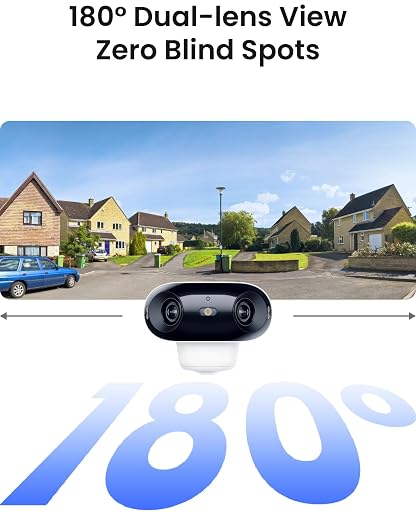
180-degree seamless ultra-wide stitched dual-lens field of view
Full spec sheet 7 more rows from the listing
| Night Vision Hardware | ColorX technology (F/1.0 aperture, 1/1.8-inch sensor, zero spotlights or IR needed) |
| Expandable Storage Capacity | Dual card slots supporting up to two 1TB microSD cards (2TB total) |
| Hub Device Capacity | Connects and manages up to 8 Reolink cameras with no monthly fee |
| Wireless Technology | Wi-Fi wireless communication protocol |
| Smart Motion Detection | Onboard artificial intelligence for humans, vehicles, and pets |
| Mounting Type | Screw-in wall mount hardware engineered for outdoor and garage installations |
| Smart Home Compatibility | Amazon Alexa controller support and companion smartphone app |
The Reolink Home Hub 4K security camera system directly addresses one of the most frustrating aspects of modern residential surveillance: ongoing subscription fees tied to cloud-locked video recording. By pairing a centralized management console with wire-free, dual-lens outdoor cameras, this setup creates an independent perimeter defense platform that keeps all footage firmly under your local control. The core appeal rests on its 180-degree stitched 4K panoramic field of view and full-color night imaging, designed to eliminate blind spots without requiring monthly data contracts or commercial monitoring subscriptions.
Determining whether this hardware package delivers dependable long-term protection requires looking beyond promotional highlights and evaluating real-world operational constraints. In this review, we examine the local storage architecture, evaluate wireless transmission reliability through residential walls, analyze the endurance of solar-assisted battery power, and scrutinize hardware durability. We also assess on-device smart detection accuracy, Alexa platform integration, and how the system performs when disconnected from the broader internet.
What You Get With the Reolink Home Hub 4K



The system is packaged as an all-in-one wireless outdoor surveillance kit engineered to operate without external recording subscriptions or complex electrical wiring.
- Dual-lens 4K outdoor security cameras providing a seamless 180-degree blindspot-free perspective.
- Reolink Home Hub centralized management console supporting up to eight wireless cameras.
- Pre-installed 64GB microSD card inside the hub for instant out-of-the-box local storage.
- Dual microSD card expansion slots accommodating up to two 1TB cards for a maximum 2TB capacity.
- High-efficiency solar panels paired with integrated rechargeable batteries for wire-free outdoor use.
- ColorX night vision optics featuring an F/1.0 wide aperture and a large 1/1.8-inch photo sensor.
- Onboard intelligent detection algorithms capable of distinguishing humans, vehicles, and animals.
- Wall mount brackets and screw-in hardware designed for outdoor structures such as garage exteriors.
- Integrated 10x digital zoom controls operated directly through the smartphone application.
- Voice command integration and smart home ecosystem support compatible with Amazon Alexa.
Local Storage Reliability and MicroSD Card Limits
Local recording is the operational backbone of this surveillance package, eliminating recurring service subscriptions in favor of direct on-premises data retention. The system ships with a 64GB microSD card housed directly within the indoor hub, keeping your recordings physically secure inside your home rather than exposed on outdoor camera bodies where a thief could tamper with them. With dual expansion slots capable of housing two separate 1TB microSD cards, users can scale their storage ceiling up to 2TB. This centralized architecture provides substantial space for motion clips captured across multiple camera channels.
Long-term reolink home hub local storage reliability depends heavily on the grade of memory card you deploy. Flash memory has a finite number of write-and-erase cycles, and continuous event logging across multiple 4K cameras produces heavy input-output traffic. While buyers evaluating compact setups often cross-shop hardware like the reolink mini hub, this dual-slot hub gives you the physical runway for higher capacity. To prevent card corruption or premature write failure, owners must bypass standard consumer microSD cards in favor of high-endurance, video-rated cards specifically formulated for continuous surveillance overwrites.
Another major advantage of this architecture is reolink home hub 4k offline recording. Because the cameras communicate wirelessly with the hub over local network protocols, the system continues to capture motion triggers, execute on-device AI classifications, and commit high-resolution video directly to the internal storage even during an active internet outage. While off-site smartphone notifications pause until broadband access returns, your property remains fully guarded, ensuring an intentional ISP cable cut does not blind your perimeter defenses.
Dual-Lens 180-Degree Image Quality and ColorX Night Performance
The standout physical feature of the cameras is the dual-lens configuration, engineered to solve the narrow tunnel-vision problem common to standard fixed-lens cameras. The reolink 4k dual lens camera setup captures two distinct visual feeds and stitches them internally into a single, seamless 180-degree panoramic view. This wide field of view eliminates the blind spots that typically plague corners, driveways, and broad property lines. Producing an effective 8 MP still and 4K video resolution across this ultra-wide span ensures structural edges, license plates, and fence boundaries remain clearly defined.
Night surveillance is handled through ColorX optical engineering, which takes a radically different approach from traditional night vision cameras. By pairing a massive F/1.0 aperture lens with a large 1/1.8-inch optical sensor, the camera gathers significantly more ambient light from surrounding streetlamps, porch lights, or the moon. Consequently, it renders true-to-life full-color video in near darkness without triggering bright, blinding white spotlights or relying on visible red infrared LEDs. When compared to high-end wire-free platforms like the arlo ultra 3 4k hdr camera, avoiding intrusive floodlights helps the camera blend discreetly into exterior architecture while maintaining full color recognition of clothing and vehicle hues.
Digital magnification remains an area where buyers must maintain realistic expectations. The companion smartphone app provides a 10x digital zoom feature, allowing you to crop into specific sectors of the 180-degree image frame. However, digital enlargement simply scales up existing pixel data rather than optically adjusting focal length. While zooming in is useful for identifying clothing textures or general vehicle shapes within close-to-medium range, fine distant details such as registration numbers across a broad roadway will inevitably soften at full magnification.
Solar Power Delivery and Battery Maintenance Realities
Achieving a completely wire-free installation requires a dependable power generation and storage cycle. The cameras pair an integrated rechargeable battery with dedicated solar panels, allowing you to install the units on detached garages, perimeter fence posts, or exterior walls without running high-voltage wiring. Setting up the hardware requires only the provided screw-in wall mount, making structural placement straightforward on wood siding, brick, or masonry.
Potential reolink home hub battery life issues rarely stem from cell defects; instead, they are almost always caused by improper power budgeting and adverse environmental conditions. Battery-powered security cameras operate on a sleep-and-wake cycle, using passive infrared detection to trigger recording only when activity occurs. If a camera is oriented toward a busy public sidewalk or swaying tree limbs, hundreds of false triggers will drain the battery faster than the solar panel can replenish it. Configuring the onboard AI to filter exclusively for humans, vehicles, or animals is essential for preserving cell longevity.
Winter conditions present an unavoidable hurdle for solar-dependent hardware. Shorter daylight hours, low sun angles, heavy cloud cover, and surface snow accumulation all degrade panel efficiency. Concurrently, sub-freezing ambient temperatures temporarily lower lithium-ion battery capacity. Maintaining uninterrupted power during harsh winter stretches requires angling the solar panel toward unobstructed southern skies and occasionally brushing away accumulated frost and debris.
Wireless Transmission Stability and Smart Home Ecosystem Support
As a completely wireless system, communication between the cameras and the central hub relies entirely on local Wi-Fi. The reolink home hub 4k security camera system centralizes management by acting as a dedicated access point for up to eight separate cameras. This dedicated local connection offloads camera traffic from your primary home Wi-Fi network, preserving bandwidth for streaming, gaming, and remote work. However, pushing heavy 4K video streams across long outdoor distances requires careful hub placement inside the home, keeping interior walls, metal ductwork, and brick siding to an absolute minimum between devices.
Smart home integration is tailored around the Amazon Alexa ecosystem. Users can link the hub to their Amazon account and issue voice commands to stream live camera feeds directly to connected smart screens. When managing outdoor views from a countertop device like the echo show 8, the 180-degree feed provides an immediate, wide-angle snapshot of driveway activity. Latency over local Wi-Fi remains minimal, allowing homeowners to quickly verify delivery arrivals or inspect strange noises outside.
Larger wall-mounted command centers such as the echo show 15 also integrate smoothly with the hub, serving as dedicated monitoring panels in kitchens or entryways. The smartphone application provides granular configuration controls, letting you adjust detection sensitivity zones, set privacy masking, schedule push notifications, and review stored timeline clips without paying software access fees. Managing all eight camera channels from a single dashboard simplifies daily operation, particularly for sprawling properties requiring multiple viewing angles.
Reolink Home Hub 4K Pros and Cons
Pros
- Seamless 180-degree 4K dual-lens panoramic perspective
- ColorX night vision with wide F/1.0 aperture
- Expandable local storage up to 2TB without subscriptions
- Hub manages up to eight wireless security cameras
- On-device AI human, vehicle, and pet filtering
Cons
- Event-triggered recording only, no continuous 24/7 recording
- Battery charging depends heavily on direct solar exposure
- 10x digital zoom loses clarity at distant ranges
Is the Reolink Home Hub 4K Worth It
Evaluating whether this surveillance kit justifies the investment depends entirely on your property layout and monitoring preferences. For homeowners who refuse to pay mandatory monthly subscriptions, prioritize data privacy, and require broad perimeter coverage, the answer to whether the package is worth it is an unequivocal yes. Combining two 180-degree panoramic cameras with an expandable local storage hub delivers a modern, high-resolution surveillance footprint that operates independently of third-party cloud servers.
Conversely, this hardware will disappoint buyers looking for continuous, frame-by-frame 24/7 video recording. Because the cameras are battery-driven and solar-supplemented, they are strictly engineered for event-based surveillance. Attempting to force continuous recording onto wire-free cameras will deplete the internal batteries within days, regardless of solar panel attachment. Properties blanketed by dense tree canopies that block solar exposure or buyers requiring optical telephoto lenses should bypass battery setups in favor of a commercial-grade, hardwired PoE NVR system.
Long-term peace of mind also hinges on reolink home hub warranty and support considerations. Because the hub and cameras rely on proprietary firmware to manage image stitching, wireless handshakes, and smart detection models, regular software updates are vital. The hardware build quality is physically robust and well-sealed against outdoor elements, but maintaining proper registration and keeping track of official support documentation ensures that hardware issues or firmware inquiries are handled promptly throughout the lifespan of the equipment.
FAQ
Does the Reolink Home Hub 4K require an ongoing monthly subscription?
No, the system operates completely free of mandatory monthly service fees. Video recordings are stored directly on the indoor hub’s pre-installed 64GB microSD card, and the companion smartphone application provides live streaming, clip playback, and push notifications without subscription paywalls.
Can the Reolink Home Hub 4K record video continuously 24/7?
No, these cameras are engineered specifically for motion-activated event recording. Because they rely on solar panels and integrated rechargeable batteries, continuous 24/7 recording would exhaust the battery reserves faster than solar energy can replenish them. Those requiring non-stop recording should consider a hardwired PoE system.
How does Reolink Home Hub 4K offline recording function without internet?
The cameras transmit video feeds directly to the indoor hub over local wireless frequencies. If your home broadband connection fails, the system continues to detect motion, run onboard AI filtering, and record full-resolution 4K video clips directly to the microSD card. Remote mobile alerts and off-site streaming will resume once internet service returns.
What happens when the included 64GB microSD card fills up?
Once storage capacity is reached, the hub automatically initiates an overwrite cycle that deletes the oldest unlocked video clips to make room for new recordings. You can significantly expand your recording archive by adding up to two 1TB high-endurance microSD cards into the hub’s dual expansion slots, providing up to 2TB of total local space.
How does the ColorX night vision work without spotlights or infrared LEDs?
ColorX technology utilizes an exceptionally wide F/1.0 aperture lens combined with a large 1/1.8-inch photo sensor. This optical hardware captures four times more ambient light than conventional security lenses, enabling clear, full-color night video using only ambient environmental light without drawing attention with harsh spotlights or visible infrared emitters.
How many cameras can the Reolink Home Hub support at one time?
The centralized Reolink Home Hub is engineered to manage up to eight compatible Reolink wireless cameras simultaneously. All connected cameras stream to and store footage on the hub’s shared microSD memory cards, allowing property owners to expand perimeter coverage gradually over time.


