As Amazon Associates, we earn from qualifying purchases. This means we may receive a small commission at no extra cost to you if you click through and make a purchase.
Continuous AC Power Output
1,500W pure sine wave
Battery Capacity
1,070Wh
Battery Cell Chemistry
LiFePO4 (LFP)
Unit Weight
23.8 lbs
Full spec sheet 6 more rows from the listing
| Model Identifier | JE-1000D |
| Surge Peak Capacity | 3,000W |
| Operating Voltage | 120V |
| Total Port Count | 6 ports (3 AC, 2 USB-C, 1 USB-A, 1 DC car port) |
| Maximum USB-C Output | 100W Power Delivery |
| Retained Capacity Lifespan | Over 70% capacity after 4,000 charge cycles |
The Jackery Explorer 1000 v2 represents a significant generational update for homeowners and outdoor enthusiasts seeking reliable mid-tier portable power. Equipped with a 1,070Wh lithium iron phosphate battery and an upgraded 1,500W pure sine wave inverter, this unit is engineered to power essential appliances, field workstations, and medical equipment during off-grid travel or sudden electrical outages. For cautious buyers, the central consideration is whether this updated platform resolves common longevity concerns, how its continuous output behaves under demanding appliance loads, and whether its high-speed charging profile introduces hidden thermal stress over time.
This technical overview provides an objective assessment of the Jackery Explorer 1000 v2 specs, internal hardware components, and overall real-world endurance. We examine the long-term cycle resilience of the battery cells, analyze how the 1,500W inverter handles sustained electrical draws versus inductive surges, and detail the functionality of its app-controlled fast charging modes. The following sections walk through the included hardware, verified capabilities, field durability limits, and practical suitability across various outdoor and emergency settings.
What You Get With the Jackery Explorer 1000 v2
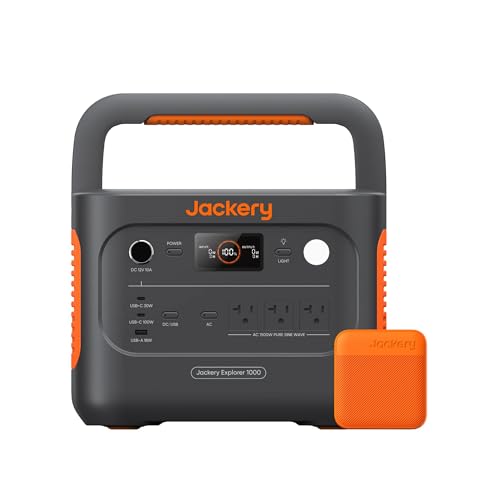


The standard retail bundle includes essential connection cables and an auxiliary charging accessory designed to power personal electronics straight out of the box.
- 1 Jackery Explorer 1000 v2 portable power station
- 1 3-Port 102W Fast Charger
- 1 AC charging cable
- 1 user manual
- Built-in LED lighting panel
- Integrated fold-down carrying handle
- ChargeShield 2.0 system protection architecture
Battery Longevity and LiFePO4 Durability
The primary engineering milestone in this model is the adoption of lithium iron phosphate chemistry. The Jackery Explorer 1000 v2 LiFePO4 battery effectively resolves the primary operational limitation found in legacy portable stations, which relied on chemistries that degraded after several hundred discharges. The LFP cells inside this unit are rated to retain more than 70 percent of their initial 1,070Wh capacity across 4,000 complete charge cycles. For an individual utilizing the generator multiple times per week, this benchmark provides an operational life expectancy exceeding ten years before meaningful capacity reduction occurs.
Beyond extended cycle counts, LFP technology offers superior thermal and structural stability. These cells feature an inherently higher thermal runaway threshold compared to older lithium-ion variants, significantly reducing risks associated with high operating temperatures and prolonged continuous draws. Jackery augments this chemistry with ChargeShield 2.0, a proprietary firmware protocol that continuously tracks cell balance, voltage regulation, and internal temperature fluctuations. Users researching legacy hardware such as the jackery explorer 2000 portable power station will notice that this updated chemistry shifts the station from a consumable gadget into a long-term utility asset.
To maximize this hardware lifespan, owners must adhere to realistic operating limits. While LFP cells are chemically resilient, subjecting them to charging below freezing temperatures or storing the chassis in hot, unventilated vehicles can cause premature electrolyte stress. The internal battery management system acts as a protective barrier, disabling current intake if temperatures drift outside safe operational envelopes, but maintaining ambient conditions remains the best way to safeguard total cycle longevity.
Continuous Inverter Limits and High-Wattage Demands
The continuous output rating determines which household and outdoor tools the internal inverter can safely operate without triggering safety cutoffs. With the Jackery 1000 v2 1500W AC output, the power station accommodates standard appliances such as electric skillets, countertop microwaves, electric water kettles, and portable refrigeration systems. The unit outputs clean 120V pure sine wave power across three outlets, eliminating the harmonic distortion and excess component heat that frequently impacts sensitive medical hardware or variable-speed motors connected to modified sine wave sources.
Sustaining near-capacity power delivery introduces predictable thermal and operational boundaries. While the 3,000W surge threshold accommodates the brief inductive inrush current of compressor motors in refrigerators and portable air conditioners, the station cannot maintain loads above 1,500 continuous watts. When approaching that maximum threshold, internal cooling fans engage at full speed to dissipate heat from the inverter heatsinks. Users needing to run heavy-duty shop tools or whole-home survival loads over prolonged blackouts may find that stepping up to higher-output gear like the jackery 2000 plus portable power station provides the necessary continuous wattage headroom without pushing hardware to its thermal ceiling.
Energy management also requires factoring in standard inverter conversion losses. Because direct current from the battery must be stepped up and converted to alternating current, real-world usable energy typically measures between 85 and 90 percent of total nominal capacity. Drawing a continuous 1,400 watts will exhaust the 1,070Wh battery pack in roughly 40 to 45 minutes. Cautious buyers should view this inverter capacity as an enabler for intermittent cooking, emergency medical tasks, or appliance cycling rather than continuous, uninterrupted multi-hour heating.
Charging Speed and Thermal Stress in Real-World Use
Replenishment times are a central consideration for emergency preparedness and fast turnaround field work. The Jackery 1000 v2 charging speed reaches a zero to 100 percent replenishment state in approximately one hour when emergency charging mode is engaged. However, the station purposefully defaults to a standard 1.7-hour charging profile when plugged into an AC wall socket. This factory default is designed to moderate incoming current and limit thermal buildup, preserving the long-term health of the internal cathode structure during routine use.
Managing these charging parameters relies directly on the Jackery Explorer 1000 v2 app control ecosystem. To utilize the one-hour fast charge, the user must explicitly toggle the emergency charging option inside the mobile application prior to connecting AC power. Within the application, users can also select a 30 dB quiet overnight charging profile that throttles incoming electrical wattage to suppress cooling fan noise, as well as an energy efficiency profile. Requiring app engagement for ultra-fast input guarantees that rapid charging remains a deliberate user choice rather than an unmanaged default that degrades cells over time.
When charging from solar panels, the unit relies on an internal solar charge controller that adapts to changing outdoor sunlight levels. For outdoor enthusiasts balancing alternative mid-sized options like the bluetti elite 100 v2 portable power station, input management during high-temperature days is essential. If the power station is charged in direct, intense sunlight while simultaneously discharging to high-draw appliances, the internal safety firmware will throttle input current to protect the battery chemistry from excessive core temperatures.
Field Portability and Outdoor Readiness
When evaluating the Jackery Explorer 1000 v2 for camping, weight distribution and physical packaging become decisive factors. At 23.8 lbs, this unit is remarkably light for a power station packing 1,070Wh of LFP capacity and a 1,500W pure sine wave inverter. The inclusion of a robust, fold-down handle enables flat stacking inside vehicle trunks or camping gear shelves, addressing a frequent complaint regarding older power station designs that featured rigid, protruding top handles. The built-in LED panel on the front provides convenient illumination for setting up basecamps after dark or managing household circuit panels during an outage.
Port connectivity supports a broad range of mobile technology and DC field gear. The station provides two 100W Power Delivery USB-C ports alongside a standard USB-A port and a 12V DC car socket. The 100W USB-C capability enables users to fast-charge modern laptops, drones, and camera gear directly without relying on bulky AC power adapters that introduce conversion inefficiency. Jackery also includes a separate 3-port 102W fast charger in the packaging, giving remote workers additional multi-device charging avenues away from the primary chassis.
Prospective buyers must also recognize physical limitations and potential Jackery Explorer 1000 v2 problems when operating outdoors. Like most portable power stations, the housing features active ventilation grates to cool the internal transformer and inverter components. The unit does not have an ingress protection rating against rain, moisture, or fine dust. Operating the generator in open rain, damp grass, or dusty off-road environments without protective shelter can lead to moisture intrusion and circuit damage, making an awning or vehicle interior necessary during inclement weather.
Jackery Explorer 1000 v2 Pros and Cons
Pros
- Durable LiFePO4 battery with 4,000-cycle lifespan
- Strong 1,500W continuous output with 3,000W surge
- Fast one-hour AC emergency recharge mode
- Lightweight 23.8-pound chassis with foldable handle
- Dual 100W USB-C Power Delivery ports
Cons
- One-hour fast charge requires manual app activation
- Listing does not specify manufacturer warranty length
- High continuous loads exhaust 1,070Wh capacity quickly
Is the Jackery Explorer 1000 v2 Worth It
Determining if the Jackery Explorer 1000 v2 is worth it requires balancing your specific electrical demands against its physical form factor and storage limits. For car campers, overlanders, mobile remote professionals, and suburban homeowners wanting insurance against standard blackout scenarios, this station provides a dependable mix of manageable weight, clean pure sine wave power, and modern battery longevity. The transition to LiFePO4 cells ensures that the station remains viable through thousands of charge cycles, preventing early obsolescence.
For buyers needing to sustain high-wattage resistive heating elements, electric dryers, central air conditioning systems, or continuous multi-day household backup, the 1,070Wh capacity will deplete too rapidly to serve as a standalone solution. In those situations, a higher-capacity platform or an integrated dual-fuel generator is required. Additionally, regarding the Jackery Explorer 1000 v2 warranty, the listing does not specify the precise coverage length or registration details, meaning cautious buyers should verify the exact manufacturer warranty terms in the included documentation upon delivery.
In summary, the Explorer 1000 v2 successfully addresses the key durability shortcomings of previous generations. Its lightweight 23.8-lb profile, robust 1,500W continuous output, versatile 100W USB-C connections, and LFP cell longevity make it a practical, highly capable power hub for mobile adventures and baseline emergency home preparedness.
FAQ
How many charge cycles does the Jackery Explorer 1000 v2 battery support
The unit uses an LFP (LiFePO4) battery system engineered to deliver more than 4,000 complete charge cycles while maintaining over 70 percent of its original 1,070Wh capacity. Under standard weekly cycling, this provides an operational lifespan exceeding ten years.
Can the Jackery Explorer 1000 v2 power an air conditioner or refrigerator
Yes, the 1,500W pure sine wave inverter and 3,000W surge peak can run compact air conditioners, portable vehicle refrigerators, and standard domestic fridges. However, high continuous wattage will drain the 1,070Wh battery rapidly, requiring solar input or AC grid power to sustain extended operation.
How do you activate the one-hour fast charging mode
The unit defaults to a 1.7-hour charging profile to protect long-term battery health. To enable one-hour emergency charging, the user must open the Jackery mobile app and actively engage the emergency charging feature before connecting the power station to an AC wall outlet.
What is the warranty coverage for the Jackery Explorer 1000 v2
The listing does not specify the exact warranty length or registration requirements for this model. Buyers should check the included user manual or contact Jackery customer service directly to confirm warranty duration and coverage terms.
What ports are available on the Jackery Explorer 1000 v2
The chassis features six total output ports: three 120V pure sine wave AC outlets, two 100W USB-C ports, one USB-A port, and one standard 12V DC car socket. The package also includes a separate 3-port 102W fast charger for additional mobile device flexibility.


