As Amazon Associates, we earn from qualifying purchases. This means we may receive a small commission at no extra cost to you if you click through and make a purchase.
Power Consumption
1540 Watts maximum draw
Cooling Capacity
14,000 BTU ASHRAE (10,000 BTU DOE)
Cabinet Dimensions and Weight
14.37"D x 17.32"W x 28.13"H; 55.4 pounds
Window Kit Extension Range
20 inches minimum to 53 inches maximum
Full spec sheet 6 more rows from the listing
| Floor Area Rating | 200 sq. ft. (listing notes coverage for rooms up to 200-300 sq. ft. / 241 cu. ft.) |
| Compressor Design | Variable-speed inverter technology |
| Operating Sound Level | 42 dB low-speed rating |
| Operating Voltage | 115 Volts (Corded Electric) |
| Refrigerant Charge | R-32 |
| Drainage Architecture | Self-evaporating pump mechanism (rated drainage-free under 90% humidity) |
When shopping for a high-capacity room cooler, deciding whether the Dreo TwinCool 14,000 BTU is the right investment requires looking closely at its internal mechanics. This appliance uses a variable-speed inverter compressor alongside an active water-evaporation pump to provide 14,000 BTU ASHRAE (rated at 10,000 BTU DOE) cooling for spaces between 200 and 300 square feet. Buyers looking at this dreo dual hose inverter portable ac typically expect substantial energy savings, whisper-quiet operation, and relief from the tedious chore of constantly emptying water buckets. However, integrating sophisticated inverter electronics, dual air paths, and an automated lift pump into a 55.4-pound residential unit introduces specific mechanical dependencies that standard single-hose portable coolers do not face.
Before committing to this model, buyers need to know how these systems hold up during sustained heat waves, how the unit behaves under elevated indoor humidity, and what type of routine upkeep is necessary to prevent premature failures. This review examines the engineering behind the unit, inspects its physical installation and airflow mechanics, breaks down potential drainage failure risks, and evaluates manufacturer warranty realities so you can determine if this portable air conditioner fits your home.
What You Get With the Dreo TwinCool 14,000 BTU
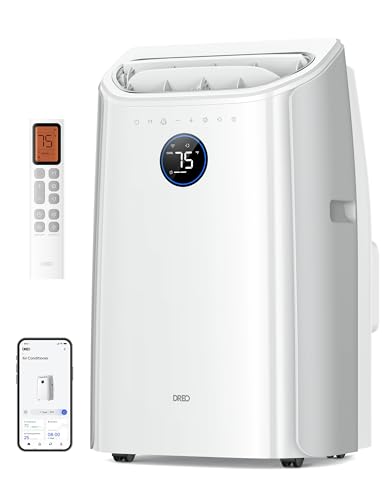

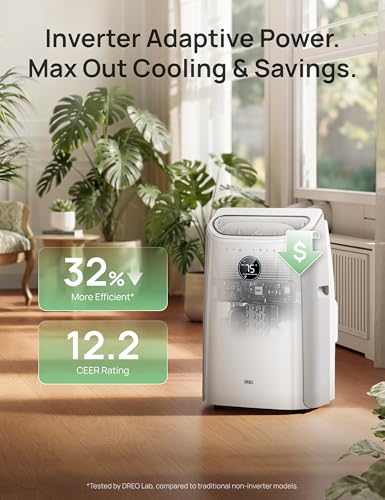

The Dreo TwinCool package comes configured as a self-contained packaged cooling system engineered for standard 115-volt residential electrical outlets, supplied with the hardware necessary to vent exhaust heat without drawing treated indoor air outside.
- Dreo TwinCool portable air conditioning unit featuring an inverter compressor and R-32 refrigerant
- Dual-hose ducting assembly designed to isolate condenser intake air from exhaust air
- Adjustable window slider bracket kit engineered to fit hung and sliding window openings between 20 and 53 inches
- Patented self-evaporating condensation system equipped with internal liquid level sensors and a mechanical pump
- Digital remote control for adjustments across the room
- Built-in smart controller compatible with companion mobile applications and Alexa voice integration
- Window sealing foam weatherstripping and exhaust connection adapters
Inverter Compressor Longevity and Dual Hose Airflow Dynamics
The engineering core of this unit relies on an inverter-driven compressor that continuously modulates its speed rather than abruptly shutting off and restarting like conventional single-stage compressors. Evaluating whynter arc 14s style portable systems demonstrates that traditional compressors experience intense electrical and mechanical spikes every time the thermostat calls for cooling. In contrast, dreo twin cool inverter reliability benefits from soft-start ramping and low-frequency cruising. By avoiding continuous full-amperage restarts, the compressor motor endures less thermal degradation over extended summer operation, and the unit consumes up to 32 percent less power during sustained maintenance runs.
Cooling performance is equally dependent on the dreo twin cool dual hose setup. Traditional single-hose air conditioners expel hot air out the window by pulling conditioned air from inside the room across the condenser coil, which produces negative air pressure. This negative pressure involuntarily pulls unconditioned, hot air inward through door gaps, electrical outlets, and wall joints. The dual-hose design on the Dreo TwinCool draws outside air through an intake channel, circulates it across the hot internal condenser, and expels it out a separate exhaust channel. This closed-loop airflow maintains neutral atmospheric pressure inside your living area, maximizing net thermal reduction across the 200 to 300 square foot rating.
While the thermodynamic benefits are significant, the dual-hose layout demands more physical window footprint and careful alignment. The window bracket must accommodate two independent airflow ports within a 20- to 53-inch span. If the duct connections are not fully seated, warm exhaust air can bleed directly into the intake hose, choking the condenser and forcing the inverter to operate at maximum wattage. Users must inspect the hose adapters regularly to guarantee that airflow restrictions do not cause internal thermal throttling.
Auto-Drainage Functionality and Condensation Failure Risks
One of the primary selling points highlighted in the technical data is the patented self-evaporating water removal system. Standard portable air conditioners rely on passive drip trays that sling moisture onto the hot condenser coil, or they require frequent manual emptying. The Dreo unit employs active liquid sensors and an internal mechanical water pump that lifts accumulated condensate and atomizes it over the hot R-32 discharge piping. This process vents water vapor out through the exhaust duct, allowing the manufacturer to state that the machine operates drainage-free in environments with relative humidity below 90 percent.
Despite this engineering convenience, potential dreo portable air conditioner drainage problems can emerge in real-world scenarios. In geographic areas with sustained humidity spikes, or in uninsulated spaces where moisture infiltration is high, the volume of extracted airborne water can overwhelm the self-evaporation rate. When the internal reservoir reaches maximum threshold, an internal float sensor engages a compressor lockout to prevent water from spilling onto your floor. Unlike simpler units like the black+decker portable air conditioner, 10,000 btu, bpact10wt, white that use rudimentary gravity drainage paths, this appliance depends on an electronic sensor array and an active pump mechanism.
If the internal pump experiences mechanical wear, or if hard water leaves mineral crusting across the liquid sensors, the machine may trigger continuous water-full warnings even when water levels are low. Furthermore, if stagnant water sits inside the internal collection pan during mild weather stretches, microbial slime and algae can form. This biological growth can obstruct the pump intake screen, necessitating manual teardowns or rigorous chemical flushes to restore automatic evaporation functionality.
Acoustic Profile and Bedroom Suitability
Operational sound is a critical purchasing factor for anyone placing an air conditioner in sleeping quarters. The technical data lists a dreo 14000 btu portable ac noise level as low as 42 dB. In the air conditioning industry, 42 dB represents an exceptionally quiet baseline, roughly equivalent to the gentle hum of a modern household refrigerator. This ultra-quiet threshold is achievable primarily because the variable-speed inverter can throttle the motor down to its lowest frequency once the room reaches the target temperature, rather than running at full mechanical output indefinitely.
When assessing the dreo twin cool for bedroom installations, the acoustic character proves far more comfortable than that of fixed-speed portable units. Traditional air conditioners feature an intrusive cyclic operation where the compressor engages with a loud mechanical shudder and high fan rush, often waking light sleepers. Looking at smaller entry-level units such as the line blaster 3-in-1 8500 btu portable air conditioner illustrates the typical compromise between raw decibels and compressor cycle frequency. The Dreo unit minimizes sleep disruption by gliding gradually between output frequencies, eliminating sharp decibel peaks in the middle of the night.
However, prospective buyers must understand that the 42 dB rating reflects lowest-fan and lowest-compressor operation. When the unit is first powered on in a hot room, the compressor spins up to meet the 14,000 BTU ASHRAE cooling demand, drawing up to 1540 watts. During this high-output pull-down phase, fan turbulence and refrigerant expansion generate significantly higher acoustic output. Furthermore, because the unit weighs 55.4 pounds and sits directly on casters, operating on uncarpeted wooden subfloors can transmit low-frequency motor hum into adjoining spaces unless an acoustic isolation mat is positioned beneath the chassis.
Long-Term Maintenance and Warranty Support Realities
Maintaining long-term reliability on an advanced climate control machine requires adhering to a structured upkeep routine. Performing regular dreo twin cool maintenance involves more than simply wiping down the exterior white chassis. Because the unit moves substantial air volume across two independent intake ports—one for the room evaporator and one for the outdoor condenser—air filters must be removed, washed, and dried thoroughly every two weeks during the cooling season. Allowing dust to blanket the internal evaporator fins insulates the coil, forcing the inverter to push higher current and raising internal operating temperatures.
End-of-season storage protocols require meticulous execution. Owners must access the rear gravity drain port to evacuate every drop of residual water from the internal pan and pump sump before stowing the machine away for the winter. Storing a portable AC with moisture locked inside its chassis leads to corroded electrical terminals, mold growth across the blower wheel, and scale buildup inside the pump casing. When the dual hoses are packed away, users must also inspect the flexible ducting for micro-punctures or tears that could compromise the closed-loop intake and exhaust cycle during subsequent seasons.
Evaluating the dreo portable air conditioner warranty support experience reveals considerations common to direct-to-consumer appliances. While the manufacturer provides customer service channels through digital ticketing, email, and app-based feedback, warranty claims involving major component failures can be logistically challenging. The listing does not specify on-site residential technician repair services. Transporting or shipping a packaged appliance that weighs 55.4 pounds and houses pressurized R-32 refrigerant requires specialized packaging and hazardous material shipping protocols. Consumers should verify all warranty terms and retain the original heavy-duty shipping box and foam inserts to safeguard against transit damage if factory servicing is required.
Dreo TwinCool 14,000 BTU Pros and Cons
Pros
- Energy-saving variable-speed inverter compressor
- Balanced dual-hose airflow prevents room drafts
- Quiet 42 dB low-speed operational noise
- Automated self-evaporating pump reduces drainage needs
- Controls via remote, smartphone app, or Alexa
Cons
- Heavier cabinet at 55.4 pounds
- High 1540-watt maximum electrical draw
- High humidity can overwhelm auto-evaporation rate
Is the Dreo TwinCool 14,000 BTU Worth It
Deciding whether the Dreo TwinCool 14,000 BTU is worth your investment comes down to your local climate conditions, room dimensions, and tolerance for operational maintenance. If you live in an urban apartment or need quiet, stable climate control in a master bedroom measuring up to 300 square feet, this unit outperforms traditional single-hose, fixed-speed alternatives. The combination of variable-capacity inverter efficiency, balanced dual-hose room pressurization, and low-speed acoustic dampening creates a distinctly superior indoor living environment that avoids erratic temperature swings and jarring compressor clatter.
Conversely, shoppers situated in sustained high-humidity regions where relative humidity regularly hovers above 85 to 90 percent may find the self-evaporating claims less absolute. Under extreme humidity, no internal pump can evaporate water faster than a 14,000 BTU coil condenses it, inevitably requiring direct drainage hoses or periodic manual draining. Furthermore, buyers who want an elementary, purely mechanical appliance with no electronic circuit boards, sensors, or smart apps may find the complex inverter circuitry and integrated lift pump over-engineered for basic utility cooling.
Ultimately, is dreo twin cool worth it for the careful shopper? Yes, provided you prioritize quiet bedroom performance, energy efficiency, and modern smart controls, and are prepared to follow strict seasonal cleanout routines. The engineering value is clearly evident in its thermodynamic specs, but longevity relies heavily on keeping the dual air paths free of dust and preventing stagnant moisture from fouling its internal sensor array.
FAQ
Does the Dreo TwinCool 14,000 BTU require manual water draining?
Under normal indoor operating conditions where relative humidity remains below 90 percent, the integrated mechanical pump and self-evaporating system vaporize water droplets against the hot internal condenser lines, venting the moisture out through the exhaust hose without manual draining. However, if indoor humidity exceeds 90 percent or prolonged heavy condensation occurs, the internal safety reservoir will fill, requiring manual drainage via the lower drain port.
What window styles and sizes are compatible with the dual-hose kit?
The included window slider bracket is designed for residential hung windows and horizontal sliding windows. The bracket expands to accommodate frame openings ranging between 20 inches and 53 inches. The listing specifies that installation requires a window opening within this dimension range to properly anchor the dual-hose adapters.
How does the inverter compressor improve efficiency over standard portable units?
Traditional portable air conditioners employ fixed-speed compressors that operate at 100 percent capacity until the thermostat is satisfied, then shut down completely, causing large temperature swings and high electrical startup spikes. The inverter compressor modulates its operating frequency smoothly, running at lower motor speeds once the target temperature is reached, which reduces energy consumption by up to 32 percent according to manufacturer data.
Can I run this air conditioner without connecting it to Wi-Fi or Alexa?
Yes. Although the appliance includes built-in wireless smart connectivity for mobile app control and Alexa voice commands, all standard cooling modes, target temperatures, fan speeds, and timer settings can be fully adjusted using the physical control interface on the unit or the included handheld remote control.
What should I do if the unit displays a full reservoir alert?
When the internal water pan reaches maximum safety capacity, the compressor automatically shuts down to avoid overflow. Turn off the unit, place a shallow pan beneath the lower rear drain plug (or wheel the machine outdoors), remove the drain cap, and let all stored condensate escape. Ensure the air filters and drain path are free of lint or debris before restarting the unit.