As Amazon Associates, we earn from qualifying purchases. This means we may receive a small commission at no extra cost to you if you click through and make a purchase.
Power Connection
Integrated 1 m (3.28 ft) USB-C power lead
Overall Outer Dimensions
156 mm x 120 mm
Total Package Weight
3.53 ounces
Pack Quantity
2 backlight boards included per package
Full spec sheet 6 more rows from the listing
| Product Name | Smaxthsen Lithophane LED Backlight Board Kit |
| Illuminated Window Area | 144 mm x 108 mm |
| LED Quantity | 110 surface-mounted diodes per board |
| Color Temperature | 6500K daylight white |
| Brightness Control | In-line touch-sensitive toggle and smooth dimming |
| Package Dimensions | 7.8 x 5.59 x 1.54 inches |
When printing high-resolution color or monochrome lithophanes on modern 3D printers, illumination makes or breaks the finished presentation. The Smaxthsen Lithophane LED Backlight Board is marketed directly to makers seeking a plug-and-play lighting solution that matches the exact physical profile established by Bambu Lab’s original accessories. Whether you are running a bambu x1c p1s lithophane light project or illuminating prints from another enclosed machine, finding a dependable bambu lithophane led panel is critical because standard DIY LED strips frequently suffer from visible hot spots, loose wiring harnesses, and awkward physical dimensions that fail to seat cleanly inside 3D printed housings.
This detailed evaluation investigates whether this third-party Bambu Lab lithophane backlight replacement lives up to its dimensional and optical promises. We examine how its physical footprint aligns with standard downloadable Wiki frame files, evaluate the diffusion behavior of its 110-diode matrix, examine long-term thermal behavior inside enclosed plastic prints, and analyze the durability of its in-line touch dimmer. By the end of this guide, you will know exactly what to anticipate regarding build tolerances, lighting consistency, and electrical performance before committing to this lighting kit.
What You Get With the Smaxthsen Lithophane LED Backlight Board


The product package arrives as a two-piece lighting kit designed to provide immediate illumination for dual display projects without requiring separate wiring or soldering.
- Two fully assembled Smaxthsen lithophane LED backlight panels measuring 156mm by 120mm
- Dense internal light array featuring 110 surface-mounted LEDs across a 144mm by 108mm active aperture
- Attached 1-meter (3.28-foot) power cable terminating in a standard USB-C interface
- Integrated capacitive touch controller supporting tap switching and continuous press-and-hold dimming
- Pre-wired electronics engineered to mount directly behind the standard light guide board in Bambu-style frames
Dimensional Accuracy and Bambu Frame Fit
The primary attraction of this specific panel is its physical adherence to the open-source frame standards popularized by Bambu Lab. Official frame models downloaded from maker repositories and the official Wiki rely on an exact internal pocket engineered for a bambu 156x120mm led board. If an aftermarket circuit board deviates by even a single millimeter in length, width, or corner radius, it forces the maker to either file down plastic tabs, modify the CAD geometry, or risk snapping delicate frame retention clips. Smaxthsen explicitly machines this board to outer dimensions of 156mm by 120mm, providing a true drop-in tolerance for models designed for Bambu H2D, X1, X1C, X1E, X1 Carbon, P1P, P1S, and A1 ecosystems.
Assembly requires layering three distinct components inside the printed frame: the outer 3D printed lithophane panel, the translucent light guide plate, and finally the backlight board seated firmly at the rear. Because the active illumination window measures 144mm by 108mm, it aligns symmetrically within the perimeter of standard 4:3 aspect ratio prints. Makers who print their structures using compact beds like the bambu lab a1 mini 3d printer often print modular frames or smaller lithophanes, but for the standard desktop formats, having this rigid backing board sit flush eliminates light bleed around the exterior bezel.
One structural factor to note during installation is the rear cable exit. The listing details an attached 1-meter cable rather than an onboard female USB port. This means your printed frame must have an open wiring notch or channel at the perimeter to allow the cable to pass outward without pinching the internal solder points. When seated into standard Bambu Wiki frames, the board rests flat against the rear retaining brackets, holding the light guide and lithophane stack tightly against the front lip without excessive internal rattle.
Lighting Uniformity and Color Calibration
Lithophanes rely entirely on varying layer thickness to block, attenuate, and transmit light to recreate a photographic image. If the underlying light source has gaps or localized bright patches, the entire optical illusion collapses into visible stripes or vignetting. Smaxthsen addresses this challenge by embedding 110 individual LEDs across the 144x108mm surface area. Distributing that many light-emitting diodes across such a compact footprint significantly reduces the physical distance between individual light emitters, effectively preventing the harsh circular glare cones common on budget backlights that use only a dozen sparse diodes.
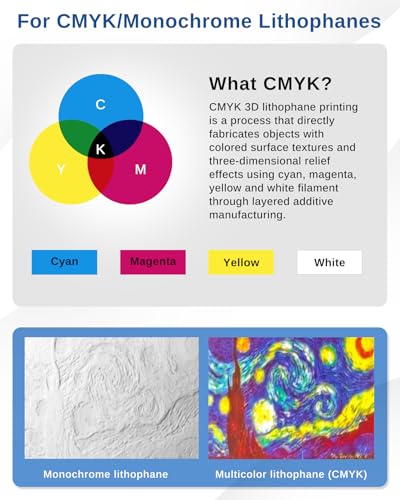
The color tuning of this panel is set to 6500K daylight white, which is essential for preserving chromatic balance. Bambu lithophane led 6500k uniformity is vital when displaying four-color CMYK lithophanes produced with cyan, magenta, yellow, and white filaments. If a backlight skews warm (such as 2700K or 3000K), skin tones turn orange, skies appear sickly green, and shadows lose depth. The neutral daylight spectrum delivered by these 110 diodes allows the precise color mixing calculated by slicing software to translate accurately to the viewer’s eye without introducing an unwanted yellowish cast.
When combined with the recommended light guide panel, the light spreads evenly across the entire active pane. Translucent plastic sheets act as forward diffusers, but they cannot compensate entirely for an underpowered or uneven array. The high density of the Smaxthsen board ensures that peripheral corners receive virtually the same lumen intensity as the center, avoiding the dim perimeter drop-off that often ruins panoramic landscapes or edge-to-edge family portraits.
Thermal Management and Long-Term Display Risks
Any lighting assembly that packs 110 LEDs into an enclosed 156x120mm housing will generate ambient heat during extended operation. In continuous display setups, such as nightlights or desktop photo frames left powered on for hours, thermal management becomes a genuine concern. Most makers produce their initial frames using basic polylactic acid, but materials like pla basic filament bambu lab have a glass transition temperature near 55 to 60 degrees Celsius. If heat accumulates inside an unventilated plastic shell, thin retaining clips and thin lithophane layers can warp or sag over time.
The listing does not specify an integrated aluminum heat sink or active cooling fins on the rear of the board, relying instead on passive dissipation through the circuit substrate. In practice, running the backlight at maximum brightness for multiple continuous hours in a tightly sealed enclosure will cause warmth to build up against the rear wall. To safeguard against long-term thermal deformation, makers should incorporate small ventilation slots into the frame backing or adjust the touch dimmer to moderate output levels rather than running the board at absolute maximum output continuously.
For installations intended for continuous 24/7 illumination, selecting more thermally resilient frame materials is a sensible precaution. Printing the structural housing with higher-temperature filaments such as bambu labs filament petg hf raises the structural deflection threshold to over 70 degrees Celsius, providing a generous thermal buffer. While the Smaxthsen board operates safely under typical USB 5V power loads, respecting the thermodynamic limitations of enclosed plastic housings ensures your lithophane art remains perfectly flat and structurally sound over years of use.
Dimmer Switch Reliability and Power Delivery
A frequent failure point on third-party lighting kits is the in-line control switch. Smaxthsen integrates a capacitive touch-sensitive sensor directly into the 1-meter wiring lead. Lithophane led board dimming reliability depends on how cleanly this sensor registers user inputs without false triggers or jitter. The switch operates via two distinct interactions: a quick tap alternates the power state between on and off, while a continuous press-and-hold smoothly raises or lowers the lumen output across a stepless gradient.
This stepless adjustment is more than a convenience feature; it is an optical necessity. Lithophane density varies considerably depending on the slicer settings, print layer height, and whether you are rendering a delicate monochrome portrait or a heavy multi-color CMYK assembly. A light level that cleanly penetrates a dense multi-color print might completely blow out the highlights on a thin monochrome print. Being able to fine-tune the brightness allows you to calibrate the backlight intensity to the exact optical density of your specific plastic print.
Regarding power delivery, the panel uses lithophane led panel usb-c power, requiring a standard 5V supply from an external adapter, PC port, or portable power bank. It is important to note that the product listing does not include a USB wall charging block in the box; you must supply your own 5V power source. Furthermore, because the control is an electronic touch sensor rather than a mechanical click toggle, cutting power at an external smart plug or wall switch typically causes the unit to remain in an off state once power is restored, requiring a manual touch to illuminate again.
Smaxthsen Lithophane LED Backlight Board Pros and Cons
Pros
- Precise 156x120mm dimensions match official Bambu frame files
- Dense 110-LED array eliminates localized lighting hot spots
- Accurate 6500K daylight white preserves CMYK color fidelity
- Smooth stepless dimming via integrated touch-sensitive controller
- Includes two complete backlight panels in one kit
Cons
- Requires user-supplied USB-C 5V power adapter
- Power cable is permanently soldered to the board
- Touch sensor resets to off when main power is cut
Is the Smaxthsen Lithophane LED Backlight Board Worth It
Determining whether this hardware belongs in your workshop comes down to your project volume and component availability. If you are questioning is smaxthsen lithophane led worth it compared to waiting on official OEM hardware, the two-pack bundle format presents compelling practical value. Having two identical, dimensionally matched boards on hand allows you to assemble gift displays in pairs or keep a reliable spare ready without paying single-unit shipping fees each time you complete a complex lithophane print.
For enthusiasts running multi-color prints on Bambu machinery, the optical performance meets the strict technical demands of CMYK lithophane profiles. The combination of genuine 6500K daylight white rendering and an ultra-dense 110-LED matrix eliminates the hot spots and color shifting that routinely plague generic DIY LED tape strips. The seamless fit inside standard 156x120mm community frame files means you will not waste time modifying STLs or trimming printed parts to force the lighting to fit.
However, if your specific project demands automated smart-home integration through external timers, the touch-sensitive switch behavior may require consideration, as it resets when external power is interrupted. Similarly, those who require long power runs may find the fixed 1-meter cable slightly short without an additional USB extension. For the vast majority of makers looking for a well-fitted, evenly balanced, plug-and-play backlight kit to showcase their prints, the Smaxthsen board functions as a capable and faithful hardware solution.
FAQ
How does the touch dimmer on the Smaxthsen Lithophane LED Backlight Board operate?
The integrated touch sensor on the power cable recognizes two distinct gestures. A rapid tap turns the LED board on or off instantly. Pressing and holding your finger on the sensor smoothly ramps the brightness up or down, allowing you to stop at the exact light level needed to illuminate your lithophane without washing out highlights.
Does this kit include the 3D printed frame or light guide panel?
No. The listing covers only the electrical backlight board kit with its integrated USB-C cable and dimmer. The outer decorative frame, the front lithophane photo print, and the clear light guide diffusion plate must be 3D printed separately using models available from Bambu Lab’s official Wiki or community repositories.
Can I power this backlight panel from a standard phone charger or power bank?
Yes. The board is equipped with an integrated 1-meter USB-C cable designed to draw standard 5V power from standard USB-C wall adapters, desktop computer ports, or portable power banks. Note that a wall adapter is not included in the package, so you must provide your own standard 5V power block.
Will the heat from 110 LEDs damage or warp a standard PLA frame?
Under normal room conditions and moderate brightness settings, the heat generated is generally safe. However, running the panel at maximum brightness inside a sealed, unvented PLA enclosure for many continuous hours can raise internal temperatures near PLA’s softening point. Adding small ventilation holes to the frame or using PETG filament provides added structural stability for continuous illumination.
Which 3D printer files are compatible with the physical dimensions of this board?
The board is engineered precisely to 156mm by 120mm with an active lighting area of 144mm by 108mm. This matches the standard downloadable lithophane frame models created for Bambu Lab printers, including the H2D, X1, X1C, X1E, X1 Carbon, P1P, P1S, and A1 series machines.


