As Amazon Associates, we earn from qualifying purchases. This means we may receive a small commission at no extra cost to you if you click through and make a purchase.
Moisture Output Capacity
13 gallons per day
Total Unit Weight
29.2 pounds
Filter System
Evaporative Water Panel with bottom access
Maximum Coverage Area
Up to 3,900 square feet (in tightly built homes)
A thorough review of the technical parameters is essential to verify structural fit, power compatibility, and mechanical capacity before committing to an installation. The table below outlines the core manufacturer specifications for the AprilAire 300.
Full spec sheet 6 more rows from the listing
| Brand and Model | AprilAire Model 300 (UPC: 686720005787) |
| Humidification Method | Evaporative |
| Operating Mechanism | Self-Contained Fan-Powered |
| Electrical Rating | 120 Volts AC (Alternating Current) |
| Unit Dimensions (D x W x H) | 22.07 x 14.38 x 12.43 inches (Chassis: 12-1/2"W x 14-3/8"H x 22-3/32"D) |
| Control Interface | Humidistat with Onboard Sensor, Digital Display, Remote Control Method |
Finding a reliable humidification system is notoriously difficult for homeowners whose properties rely on ductless mini-splits, hydronic radiators, or radiant floor heating. Traditional whole-home units depend strictly on a central furnace blower to circulate water vapor across an existing duct network, leaving properties without forced-air ductwork stranded with localized tabletop units. The AprilAire 300 directly addresses this challenge as a self-contained, fan-powered evaporative system built to inject moisture into living areas independently or alongside forced-air setups. For buyers evaluating whether this unit fits their living space, the answer hinges on understanding its plumbing, power, and dimensional footprints, as well as how its internal blower operates without relying on an existing heating furnace.
This technical overview examines the realistic expectations surrounding the AprilAire 300 whole house humidifier, detailing its core specifications, installation realities, routine upkeep protocols, and physical limitations. Rather than relying on marketing generalities, we explore how its evaporative technology interacts with various heating architectures, what mechanical access is required for long-term servicing, and whether its rated output matches the specific tightness and layout of your residence.
What You Get With the AprilAire 300
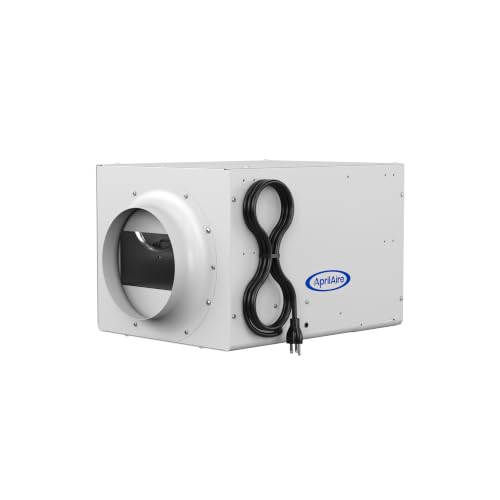

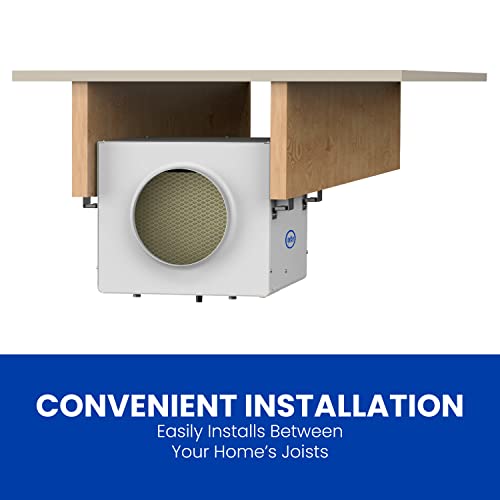

The AprilAire 300 fan powered humidifier package provides a dedicated, self-contained evaporative appliance designed and manufactured in the USA by AprilAire. The physical assembly integrates an internal air-moving mechanism and digital environmental monitoring to maintain ambient moisture levels between the targeted range of 40 percent to 60 percent relative humidity without requiring an external furnace fan.
- One self-contained AprilAire model 300 evaporative humidifier housing constructed in a gray rectangular profile
- Built-in quiet fan technology to drive internal air circulation across the evaporative media
- Digital control humidistat featuring an onboard sensor that measures indoor relative humidity for manual target setting
- Remote control method functionality integrated with the digital display interface
- Dedicated bottom-panel access chamber designed for servicing the internal evaporative water panel filter
- Integrated auto shut off mechanism and adjustable humidity control components
- Standard AC power interface operating on 120 volts of alternating current
Heating System Compatibility and Ductless Operations
Standard whole-house humidifiers have historically been engineered around ducted supply and return plenums, requiring continuous airflow generated by a centralized furnace or air handler. The AprilAire 300 for ductless homes bypasses this architectural restriction through its self-contained design. By housing its own internal fan motor, the unit pulls ambient air across its wetted evaporative panel and discharges conditioned moisture directly into the structure. This fundamental operational shift makes it suitable for structures heated by hydronic boilers, radiant floor tubing, baseboard convection, and wall-mounted mini-split heat pumps that lack any centralized ductwork.
For residences with existing ductwork, the system retains full backward compatibility. It can be integrated into standard ducted forced-air furnace arrangements to boost evaporative introduction without relying solely on passive static pressure differential bypass ducts. Because bypass humidifiers rely on pressure differences created by the central blower to force air through a bypass pipe, their delivery plummets whenever duct static pressures vary. The AprilAire 300 fan powered humidifier maintains its own positive pressure across the evaporative media, ensuring steady evaporation rates regardless of whether your heating appliance is running a high-static ECM blower or operating as a duct-free radiant grid.
Achieving stable atmospheric humidity with ductless equipment requires understanding air movement dynamics. Radiant heat panels and ductless indoor cassettes do not mix air across long distances as aggressively as central HVAC trunks. While the unit introduces up to 13 gallons per day into the home, natural convection, door placement, and internal hallway geometry dictate how effectively that vapor disperses. When supplementing centralized systems with targeted localized units like a blueair dreamwell humidifier in a closed home office or nursery, homeowners notice that self-contained evaporative systems serve as an overarching structural baseline, whereas localized devices manage isolated boundary zones.
Mounting Location and aprilaire 300 installation requirements
Assessing the physical footprint is critical before beginning an installation. The unit weighs 29.2 pounds dry and measures 22.07 inches deep by 14.38 inches wide by 12.43 inches high. These physical dimensions mean the appliance cannot simply be tucked into tight wall cavities without careful spatial planning. Because the chassis incorporates an active mechanical blower and a continuous water supply, the mounting structure must be rigid enough to prevent vibration transfer into living spaces while maintaining absolute level alignment to ensure even water distribution across the internal distribution tray.
Plumbing connections represent another non-negotiable aspect of the installation process. The evaporative process demands an active, pressurized cold or hot water feed line connected directly to the unit’s internal solenoid assembly. Unlike sealed ultrasonic humidifiers that retain every droplet of liquid, evaporative systems use a continuous trickling stream of water over a porous matrix to rinse away mineral deposits. Consequently, the installation location must have access to a reliable gravity drain line or an auxiliary condensate pump to safely route flush-out water away from structural framing, subfloors, and finished drywall.
Electrical and sensor wiring demands equal diligence during setup. The system requires standard 120-volt AC power to drive its internal fan assembly, digital control circuits, and internal water valves. In addition, the humidistat must be placed in a representative living zone rather than directly next to the moisture discharge port to avoid false high-humidity readings. Ensuring the digital humidistat is positioned in an area with stable ambient air currents allows the onboard sensor to accurately reflect the true indoor relative humidity and prevent short-cycling of the integrated fan assembly.
Maintenance Access and Water Panel Servicing
Neglecting seasonal upkeep is the leading cause of poor performance and water leaks in evaporative appliances. Routine aprilaire 300 maintenance centers primarily around the internal evaporative matrix, which captures lime, calcium, and mineral scale from the evaporating water supply. To facilitate this task, the chassis is engineered with water panel access located at the bottom of the unit. This configuration allows technicians and homeowners to slide out the media housing without dismounting the entire 29.2-pound enclosure from its support brackets or severing fixed electrical wiring.
Monitoring the condition of the aprilaire 300 replacement filter is crucial throughout the heating season. Depending on municipal water hardness and the total operational run time, mineral deposits accumulate within the porous aluminum or paper slurry matrix, reducing the effective surface area available for evaporation. When the panel becomes calcified, airflow through the unit drops, the internal fan encounters higher static resistance, and unevaporated water risks channeling outward against the side walls of the distribution tray rather than draining safely down the collection port. Inspecting this component halfway through the winter prevents unwanted mineral crusting from hardening inside the chassis.
Addressing potential aprilaire model 300 problems before they cause property damage requires a disciplined servicing routine. The drainage line should be inspected annually for algae or sediment clogging, which could result in reservoir overflow. Furthermore, scale deposits can build up on the solenoid valve orifice or distribution orifice, causing restricted flow or failure of the auto shut off mechanism. Comprehensive indoor air management often involves pairing clean humidity control with effective particulate capture, such as running a levoit 300 sp air purifier in bedrooms to reduce ambient lint and dust that might otherwise be pulled into the moist humidifier intake screen.
Humidity Output and Real-World Structural Coverage
The performance metrics of the unit are anchored by its 13-gallon daily rating and an advertised coverage ceiling of up to 3,900 square feet. However, the listing explicitly notes that this aprilaire 300 square foot coverage applies strictly to tightly built homes. Structural tightness refers to modern construction standards featuring sealed vapor barriers, low-E double or triple-pane windows, and minimal air infiltration rates. In drafty, historic, or loosely insulated homes, natural air exchanges constantly replace conditioned indoor air with dry, frigid outdoor air, dramatically increasing the required gallons per day necessary to sustain a 40 percent to 60 percent relative humidity baseline.
To put the aprilaire 300 humidifier specs in practical context, a 3,900-square-foot home with average or loose insulation will experience humidity dissipation far faster than the 13-gallon capacity can replenish during sub-zero cold snaps. In such scenarios, the humidifier fan will run continuously without reaching the manually set target on the digital humidistat. Homeowners in expansive or older properties must recognize that while the unit produces significant moisture, structural envelope physics dictate whether those 13 gallons suffice for the entire square footage or merely maintain acceptable levels across a smaller primary zone.
The evaporative method itself provides an inherent mechanical safeguard against over-saturation. Unlike atomizing or ultrasonic appliances that blast raw liquid droplets into the air regardless of ambient saturation, evaporative units transfer moisture strictly via vapor pressure differentials. As indoor relative humidity rises toward the target setting, the rate of natural evaporation across the water panel decreases. This process minimizes the risk of condensation forming inside walls, while parents managing nursery environments who also utilize a frida baby 3-in-1 cool mist humidifier for large rooms, top fill humidifier for bedroom, allergy rel can rest assured that the whole-house evaporative process maintains structural balance without creating wet surfaces.
AprilAire 300 Pros and Cons
Pros
- Operates without central forced-air ductwork
- Self-contained internal circulation fan
- 13-gallon daily evaporative output
- Bottom-panel access for filter changes
- Integrated digital humidistat and sensor
- Compatible with radiant and mini-split heat
Cons
- Substantial 29.2-pound physical housing
- Requires dedicated plumbing water feed
- Requires gravity drain connection
- Coverage requires tightly sealed construction
Is the AprilAire 300 Worth It
Evaluating whether the AprilAire 300 justifies the investment depends entirely on your home’s heating infrastructure and physical floor plan. For owners of homes with mini-split heat pumps, hydronic radiators, or radiant in-floor heating, finding a whole-home solution that operates independently of a furnace duct loop is an uncommon find. In these ductless environments, the self-contained fan and independent digital humidistat solve an otherwise intractable indoor air quality issue, replacing the tedious daily chore of filling multiple tabletop tanks with a single plumbed installation.
Conversely, if your home already features a modern, central forced-air furnace with balanced supply and return plenums, paying for a self-contained fan-powered chassis may introduce unnecessary mechanical complexity. Standard bypass or furnace-powered evaporative units can leverage the existing central blower at a simpler mechanical profile with fewer independent fan motors to maintain over time. Furthermore, if your residence exceeds 3,000 square feet and has loose, drafty window framing, the 13-gallon maximum capacity may struggle during sustained freezing temperatures, requiring supplemental units or extensive air-sealing measures to hit optimal moisture benchmarks.
Ultimately, the AprilAire 300 whole house humidifier stands as an exceptionally capable piece of environmental equipment for tightly sealed structures, retrofit installations, and duct-free architectural layouts. If you have clear access to a 120-volt AC power outlet, a dedicated cold or hot water line, and a functioning gravity drain, the unit provides reliable, automated humidity regulation backed by established domestic engineering.
FAQ
Can the AprilAire 300 be installed in a home without ductwork?
Yes. The AprilAire 300 is specifically engineered as a self-contained, fan-powered unit that circulates its own air across the evaporative water panel. This design allows it to operate in properties heated by boilers, radiant floor heating, mini-splits, and other ductless heating configurations.
What are the primary utility connections required for installation?
The unit requires three main utility connections: a standard 120-volt AC power source to drive the fan and control circuitry, a continuous pressurized water line to supply the evaporative panel via the solenoid valve, and a dedicated gravity drainage line to discard flush water and mineral deposits.
How often does the evaporative water panel filter need replacement?
Under normal operational conditions, the evaporative water panel should be inspected and replaced at least once per heating season. In areas with exceptionally hard water containing heavy mineral content, mid-season replacement may be necessary to maintain rated airflow and moisture transfer efficiency.
Where is the filter access located on the unit?
The chassis features water panel access at the bottom of the unit. This allows for straightforward maintenance and filter extraction without requiring the entire mechanical housing to be dismantled from its mounting location.
Will the unit cover 3,900 square feet in an older, drafty home?
The manufacturer’s rating of up to 3,900 square feet of coverage is specified for tightly built homes with modern insulation and vapor barriers. In drafty, older homes with elevated air exchange rates, the 13-gallon daily output will cover significantly less square footage, as dry outdoor air continuously displaces humidified indoor air.


