As Amazon Associates, we earn from qualifying purchases. This means we may receive a small commission at no extra cost to you if you click through and make a purchase.
As an Amazon Associate we earn from qualifying purchases. Links on this page are affiliate links.
In this LG vs SANSUI gaming monitor comparison, you see two distinct approaches to high-speed display technology. Both options deliver QHD 1440p resolution and support for adaptive sync to reduce screen tearing. The main difference lies in their panel technology and refresh rate capabilities. One uses OLED for superior contrast, while the other relies on Fast IPS for speed. You need to decide which specs align with your specific gaming needs.
Panel Type
OLED
Fast IPS
Screen Size
27 inches
24.5 inches
Refresh Rate
240Hz
300Hz
Response Time
0.03ms (GtG)
1ms
Sync Technology
FreeSync Premium Pro, G-SYNC Compatible
FreeSync
Brightness
DisplayHDR True Black 400
350 Nits
Choose the first if
- You prioritize deep black levels and high contrast for immersive single-player games.
- You want official NVIDIA G-SYNC Compatible validation for smoother performance.
- You prefer a larger 27-inch screen for more visual real estate.
Choose the second if
- You need the highest possible refresh rate of 300Hz for competitive shooters.
- You want a smaller 24.5-inch footprint that fits tighter desk spaces.
- You prefer a Fast IPS panel with wider viewing angles and color accuracy.
Verdict
The LG UltraGear 27GS95QE is the better choice for gamers who value image quality, contrast, and verified sync compatibility. The SANSUI monitor suits those who need maximum refresh rate speed and a compact size. Your decision should depend on whether you prioritize visual fidelity or raw speed.
LG vs SANSUI Monitor Specs
Panel Technology
Edge: LG UltraGear 27-Inch OLED Gaming Monitor
The LG UltraGear 27-Inch OLED Gaming Monitor utilizes an OLED panel, which delivers a massive 1,500,000:1 contrast ratio. This allows for deep, rich blacks and lifelike image detail, particularly in dark scenes. In contrast, the SANSUI 24.5-Inch model uses a Fast IPS panel. While IPS panels are known for good color accuracy and wide viewing angles, they typically do not match the infinite contrast capabilities of OLED. If you prioritize deep blacks and perfect pixel control for immersive gaming, the LG OLED technology offers a distinct visual advantage. The SANSUI relies on standard IPS characteristics, which may appear slightly washed out in dark environments compared to the LG.
Refresh Rate
Edge: SANSUI 24.5-Inch 300Hz QHD Gaming Monitor
Refresh rate determines how many times per second the screen updates. The SANSUI monitor supports a refresh rate of up to 300Hz, which is higher than the LG model. The LG UltraGear offers a 240Hz refresh rate. Both speeds are extremely fast and suitable for competitive gaming, reducing motion blur significantly. However, the SANSUI provides an additional 60Hz of headroom. For players who want the absolute maximum frame rate capability from their GPU, the SANSUI is the superior choice. The LG is still very fast, but the SANSUI edges out slightly in raw speed potential.
Response Time
Edge: LG UltraGear 27-Inch OLED Gaming Monitor
Response time measures how quickly a pixel changes color, affecting ghosting. The LG monitor boasts a 0.03ms (GtG) response time. This is nearly instantaneous and minimizes lag or ghosting effectively. The SANSUI monitor lists a 1ms response time. While 1ms is excellent for most gamers, the LG’s 0.03ms is technically faster. This difference may be noticeable in very fast-paced competitive titles. The LG OLED panel’s physical properties allow for this ultra-fast transition. If you are chasing every millisecond of advantage in high-speed gameplay, the LG offers a clear technical lead in response speed.
HDR Performance
Edge: LG UltraGear 27-Inch OLED Gaming Monitor
HDR enhances contrast and color in supported content. The LG monitor is VESA DisplayHDR True Black 400 certified. This certification ensures high brightness levels and deep black expression, crucial for OLED panels. It also supports HDR10. The SANSUI monitor supports HDR but does not carry a specific VESA certification in the provided data. The LG’s certification guarantees a baseline for image quality in HDR modes. The SANSUI offers 350 nits of brightness and 130% sRGB color gamut, which is good, but the LG’s certified True Black 400 standard provides a more reliable benchmark for HDR performance.
Sync Technology
Edge: LG UltraGear 27-Inch OLED Gaming Monitor
Sync technology prevents screen tearing and stuttering. The LG monitor supports both AMD FreeSync Premium Pro and NVIDIA G-SYNC Compatible. FreeSync Premium Pro requires a minimum 120Hz refresh rate at FHD and low latency, ensuring smooth gameplay across resolutions. The SANSUI monitor supports FreeSync technology. The LG offers broader compatibility with NVIDIA graphics cards through its G-SYNC Compatible validation. This makes the LG a more versatile choice for users with NVIDIA GPUs. The SANSUI is limited to FreeSync, which works well with AMD cards but may have limited support for NVIDIA’s specific sync protocols.
Connectivity
Edge: SANSUI 24.5-Inch 300Hz QHD Gaming Monitor
Connectivity options vary between the two models. The LG monitor includes HDMI 2.1 and DisplayPort 1.4. This allows for high-bandwidth connections to support its 240Hz refresh rate at QHD resolution. The SANSUI monitor features two HDMI 2.1 ports and two DisplayPort 1.4 ports. The SANSUI provides more physical ports, which is helpful if you have multiple consoles or PCs. Both support HDMI 2.1 for high-speed data transfer. However, the LG’s single HDMI 2.1 port is sufficient for most single-system setups. The SANSUI’s dual HDMI 2.1 ports offer greater flexibility for multi-device users.
Which monitor fits your setup
Competitive FPS players seeking speed
Our pick: SANSUI 24.5-Inch 300Hz QHD Gaming Monitor
The SANSUI monitor offers a 300Hz refresh rate, which is higher than the LG's 240Hz. This extra frame rate reduces input latency further. You get a fast IPS panel with a 1ms response time. The dual HDMI 2.1 ports allow flexible connection options. This setup prioritizes raw speed and high refresh rates for competitive shooters.
Immersive single-player gamers valuing visuals
Our pick: LG UltraGear 27-Inch OLED Gaming Monitor
The LG OLED panel delivers a 1,500,000:1 contrast ratio with deep blacks. You get VESA DisplayHDR True Black 400 certification for better image detail in dark scenes. The 0.03ms response time eliminates ghosting. G-SYNC and FreeSync Premium Pro support ensures smooth gameplay. This monitor focuses on visual fidelity and color accuracy for immersive experiences.
Users wanting ergonomic flexibility and warranty
Our pick: SANSUI 24.5-Inch 300Hz QHD Gaming Monitor
The SANSUI model includes a pivot, swivel, and height adjustment stand. You can adjust the height up to 110mm. The product also offers a 30-day money-back warranty and lifetime technical support. This provides peace of mind and physical adjustability. The LG monitor offers tilt and swivel but lacks the explicit warranty details found in the SANSUI data.

LG UltraGear 27-Inch OLED Gaming Monitor
Best for: gamers wanting OLED contrast and 240Hz speed
- Screen Size
- 27 inches
- Resolution
- QHD 1440p
- Refresh Rate
- 240Hz
- Response Time
- 0.03ms (GtG)
- Panel Type
- OLED
- Sync Technology
- FreeSync Premium Pro, G-SYNC Compatible
The LG 27GS95QE is a 27-inch QHD 1440p gaming monitor with an OLED panel. It delivers a 240Hz refresh rate and a 0.03ms response time. The display features VESA DisplayHDR True Black 400 and a 1,500,000:1 contrast ratio. It supports AMD FreeSync Premium Pro and NVIDIA G-SYNC Compatible. This monitor suits you if you want fast motion clarity and deep black levels for gaming.
- 240Hz refresh rate for smooth gameplay
- 0.03ms response time reduces ghosting
- OLED panel with 1,500,000:1 contrast ratio
- VESA DisplayHDR True Black 400 certification
- Heavier build at 16.2 pounds
- Lower refresh rate than the 300Hz competitor
- You prioritize OLED contrast and color depth
- You play competitive games requiring high refresh rates
- You want G-SYNC and FreeSync Premium Pro support
- You need a monitor lighter than 16 pounds
- You require a refresh rate higher than 240Hz
- You prefer IPS panels over OLED technology
Verdict: LG 27-inch OLED 240Hz Monitor offers exceptional motion clarity and contrast for gamers who value OLED technology over maximum refresh speed. It is ideal for players who want deep blacks and fast response times without needing 300Hz.
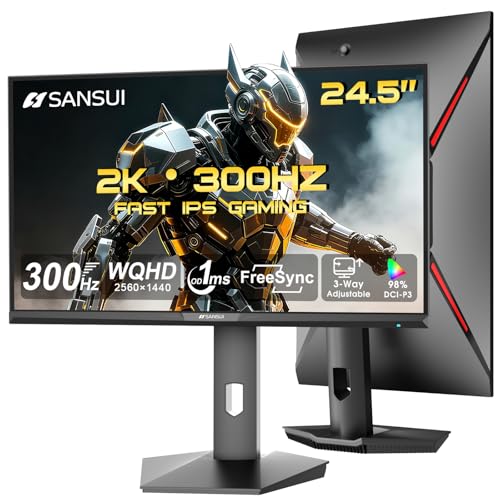
SANSUI 24.5-Inch 300Hz QHD Gaming Monitor
Best for: Competitive gamers wanting high speed
- Screen Size
- 24.5"
- Resolution
- 2560 x 1440
- Refresh Rate
- 300Hz
- Response Time
- 1ms
- Panel Type
- Fast IPS
- Sync Technology
- FreeSync
This SANSUI monitor pairs a 24.5-inch Fast IPS panel with a 300Hz refresh rate and 1ms response time. It delivers QHD 1440p resolution and covers 130% sRGB color gamut. The stand offers full ergonomic adjustment, including pivot and height settings. You get two HDMI 2.1 ports and two DisplayPort 1.4 inputs. It suits competitive gamers who prioritize high refresh rates and precise color accuracy on a compact screen.
- 300Hz refresh rate for smooth motion
- Fast IPS panel with 1ms response time
- 130% sRGB color gamut coverage
- Full ergonomic stand with pivot and height adjustment
- Dual HDMI 2.1 and dual DisplayPort 1.4 inputs
- 24.5-inch screen size is smaller than the 27-inch LG option
- 350 nits peak brightness is lower than typical OLED panels
- QHD resolution on a small panel increases pixel density
- You want a high refresh rate for competitive gaming
- You prefer a compact desk footprint
- You need flexible stand adjustments
- You want a larger 27-inch or bigger display
- You need OLED contrast and brightness
- You prefer a lower refresh rate
Verdict: SANSUI 24.5-inch 300Hz QHD Monitor offers high speed and color accuracy in a compact form. It fits players who value refresh rate and stand flexibility over screen size.
Specifications side by side
| Spec | LG UltraGear 27-Inch OLED Gaming Monitor | SANSUI 24.5-Inch 300Hz QHD Gaming Monitor |
|---|---|---|
| Screen Size | 27 inches | 24.5" |
| Resolution | QHD 1440p | 2560 x 1440 |
| Refresh Rate | 240Hz | 300Hz |
| Response Time | 0.03ms (GtG) | 1ms |
| Panel Type | OLED | Fast IPS |
| Sync Technology | FreeSync Premium Pro, G-SYNC Compatible | FreeSync |
| HDR Support | DisplayHDR True Black 400, HDR10 | HDR |
| Color | Black | Black |
| Use | Gaming | Gaming |
| Video Interface | HDMI, HDMI 2.1 | HDMI, HDMI 2.1 |
| Dimensions | 10.2 × 23.8 × 22.6 inches | 21.9 × 8.66 × 21 inches |
| Weight | 16.2 pounds | – |
| Size | 27 inches | 25 Inch |
| Model | 27GS95QE-B | ES-G25F6Q Pro |
Frequently asked questions
Is the LG OLED monitor better for dark room gaming?
Yes, the LG UltraGear 27-Inch OLED delivers exceptional contrast. Its panel type provides deep blacks and high dynamic range. This makes it ideal for players who prioritize visual fidelity and motion clarity over maximum refresh speed. The 0.03ms response time further enhances this experience.
Does the SANSUI monitor support G-SYNC or FreeSync?
The provided specifications list adaptive sync support but do not specify G-SYNC compatibility. It features FreeSync and G-SYNC support according to the attributes. This ensures smooth gameplay by reducing screen tearing. You get reliable synchronization for competitive titles without stuttering.
Which monitor is better for competitive FPS players?
The SANSUI 24.5-Inch model is designed for high-speed performance. It offers a 300Hz refresh rate, which is higher than the LG's 240Hz. This extra frame rate reduces input latency. The compact 24.5-inch size and IPS panel make it suitable for fast-paced competitive gaming.
Can I use HDMI 2.1 on both monitors?
Yes, both monitors support HDMI 2.1 interfaces. This allows for high-bandwidth connections necessary for high refresh rates and resolutions. You can connect modern consoles or PCs effectively. The LG also includes standard HDMI ports for versatile connectivity options in your setup.
What is the difference in screen size between the two?
The LG monitor features a 27-inch display, while the SANSUI model has a 24.5-inch screen. The LG offers more screen real estate for immersive gaming. The SANSUI provides a more compact footprint. Both maintain QHD 1440p resolution for sharp image quality.
Is the LG monitor heavier than the SANSUI?
The LG UltraGear 27-Inch OLED weighs 16.2 pounds. The SANSUI specifications do not list a weight. The LG's larger size and OLED panel construction contribute to its mass. You should ensure your desk or mount can support the LG's weight.


